
黄曲霉泛基因组(AflaPan)揭示了新的黄曲霉毒素和次级代谢物相关基因簇。
Aspergillus flavus pangenome (AflaPan) uncovers novel aflatoxin and secondary metabolite associated gene clusters.
机构信息
Department of Plant Pathology, University of Georgia, Tifton, GA, 31793, USA.
Crop Protection and Management Research Unit, USDA-ARS, Tifton, GA, 31793, USA.
出版信息
BMC Plant Biol. 2024 May 1;24(1):354. doi: 10.1186/s12870-024-04950-8.
BACKGROUND
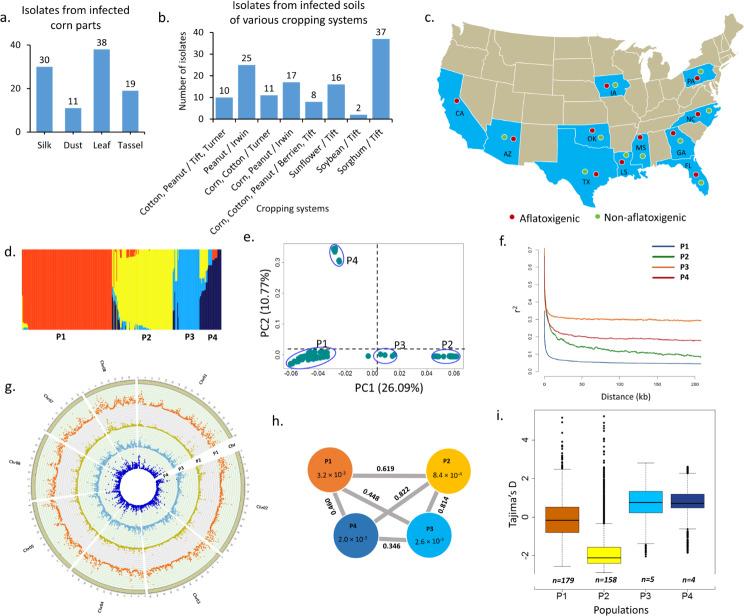
Aspergillus flavus is an important agricultural and food safety threat due to its production of carcinogenic aflatoxins. It has high level of genetic diversity that is adapted to various environments. Recently, we reported two reference genomes of A. flavus isolates, AF13 (MAT1-2 and highly aflatoxigenic isolate) and NRRL3357 (MAT1-1 and moderate aflatoxin producer). Where, an insertion of 310 kb in AF13 included an aflatoxin producing gene bZIP transcription factor, named atfC. Observations of significant genomic variants between these isolates of contrasting phenotypes prompted an investigation into variation among other agricultural isolates of A. flavus with the goal of discovering novel genes potentially associated with aflatoxin production regulation. Present study was designed with three main objectives: (1) collection of large number of A. flavus isolates from diverse sources including maize plants and field soils; (2) whole genome sequencing of collected isolates and development of a pangenome; and (3) pangenome-wide association study (Pan-GWAS) to identify novel secondary metabolite cluster genes.
RESULTS
Pangenome analysis of 346 A. flavus isolates identified a total of 17,855 unique orthologous gene clusters, with mere 41% (7,315) core genes and 59% (10,540) accessory genes indicating accumulation of high genomic diversity during domestication. 5,994 orthologous gene clusters in accessory genome not annotated in either the A. flavus AF13 or NRRL3357 reference genomes. Pan-genome wide association analysis of the genomic variations identified 391 significant associated pan-genes associated with aflatoxin production. Interestingly, most of the significantly associated pan-genes (94%; 369 associations) belonged to accessory genome indicating that genome expansion has resulted in the incorporation of new genes associated with aflatoxin and other secondary metabolites.
CONCLUSION
In summary, this study provides complete pangenome framework for the species of Aspergillus flavus along with associated genes for pathogen survival and aflatoxin production. The large accessory genome indicated large genome diversity in the species A. flavus, however AflaPan is a closed pangenome represents optimum diversity of species A. flavus. Most importantly, the newly identified aflatoxin producing gene clusters will be a new source for seeking aflatoxin mitigation strategies and needs new attention in research.
背景
黄曲霉是一种重要的农业和食品安全威胁,因为它会产生致癌的黄曲霉毒素。它具有高度的遗传多样性,能够适应各种环境。最近,我们报告了两个黄曲霉分离株的参考基因组,AF13(MAT1-2 和高产黄曲霉毒素的分离株)和 NRRL3357(MAT1-1 和中度产黄曲霉毒素的生产菌)。其中,AF13 中的 310kb 插入物包括一个产黄曲霉毒素的 bZIP 转录因子基因,命名为 atfC。这些表型截然不同的分离株之间存在显著的基因组变异的观察结果促使我们对其他农业黄曲霉分离株的变异进行了调查,目的是发现可能与黄曲霉毒素生产调控相关的新基因。本研究旨在实现三个主要目标:(1)从包括玉米植株和田间土壤在内的各种来源收集大量黄曲霉分离株;(2)对收集的分离株进行全基因组测序并开发泛基因组;(3)进行泛基因组关联研究(Pan-GWAS)以鉴定新的次级代谢物簇基因。
结果
对 346 个黄曲霉分离株的泛基因组分析确定了总共 17855 个独特的直系同源基因簇,仅有 41%(7315 个)核心基因和 59%(10540 个)辅助基因,表明在驯化过程中积累了高度的基因组多样性。在黄曲霉 AF13 或 NRRL3357 参考基因组中未注释的辅助基因组中存在 5994 个直系同源基因簇。对基因组变异的泛基因组关联分析确定了 391 个与黄曲霉毒素产生显著相关的关联泛基因。有趣的是,大多数显著相关的泛基因(94%;369 个关联)属于辅助基因组,表明基因组扩张导致了与黄曲霉毒素和其他次级代谢物相关的新基因的加入。
结论
总之,本研究为黄曲霉种提供了完整的泛基因组框架以及与病原体生存和黄曲霉毒素产生相关的相关基因。庞大的辅助基因组表明黄曲霉种的基因组多样性很大,然而 AflaPan 是一个封闭的泛基因组,代表了黄曲霉种的最佳多样性。最重要的是,新鉴定的产黄曲霉毒素基因簇将成为寻找黄曲霉毒素缓解策略的新来源,需要在研究中给予新的关注。



 Zotero 插件