Department of Pediatrics.
Biostatistics, Vanderbilt University Medical Center, Nashville, Tennessee.
Hosp Pediatr. 2024 Jun 1;14(6):430-437. doi: 10.1542/hpeds.2023-007357.
Acute gastroenteritis (AGE) is the second leading cause of death in children worldwide. Objectively evaluating disease severity is critical for assessing future interventions. We used data from a large, prospective surveillance study to assess risk factors associated with severe presentation using modified Vesikari score (MVS) and Clark score (CS) of severity.
From December 1, 2012 to June 30, 2016, AGE surveillance was performed for children between 15 days and 17 years old in the emergency, inpatient, and outpatient settings at Vanderbilt's Monroe Carell Jr. Children's Hospital in Nashville, TN. Stool specimens were tested for norovirus, sapovirus, rotavirus, and astrovirus. We compared demographic and clinical characteristics, along with the MVS and CS, by viral detection status and by setting.
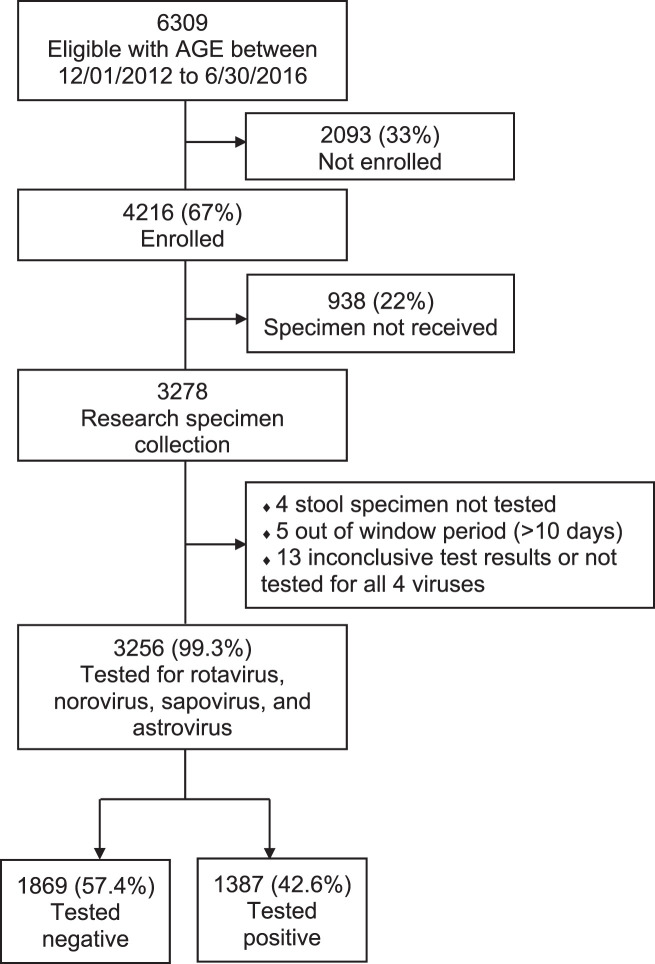
Of the 6309 eligible children, 4216 (67%) were enrolled, with 3256 (77%) providing a stool specimen. The median age was 1.9 years, 52% were male, and 1387 (43%) of the stool samples were virus positive. Younger age, male sex, hospitalization, and rotavirus detection were significantly associated with higher mean MVS and CS. Non-Hispanic Black race and ethnicity was associated with a lower mean MVS and CS as compared with non-Hispanic white race and ethnicity. Prematurity and enrollment in the ED were associated with higher mean CS. The 2 scoring systems were highly correlated.
Rotavirus continues to be associated with more severe pediatric illness compared with other viral causes of AGE. MVS and CS systems yielded comparable results and can be useful tools to assess AGE severity.
急性肠胃炎(AGE)是全球范围内导致儿童死亡的第二大原因。客观评估疾病严重程度对于评估未来干预措施至关重要。我们使用来自一项大型前瞻性监测研究的数据,使用改良 Vesikari 评分(MVS)和 Clark 严重程度评分(CS)评估严重表现的相关风险因素。
2012 年 12 月 1 日至 2016 年 6 月 30 日,在田纳西州纳什维尔范德比尔特大学 Monroe Carell Jr.儿童医院的急诊、住院和门诊环境中,对 15 天至 17 岁的儿童进行 AGE 监测。对粪便标本进行诺如病毒、肠病毒、轮状病毒和星状病毒检测。我们比较了病毒检测状态和就诊环境下的人口统计学和临床特征,以及 MVS 和 CS。
在 6309 名符合条件的儿童中,有 4216 名(67%)入组,其中 3256 名(77%)提供了粪便标本。中位年龄为 1.9 岁,52%为男性,1387 份(43%)粪便样本为病毒阳性。年龄较小、男性、住院治疗和轮状病毒检测与较高的平均 MVS 和 CS 显著相关。与非西班牙裔白人种族和民族相比,非西班牙裔黑人种族和民族的平均 MVS 和 CS 较低。早产和在急诊室就诊与较高的平均 CS 相关。这两种评分系统高度相关。
与其他 AGE 的病毒病因相比,轮状病毒仍然与更严重的儿科疾病相关。MVS 和 CS 系统得出的结果相似,是评估 AGE 严重程度的有用工具。