Xiong Ke-Gong, Ke Kun-Yu, Kong Jin-Feng, Lin Tai-Shun, Lin Qing-Biao, Lin Su, Zhu Yue-Yong
Department of Hepatology, Mengchao Hepatobiliary Hospital of Fujian Medical University, Fuzhou, 350001, China.
Department of Hepatology, Hepatology Research Institute, the First Affiliated Hospital of Fujian Medical University, Fuzhou, 350001, China.
World J Surg Oncol. 2024 May 3;22(1):117. doi: 10.1186/s12957-024-03385-7.
The prevalence of metabolic dysfunction-associated fatty liver disease (MAFLD) in hepatocellular carcinoma (HCC) patients is increasing, yet its association with postoperative complications of HCC remains unclear. The aim of this study was to investigate the impact of MAFLD on complications after radical resection in HCC patients.
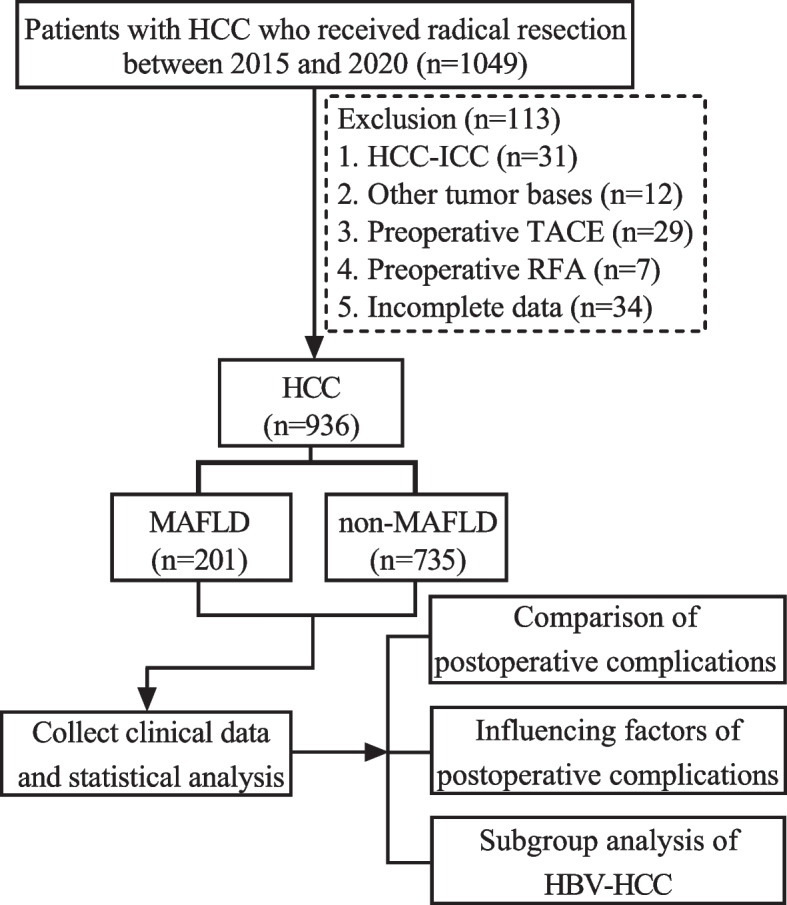
Patients with HCC who underwent radical resection were included. Patients were stratified into MAFLD group and non-MAFLD group. Clinical features and post-hepatectomy complications were compared between the two groups, and logistic regression analysis was used to determine independent risk factors associated with post-hepatectomy complications.
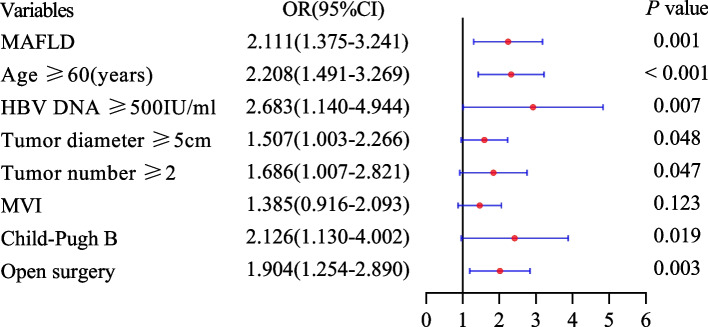
Among the 936 eligible patients with HCC who underwent radical resection, concurrent MAFLD was diagnosed in 201 (21.5%) patients. Compared to the non-MAFLD group, the MAFLD group exhibited a higher incidence of complications, including infectious and major complications after radical resection in HCC patients. The logistic regression analysis found that MAFLD was an independent risk factor for complications, including infectious and major complications in HCC patients following radical resection (OR 1.565, 95%CI 1.109-2.343, P = 0.012; OR 2.092, 95%CI 1.386-3.156, P < 0.001; OR 1.859, 95% CI 1.106-3.124, P = 0.019; respectively). Subgroup analysis of HBV-related HCC patients yielded similar findings, and MAFLD patients with type 2 diabetes mellitus (T2DM) exhibited a higher incidence of postoperative complications compared to those without T2DM (all P < 0.05).
Concurrent MAFLD was associated with an increased incidence of complications after radical resection in patients with HCC, especially MAFLD with T2DM.
代谢功能障碍相关脂肪性肝病(MAFLD)在肝细胞癌(HCC)患者中的患病率正在上升,但其与HCC术后并发症的关联仍不明确。本研究旨在探讨MAFLD对HCC患者根治性切除术后并发症的影响。
纳入接受根治性切除的HCC患者。患者被分为MAFLD组和非MAFLD组。比较两组的临床特征和肝切除术后并发症,采用逻辑回归分析确定与肝切除术后并发症相关的独立危险因素。
在936例接受根治性切除的符合条件的HCC患者中,201例(21.5%)患者被诊断为合并MAFLD。与非MAFLD组相比,MAFLD组并发症发生率更高,包括HCC患者根治性切除术后的感染性并发症和主要并发症。逻辑回归分析发现,MAFLD是HCC患者根治性切除术后并发症(包括感染性并发症和主要并发症)的独立危险因素(OR 1.565,95%CI 1.109 - 2.343,P = 0.012;OR 2.092,95%CI 1.386 - 3.156,P < 0.001;OR 1.859,95%CI 1.106 - 3.124,P = 0.019;分别)。对HBV相关HCC患者的亚组分析得出了类似的结果,与无2型糖尿病(T2DM)的MAFLD患者相比,合并T2DM的MAFLD患者术后并发症发生率更高(所有P < 0.05)。
合并MAFLD与HCC患者根治性切除术后并发症发生率增加相关,尤其是合并T2DM的MAFLD。