Ferris Jennifer K, Lo Bethany P, Barisano Giuseppe, Brodtmann Amy, Buetefisch Cathrin M, Conforto Adriana B, Donnelly Miranda R, Egorova-Brumley Natalia, Hayward Kathryn S, Khlif Mohamed Salah, Revill Kate P, Zavaliangos-Petropulu Artemis, Boyd Lara, Liew Sook-Lei
From the Gerontology Research Centre (J.K.F.), Simon Fraser University; Department of Physical Therapy and Djavad Mowafaghian Centre for Brain Health (J.K.F.), University of British Columbia, Vancouver, Canada; Chan Division of Occupational Science and Occupational Therapy (B.P.L., M.R.D., S.-L.L.), University of Southern California, Los Angeles; Department of Neurosurgery (G.B.), Stanford School of Medicine, Stanford University, CA; Central Clinical School (A.B., M.S.K.), Monash University, Melbourne, Victoria, Australia; Department of Medicine (A.B.), Royal Melbourne Hospital, University of Melbourne, Victoria, Australia; Department of Neurology (C.M.B.), Department of Rehabilitation Medicine (C.M.B.), and Department of Radiology (C.M.B.), Emory University, Atlanta, GA; Hospital das Clinicas HCFMUSP (A.B.C.), Faculdade de Medicina, Universidade de São Paulo; Hospital Israelita Albert Einstein (A.B.C.), São Paulo, Brazil; Melbourne School of Psychological Sciences (N.E.-B.), University of Melbourne; Departments of Physiotherapy, Medicine (RMH) & The Florey Institute of Neuroscience and Mental Health (K.S.H.), University of Melbourne, Victoria, Australia; Facility for Education and Research in Neuroscience (K.P.R.), Emory University, Atlanta, GA; Brain Mapping Center (A.Z.-P.), Department of Neurology, Geffen School of Medicine, University of California Los Angeles; and Mark and Mary Stevens Neuroimaging and Informatics Institute and Keck School of Medicine (L.B., S.-L.L.), University of Southern California, Los Angeles.
Neurology. 2024 May 28;102(10):e209387. doi: 10.1212/WNL.0000000000209387. Epub 2024 May 3.
Motor outcomes after stroke relate to corticospinal tract (CST) damage. The brain leverages surviving neural pathways to compensate for CST damage and mediate motor recovery. Thus, concurrent age-related damage from white matter hyperintensities (WMHs) might affect neurologic capacity for recovery after CST injury. The role of WMHs in post-stroke motor outcomes is unclear. In this study, we evaluated whether WMHs modulate the relationship between CST damage and post-stroke motor outcomes.
We used data from the multisite ENIGMA Stroke Recovery Working Group with T1 and T2/fluid-attenuated inversion recovery imaging. CST damage was indexed with weighted CST lesion load (CST-LL). WMH volumes were extracted with Freesurfer's SAMSEG. Mixed-effects beta-regression models were fit to test the impact of CST-LL, WMH volume, and their interaction on motor impairment, controlling for age, days after stroke, and stroke volume.
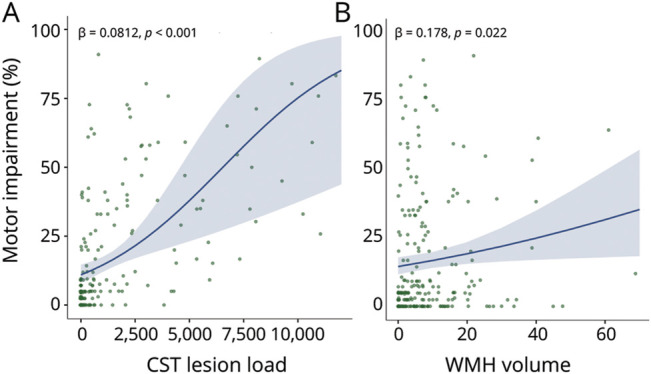
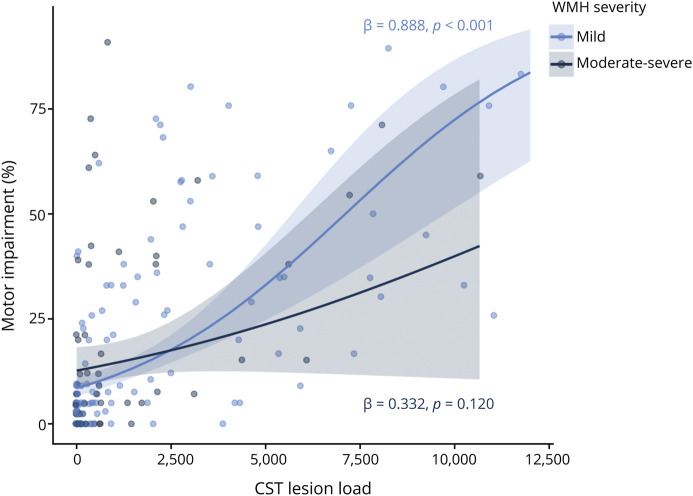
A total of 223 individuals were included. WMH volume related to motor impairment above and beyond CST-LL (β = 0.178, 95% CI 0.025-0.331, = 0.022). Relationships varied by WMH severity (mild vs moderate-severe). In individuals with mild WMHs, motor impairment related to CST-LL (β = 0.888, 95% CI 0.604-1.172, < 0.001) with a CST-LL × WMH interaction (β = -0.211, 95% CI -0.340 to -0.026, = 0.026). In individuals with moderate-severe WMHs, motor impairment related to WMH volume (β = 0.299, 95% CI 0.008-0.590, = 0.044), but did not significantly relate to CST-LL or a CST-LL × WMH interaction.
WMHs relate to motor outcomes after stroke and modify relationships between motor impairment and CST damage. WMH-related damage may be under-recognized in stroke research as a factor contributing to variability in motor outcomes. Our findings emphasize the importance of brain structural reserve in motor outcomes after brain injury.
中风后的运动结局与皮质脊髓束(CST)损伤有关。大脑利用尚存的神经通路来补偿CST损伤并介导运动恢复。因此,白质高信号(WMH)所致的与年龄相关的并发损伤可能会影响CST损伤后的神经恢复能力。WMH在中风后运动结局中的作用尚不清楚。在本研究中,我们评估了WMH是否调节CST损伤与中风后运动结局之间的关系。
我们使用了多中心ENIGMA中风恢复工作组的T1和T2/液体衰减反转恢复成像数据。CST损伤用加权CST病变负荷(CST-LL)进行量化。WMH体积通过Freesurfer的SAMSEG提取。采用混合效应β回归模型来测试CST-LL、WMH体积及其相互作用对运动功能障碍的影响,并对年龄、中风后天数和中风体积进行控制。
共纳入223名个体。WMH体积与运动功能障碍相关,且独立于CST-LL(β = 0.178,95%可信区间0.025 - 0.331,P = 0.022)。其关系因WMH严重程度(轻度与中度 - 重度)而异。在轻度WMH个体中,运动功能障碍与CST-LL相关(β = 0.888,95%可信区间0.604 - 1.172,P < 0.001),存在CST-LL×WMH相互作用(β = -0.211,95%可信区间 - 0.340至 - 0.026,P = 0.026)。在中度 - 重度WMH个体中,运动功能障碍与WMH体积相关(β = 0.299,95%可信区间0.008 - 0.590,P = 0.044),但与CST-LL或CST-LL×WMH相互作用无显著相关性。
WMH与中风后的运动结局相关,并改变运动功能障碍与CST损伤之间的关系。在中风研究中,WMH相关损伤作为导致运动结局变异性的一个因素可能未得到充分认识。我们的研究结果强调了脑结构储备在脑损伤后运动结局中的重要性。