Li Zi-Qiang, Yang Shi-Jian, Feng Jian-Wen, Zhang Hang, Huang Wei-Wei, Li Zheng
School of Civil Engineering and Architecture, Chongqing University of Science and Technology, Chongqing, 401331, China.
School of Resources and Safety Engineering, Chongqing University, Chongqing, 400045, China.
Sci Rep. 2024 May 4;14(1):10296. doi: 10.1038/s41598-024-61149-5.
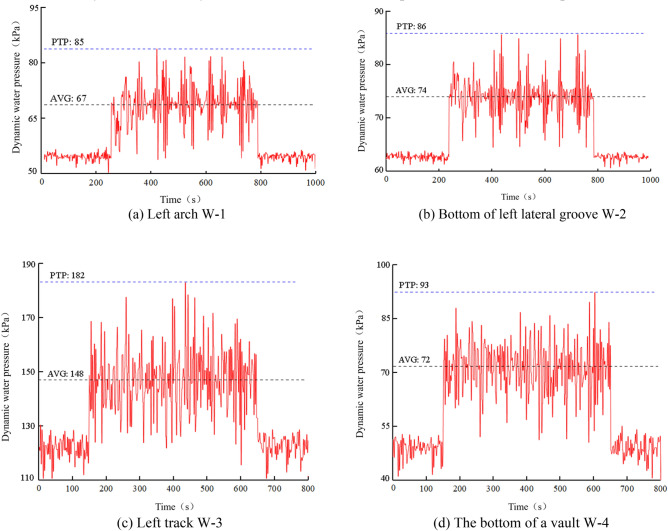
This study combines laboratory experiments and discrete element simulation methods to analyze the mechanism and deterioration patterns of sandstone surrounding rock voiding the bottom of a heavy-haul railway tunnel. It is based on previously acquired measurement data from optical fiber grating sensors installed in the Taihangshan Mountain Tunnel of the Wari Railway. By incorporating rock particle wastage rate results, a method for calculating the peak strength and elastic modulus attenuation of surrounding rock is proposed. Research indicates that the operation of heavy-haul trains leads to an instantaneous increase in the dynamic water pressure on the bottom rock ranging 144.4-390.0%, resulting in high-speed water flow eroding the rock. After 1-2 years of operation, the bottom water and soil pressures increase by 526.5% and 390.0%, respectively. Focusing on sandstone surrounding rock with high observability, laboratory experiments were conducted to monitor the degradation stages of infiltration, particle loss, and voiding of rock under the action of dynamic water flow. The impact of water flow on the "cone-shaped" bottom rock deformation was also clarified. The extent of rock deterioration and voiding was determined using miniature water and soil pressure sensors in conjunction with discrete element numerical simulations. The measured rock particle loss was used as a criterion. Finally, a fitting approach is derived to calculate the peak strength and elastic modulus attenuation of surrounding rock, gaining insight into and providing a reference for the maintenance and disposal measures for the bottom operation of heavy-haul railway tunnels.
本研究结合室内试验和离散元模拟方法,分析重载铁路隧道底部砂岩围岩空洞化的机理及劣化模式。研究基于先前在瓦日铁路太行山隧道安装的光纤光栅传感器所获取的测量数据。通过纳入岩石颗粒损耗率结果,提出了一种计算围岩峰值强度和弹性模量衰减的方法。研究表明,重载列车运行导致底部岩石动态水压力瞬间增加144.4% - 390.0%,引发高速水流对岩石的侵蚀。运营1 - 2年后,底部水压力和土压力分别增加526.5%和390.0%。针对具有高可观测性的砂岩围岩,开展室内试验以监测动态水流作用下岩石的渗透、颗粒流失和空洞化等劣化阶段。还阐明了水流对“锥形”底部岩石变形的影响。利用微型水土压力传感器结合离散元数值模拟确定岩石劣化和空洞化程度。将实测的岩石颗粒流失作为判据。最后,推导了一种拟合方法来计算围岩峰值强度和弹性模量衰减,为重载铁路隧道底部运营的维护和处置措施提供了见解和参考。