School of Public Health, College of Health and Medical Sciences, Haramaya University, Harar, Ethiopia.
Department of Psychiatry, School of Medicine, College of Health Sciences, Addis Ababa University, Addis Ababa, Ethiopia.
PLoS One. 2024 May 6;19(5):e0302635. doi: 10.1371/journal.pone.0302635. eCollection 2024.
Treating comorbid depression does not always improve outcomes for people with type 2 diabetes. Evidence is lacking on potential psychological and behavioural intermediaries of the impact of depression on diabetes outcomes.
To synthesise evidence on the impact of comorbid depression on self-efficacy, illness perceptions, and self-management in people with type 2 diabetes.
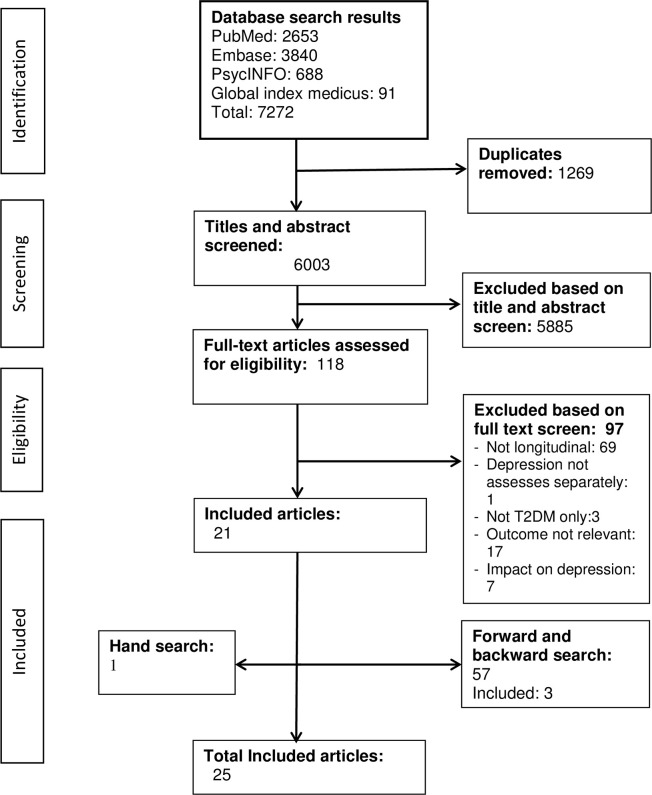
We searched PubMed, Embase, PsycINFO, and Global Health databases from inception up to 29th March 2023.
Only prospective studies (cohort or intervention studies) were included, with no restrictions on language. The outcomes were self-efficacy, illness perceptions, and self-management.
People with type 2 diabetes in community or health settings.
Comorbid depression or depressive symptoms in people with type 2 diabetes.
A narrative review of heterogeneous studies.
The risk of bias was assessed using the Effective Public Health Practice Project (EPHPP) quality assessment tool for quantitative studies.
Twenty-five studies were included, all from high-income countries. Depression was associated with lower self-efficacy (2 studies), poor illness perception (1 study), and poor self-management practices (17 studies) in people with type 2 diabetes. In 6/7 studies, depressive symptoms predicted less adherence to dietary recommendations, 8/10 studies found depressive symptoms were associated with poor medication adherence, 1/3 study found that depressive symptoms were associated with poor weight control, 3/4 with less physical exercise, and 2/3 with general self-care practices.
There were no studies from low- and middle-income countries and non-Western settings, and we cannot assume the mechanisms linking comorbid depression with diabetes outcomes are similar.
Comorbid depression was associated with lower self-efficacy, poorer self-management, and less adaptive illness perceptions among people with diabetes.
治疗 2 型糖尿病患者共病抑郁并不总能改善其结局。缺乏抑郁对糖尿病结局影响的潜在心理和行为中介的证据。
综合评估 2 型糖尿病患者共病抑郁对自我效能感、疾病感知和自我管理的影响。
我们检索了 PubMed、Embase、PsycINFO 和全球卫生数据库,检索时间截至 2023 年 3 月 29 日。
仅纳入前瞻性研究(队列或干预研究),语言不受限制。结局为自我效能感、疾病感知和自我管理。
社区或卫生机构中的 2 型糖尿病患者。
2 型糖尿病患者中的共病抑郁或抑郁症状。
对异质性研究进行叙述性综述。
使用有效公共卫生实践项目(EPHPP)质量评估工具评估定量研究的偏倚风险。
共纳入 25 项研究,均来自高收入国家。与 2 型糖尿病患者的自我效能感较低(2 项研究)、疾病感知较差(1 项研究)和自我管理实践较差(17 项研究)相关。在 6/7 项研究中,抑郁症状预示着饮食建议的依从性较差,8/10 项研究发现抑郁症状与药物依从性差有关,1/3 项研究发现抑郁症状与体重控制较差有关,3/4 项研究与较少的体育锻炼有关,2/3 项研究与一般自我保健实践有关。
没有来自低收入和中等收入国家以及非西方背景的研究,我们不能假设共病抑郁与糖尿病结局之间的机制是相似的。
2 型糖尿病患者共病抑郁与自我效能感降低、自我管理较差和疾病感知适应性较差有关。