RTI International, Research Triangle Park, NC, USA.
Gillings School of Global Public Health, University of North Carolina at Chapel Hill, Chapel Hill, NC, USA.
BMC Health Serv Res. 2024 May 9;24(1):606. doi: 10.1186/s12913-024-10988-z.
Assisted index case testing (ICT), in which health care workers take an active role in referring at-risk contacts of people living with HIV for HIV testing services, has been widely recognized as an evidence-based intervention with high potential to increase status awareness in people living with HIV. While the available evidence from eastern and southern Africa suggests that assisted ICT can be an effective, efficient, cost-effective, acceptable, and low-risk strategy to implement in the region, it reveals that feasibility barriers to implementation exist. This study aims to inform the design of implementation strategies to mitigate these feasibility barriers by examining "assisting" health care workers' experiences of how barriers manifest throughout the assisted ICT process, as well as their perceptions of potential opportunities to facilitate feasibility.
In-depth interviews were conducted with 26 lay health care workers delivering assisted ICT in Malawian health facilities. Interviews explored health care workers' experiences counseling index clients and tracing these clients' contacts, aiming to inform development of a blended learning implementation package. Transcripts were inductively analyzed using Dedoose coding software to identify and describe key factors influencing feasibility of assisted ICT. Analysis included multiple rounds of coding and iteration with the data collection team.
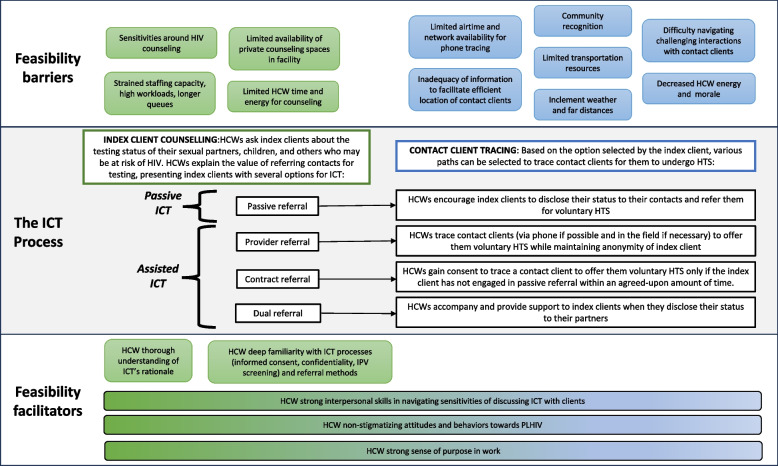
Participants reported a variety of barriers to feasibility of assisted index case testing implementation, including sensitivities around discussing ICT with clients, privacy concerns, limited time for assisted index case testing amid high workloads, poor quality contact information, and logistical obstacles to tracing. Participants also reported several health care worker characteristics that facilitate feasibility (knowledge, interpersonal skills, non-stigmatizing attitudes and behaviors, and a sense of purpose), as well as identified process improvements with the potential to mitigate barriers.
Maximizing assisted ICT's potential to increase status awareness in people living with HIV requires equipping health care workers with effective training and support to address and overcome the many feasibility barriers that they face in implementation. Findings demonstrate the need for, as well as inform the development of, implementation strategies to mitigate barriers and promote facilitators to feasibility of assisted ICT.
NCT05343390. Date of registration: April 25, 2022.
辅助索引病例检测(ICT),即卫生保健工作者在艾滋病毒感染者的接触者中积极推荐有风险的接触者进行艾滋病毒检测服务,已被广泛认为是一种具有高潜力的循证干预措施,可以提高艾滋病毒感染者的知晓率。尽管来自东部和南部非洲的现有证据表明,辅助 ICT 可以成为该地区有效、高效、具有成本效益、可接受和低风险的实施策略,但它表明实施存在可行性障碍。本研究旨在通过检查“辅助”卫生保健工作者在辅助 ICT 过程中遇到的障碍表现以及他们对促进可行性的潜在机会的看法,为减轻这些可行性障碍的实施策略提供信息。
在马拉维的卫生设施中,对 26 名从事辅助 ICT 的非专业卫生保健工作者进行了深入访谈。访谈内容包括卫生保健工作者对咨询索引客户和追踪这些客户接触者的经验,旨在为制定混合学习实施计划提供信息。使用 Dedoose 编码软件对转录本进行归纳分析,以确定和描述影响辅助 ICT 可行性的关键因素。分析包括与数据收集团队进行多轮编码和迭代。
参与者报告了实施辅助索引病例检测的各种可行性障碍,包括与客户讨论 ICT 时的敏感性、隐私问题、在高工作量下辅助索引病例检测的时间有限、联系人信息质量差以及追踪的后勤障碍。参与者还报告了一些有利于可行性的卫生保健工作者特征(知识、人际交往技巧、非污名化的态度和行为以及使命感),并确定了有可能减轻障碍的流程改进。
为了最大限度地发挥辅助 ICT 提高艾滋病毒感染者知晓率的潜力,需要为卫生保健工作者提供有效的培训和支持,以解决和克服他们在实施过程中面临的许多可行性障碍。研究结果表明,需要制定和实施减轻障碍和促进辅助 ICT 可行性的实施策略,并为其提供信息。
NCT05343390。注册日期:2022 年 4 月 25 日。