Jamaluddin Nurul Adilla Hayat, Periyasamy Petrick, Lau Chee Lan, Ponnampalavanar Sasheela, Lai Pauline Siew Mei, Loong Ly Sia, Tg Abu Bakar Sidik Tg Mohd Ikhwan, Ramli Ramliza, Tan Toh Leong, Kori Najma, Yin Mei Kuen, Azman Nur Jannah, James Rodney, Thursky Karin, Naina Mohamed Isa
Pharmacoepidemiology and Drug Safety Unit, Department of Pharmacology, Faculty of Medicine, Universiti Kebangsaan Malaysia, Kuala Lumpur, Malaysia.
Department of Hospital and Clinical Pharmacy, Faculty of Pharmacy, University of Cyberjaya, Cyberjaya, Selangor, Malaysia.
Front Pharmacol. 2024 Apr 24;15:1381843. doi: 10.3389/fphar.2024.1381843. eCollection 2024.
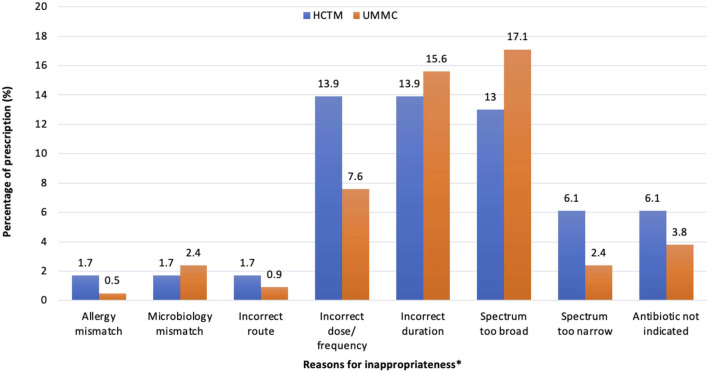
This study sought to investigate the quality of antimicrobial prescribing among adult surgical inpatients besides exploring the determinants of non-compliance and inappropriate prescribing to inform stewardship activities. A cross-sectional point prevalence study employing Hospital National Antimicrobial Prescribing Survey (Hospital NAPS) was conducted in April 2019 at two teaching hospitals in Malaysia. Among 566 surgical inpatients, 44.2% were receiving at least one antimicrobial, for a total of 339 prescriptions. Antimicrobials belonging to the World Health Organization's Watch group were observed in 57.8% of cases. Both hospitals exhibited similar types of antimicrobial treatments prescribed and administration routes. A significant difference in antimicrobial choice was observed between hospitals ( < 0.001). Hospital with electronic prescribing demonstrated better documentation practice ( < 0.001). Guidelines compliance, 32.8% ( = 0.952) and appropriateness, 55.2% ( = 0.561) did not significantly differ. The major contributors of inappropriateness were incorrect duration, (15%) and unnecessary broad-spectrum coverage, (15.6%). Non-compliance and inappropriate prescribing were found to be 2 to 4 times significantly higher with antimicrobial prophylaxis prescription compared to empirical therapy. Antimicrobial stewardship efforts to improve appropriate surgical prescribing are essential. These initiatives should prioritize surgical prophylaxis prescribing, focusing on reducing unnecessarily prolonged use and broad-spectrum antimicrobials, raising awareness among prescribers and promoting proper documentation.
本研究旨在调查成年外科住院患者抗菌药物处方的质量,同时探索不依从和不恰当处方的决定因素,以为管理活动提供信息。2019年4月,在马来西亚的两家教学医院开展了一项采用医院全国抗菌药物处方调查(医院NAPS)的横断面现患率研究。在566名外科住院患者中,44.2%的患者正在接受至少一种抗菌药物治疗,共计339张处方。在57.8%的病例中观察到属于世界卫生组织观察类别的抗菌药物。两家医院开具的抗菌药物治疗类型和给药途径相似。医院之间在抗菌药物选择上存在显著差异(<0.001)。采用电子处方的医院表现出更好的记录实践(<0.001)。指南依从性为32.8%(=0.952),适宜性为55.2%(=0.561),两者无显著差异。不恰当处方的主要原因是疗程不正确(15%)和不必要的广谱覆盖(15.6%)。与经验性治疗相比,抗菌药物预防处方的不依从和不恰当处方显著高出2至4倍。开展抗菌药物管理工作以改善外科处方的合理性至关重要。这些举措应优先考虑外科预防用药处方,重点是减少不必要的长期使用和广谱抗菌药物,提高开处方者的意识并促进正确记录。