Mondal Milon, Cao Fangyuan, Conole Daniel, Auner Holger W, Tate Edward W
Department of Chemistry, Molecular Sciences Research Hub, Imperial College London 82 Wood Lane London W12 0BZ UK
Department of Immunology and Inflammation, Imperial College London Du Cane Road London W12 0NN UK.
RSC Chem Biol. 2024 Mar 13;5(5):439-446. doi: 10.1039/d4cb00029c. eCollection 2024 May 8.
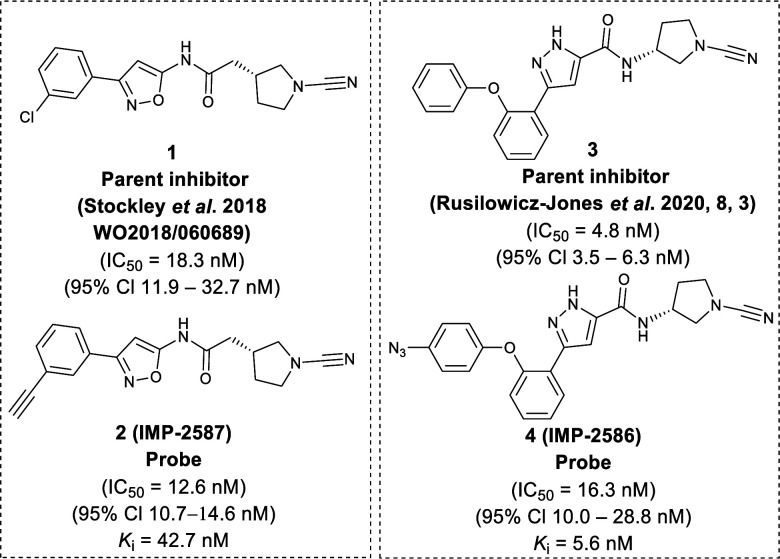
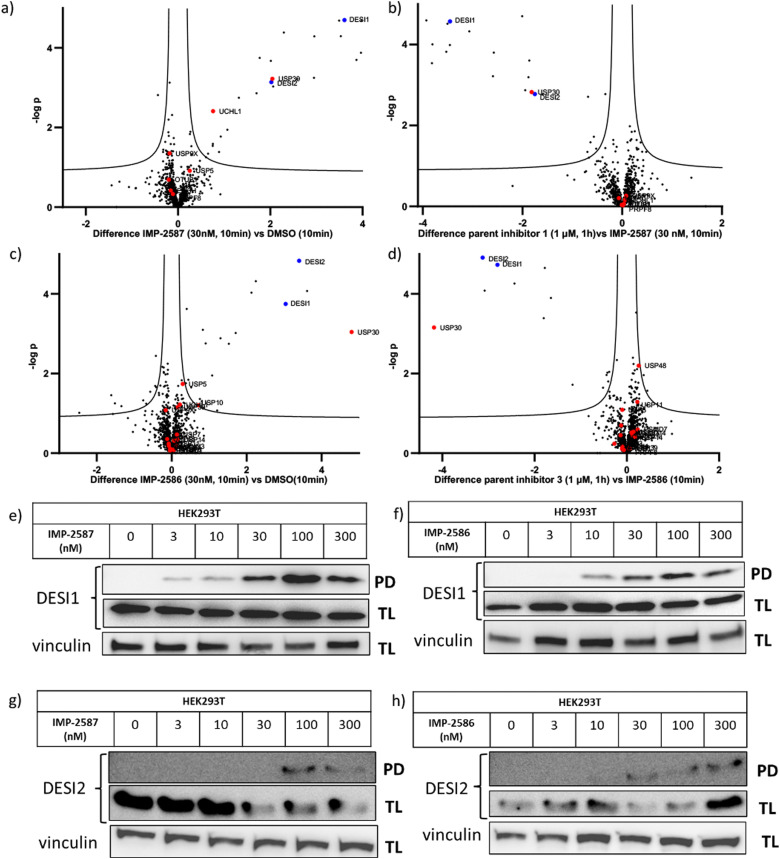
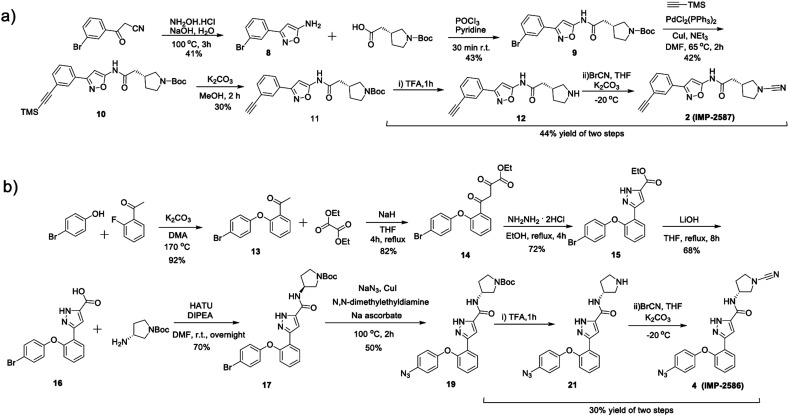
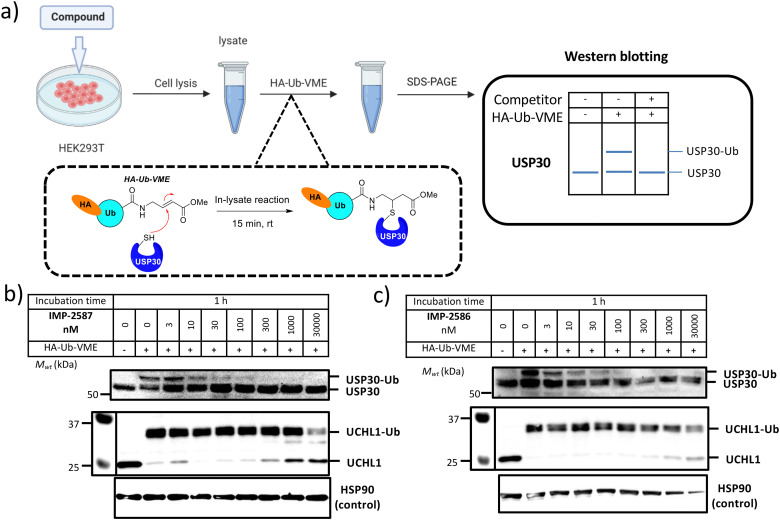
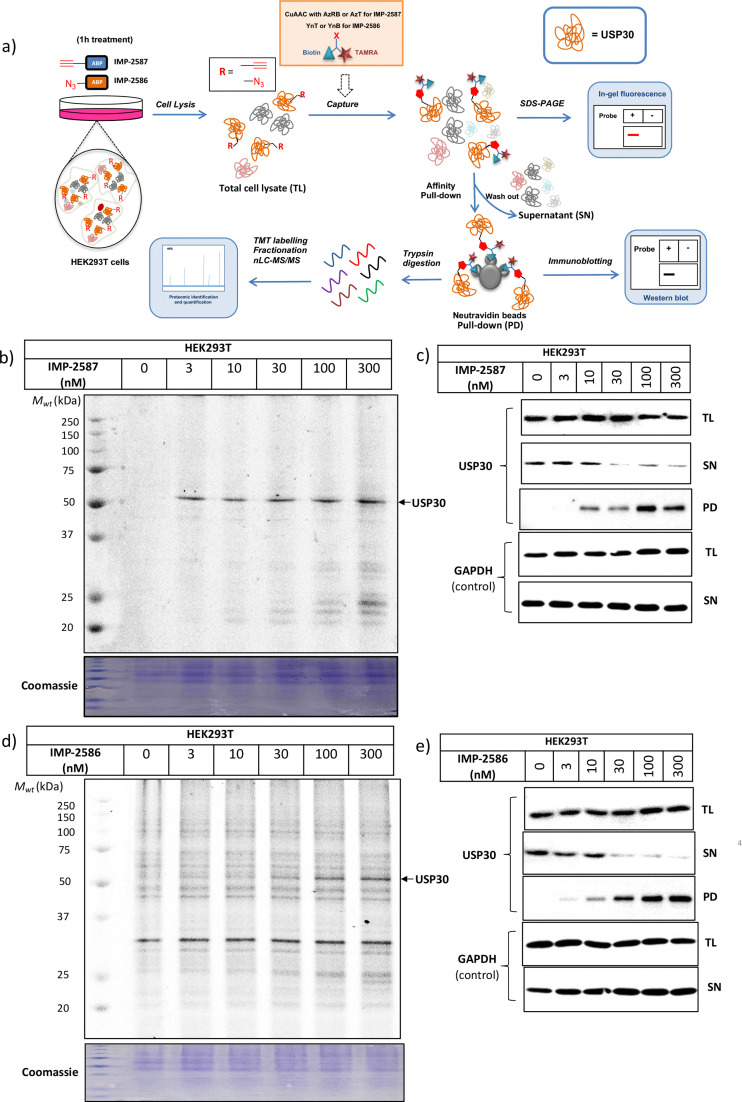
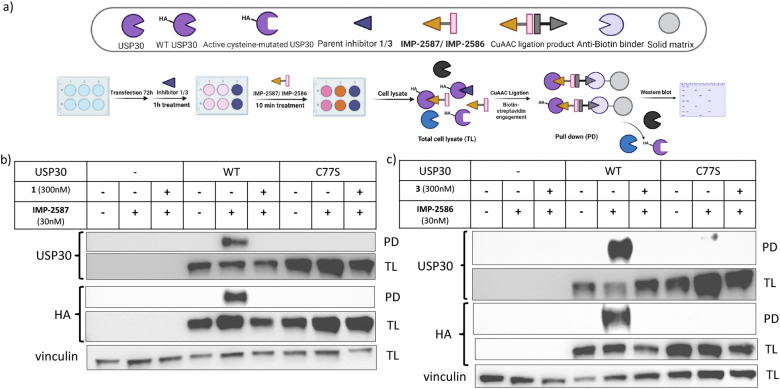
Ubiquitin-specific protease 30 (USP30) is a deubiquitinating enzyme (DUB) localized at the mitochondrial outer membrane and involved in PINK1/Parkin-mediated mitophagy, pexophagy, BAX/BAK-dependent apoptosis, and IKKβ-USP30-ACLY-regulated lipogenesis/tumorigenesis. A USP30 inhibitor, MTX652, has recently entered clinical trials as a potential treatment for mitochondrial dysfunction. Small molecule activity-based probes (ABPs) for DUBs have recently emerged as powerful tools for in-cell inhibitor screening and DUB activity analysis, and here, we report the first small molecule ABPs (IMP-2587 and IMP-2586) which can profile USP30 activity in cells. Target engagement studies demonstrate that IMP-2587 and IMP-2586 engage active USP30 at nanomolar concentration after only 10 min incubation time in intact cells, dependent on the presence of the USP30 catalytic cysteine. Interestingly, proteomics analyses revealed that DESI1 and DESI2, small ubiquitin-related modifier (SUMO) proteases, can also be engaged by these probes, further suggesting a novel approach to develop DESI ABPs.
泛素特异性蛋白酶30(USP30)是一种去泛素化酶(DUB),定位于线粒体外膜,参与PINK1/帕金蛋白介导的线粒体自噬、过氧化物酶体自噬、BAX/BAK依赖性凋亡以及IKKβ-USP30-ACLY调节的脂肪生成/肿瘤发生。一种USP30抑制剂MTX652最近已进入临床试验,作为线粒体功能障碍的潜在治疗方法。基于小分子活性的去泛素化酶探针(ABP)最近已成为细胞内抑制剂筛选和去泛素化酶活性分析的有力工具,在此,我们报告了第一种能够分析细胞中USP30活性的小分子ABP(IMP-2587和IMP-2586)。靶点结合研究表明,在完整细胞中孵育仅10分钟后,IMP-2587和IMP-2586就能以纳摩尔浓度结合活性USP30,这取决于USP30催化半胱氨酸的存在。有趣的是,蛋白质组学分析显示,小泛素相关修饰物(SUMO)蛋白酶DESI1和DESI2也能被这些探针结合,这进一步提示了一种开发DESI ABP的新方法。