Wan Fengjie, Zhu Yujia, Wu Feixiang, Huang Xuejing, Chen Ying, Zhou Yi, Li Hongtao, Liang Lifang, Qin Lirong, Wang Qi, He Min
Guangxi Medical University School of Public Health, Nanning, Guangxi 530021, PR China; Guangxi Colleges and Universities Key Laboratory of Prevention and Control of Highly Prevalent Diseases, Guangxi Medical University, Nanning, Guangxi 530021, PR China.
Guigang Dermatosis Prevention and Treatment Hospital, Guigang, Guangxi 537100, PR China.
Transl Oncol. 2024 Jul;45:101979. doi: 10.1016/j.tranon.2024.101979. Epub 2024 May 9.
The prognosis of hepatocellular carcinoma (HCC) is universally poor. Early diagnosis plays a pivotal role in determining the outcome of HCC.
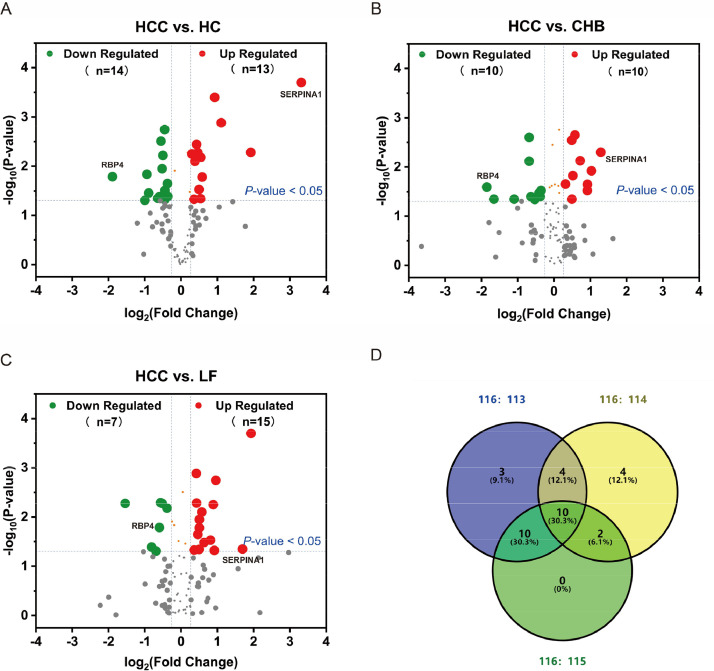
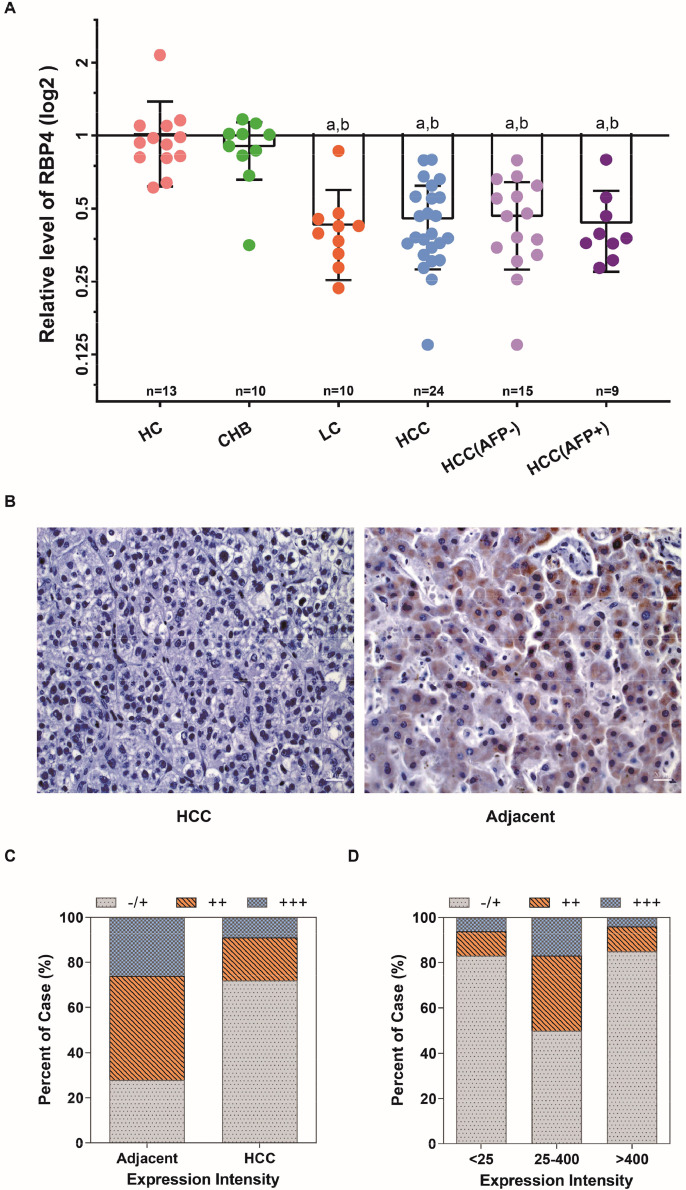
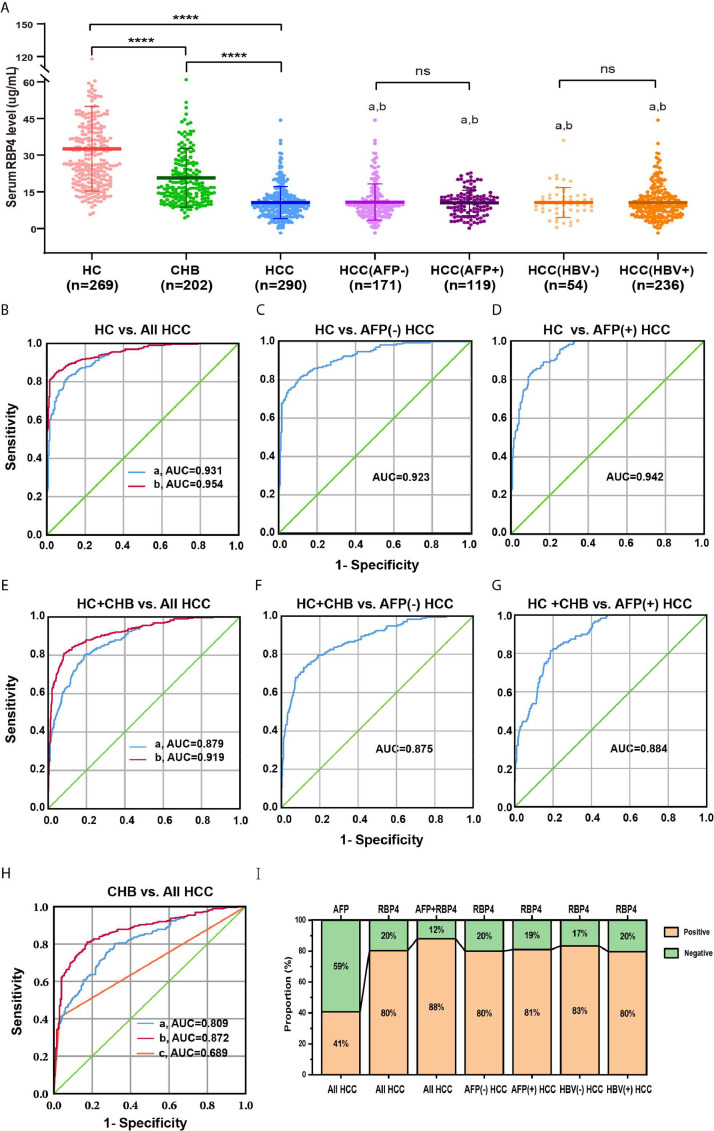
We employed a comparative proteomics approach to identify potential biomarkers and validated the application of retinol-binding protein 4 (RBP4) as a biomarker for HCC. RBP4 protein expression was examined in liver tissues from 80 HCC patients through immunohistochemical analysis. Serum RBP4 concentrations were measured by ELISA in a cohort comprising 290 HCC patients, matched 202 chronic hepatitis B patients and 269 healthy controls. Survival data were collected from HCC patients. The diagnostic and prognostic values of RBP4 were evaluated using receiver operating curve (ROC) analysis.
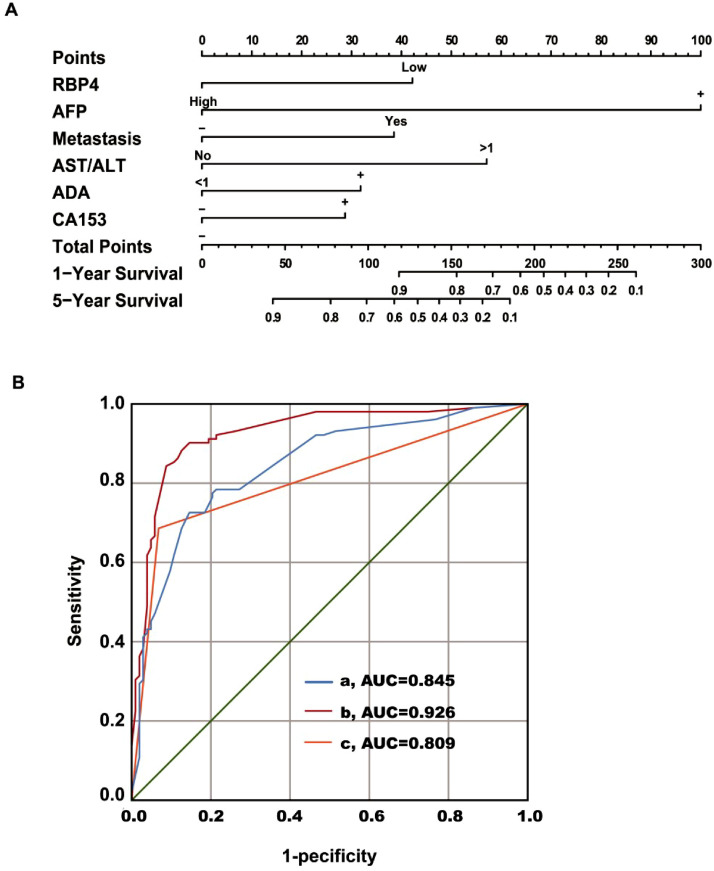
The validation results demonstrated a significant reduction in RBP4 levels in both liver tissues and serum samples from HCC patients. ROC analysis of the diagnostic value of RBP4 revealed an AUC of 0.879 (95 % CI: 0.854∼0.903) for HCC. When combined with AFP, the AUC increased to 0.919, with a sensitivity of 87.9 % and specificity of 80 %. Survival analysis revealed significantly reduced overall survival time in individuals with low-expression of RBP4 compared to those with high-expression. The joint prognostic model exhibited an AUC of 0.926 (95 % CI: 0.888∼0.964), which was significantly higher than that of AFP alone (AUC=0.809; P <0.0001).
RBP4 shows a great potential as a biomarker with appreciable diagnostic value, complementing the AFP in HCC diagnosis. Additionally, it holds promise as a prognostic biomarker that, when integrated into a combined prognostic model, could greatly improve HCC prognosis efficiency.
肝细胞癌(HCC)的预后普遍较差。早期诊断在决定HCC的预后方面起着关键作用。
我们采用比较蛋白质组学方法来鉴定潜在的生物标志物,并验证视黄醇结合蛋白4(RBP4)作为HCC生物标志物的应用。通过免疫组织化学分析检测了80例HCC患者肝组织中的RBP4蛋白表达。采用酶联免疫吸附测定法(ELISA)测量了290例HCC患者、202例配对的慢性乙型肝炎患者和269例健康对照者的血清RBP4浓度。收集了HCC患者的生存数据。使用受试者工作特征曲线(ROC)分析评估RBP4的诊断和预后价值。
验证结果表明,HCC患者肝组织和血清样本中的RBP4水平均显著降低。RBP4对HCC诊断价值的ROC分析显示,其曲线下面积(AUC)为0.879(95%置信区间:0.854~0.903)。与甲胎蛋白(AFP)联合使用时,AUC增至0.919,灵敏度为87.9%,特异性为80%。生存分析显示,与高表达RBP4的个体相比,低表达RBP4的个体总生存时间显著缩短。联合预后模型的AUC为0.926(95%置信区间:0.888~0.964),显著高于单独使用AFP时的AUC(AUC=0.809;P<0.0001)。
RBP4作为一种具有显著诊断价值的生物标志物具有很大潜力,可在HCC诊断中补充AFP。此外,它有望作为一种预后生物标志物,当整合到联合预后模型中时,可大大提高HCC的预后评估效率。