Lotz Christian N, Krollenbrock Alina, Imhof Lea, Riscoe Michael, Keiser Jennifer
Swiss Tropical and Public Health Institute, Kreuzstrasse 2, Allschwil, 4123, Switzerland; University of Basel, Petersplatz 1, Basel, 4051, Switzerland.
Department of Molecular Microbiology & Immunology, Oregon Health & Science University, 3181 SW Sam Jackson Park Rd, Portland, OR, 97239, United States.
Int J Parasitol Drugs Drug Resist. 2024 Aug;25:100546. doi: 10.1016/j.ijpddr.2024.100546. Epub 2024 May 5.
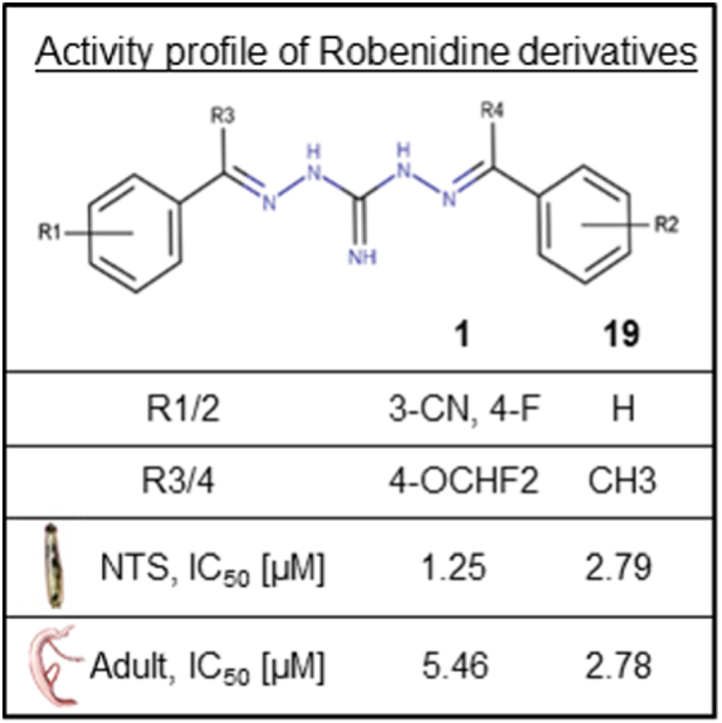
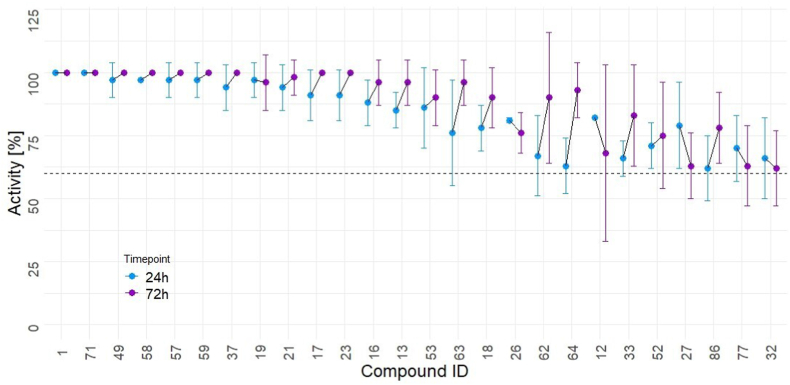
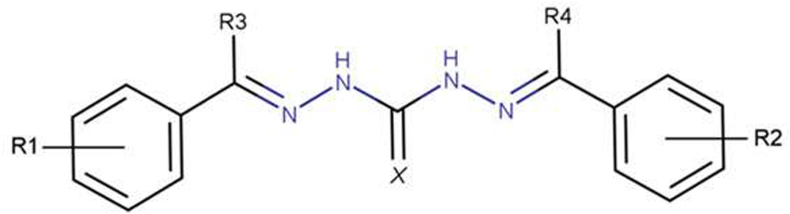
Schistosomiasis caused by Schistosoma spp. is a disease that causes a considerable health burden to millions of people worldwide. The limited availability of effective drugs on the market and the increased risk of resistance development due to extensive usage, highlight the urgent need for new antischistosomal drugs. Recent studies have shown that robenidine derivatives, containing an aminoguanidine core, exhibit promising activities against Plasmodium falciparum, motivating further investigation into their efficacy against Schistosoma mansoni, due to their similar habitat and the resulting related cellular mechanisms like the heme detoxification pathway. The conducted phenotypic screening of robenidine and 80 derivatives against newly transformed schistosomula and adult Schistosoma mansoni yielded 11 candidates with low EC values for newly transformed schistosomula (1.12-4.63 μM) and adults (2.78-9.47 μM). The structure-activity relationship revealed that electron-withdrawing groups at the phenyl moiety, as well as the presence of methyl groups adjacent to the guanidine moiety, enhanced the activity of derivatives against both stages of Schistosoma mansoni. The two compounds 2,2'-Bis[(3-cyano-4-fluorophenyl)methylene] carbonimidic Dihydrazide Hydrochloride (1) and 2,2'-Bis[(4-difluoromethoxyphenyl) ethylidene] carbonimidic Dihydrazide Hydrochloride (19), were selected for an in vivo study in Schistosoma mansoni-infected mice based on their potency, cytotoxicity, pharmacokinetic-, and physicochemical properties, but failed to reduce the worm burden significantly (worm burden reduction <20%). Thus, robenidine derivatives require further refinements to obtain higher antischistosomal specificity and in vivo activity.
由血吸虫属引起的血吸虫病是一种给全球数百万人带来相当大健康负担的疾病。市场上有效药物供应有限,且由于广泛使用导致耐药性发展风险增加,凸显了对新型抗血吸虫药物的迫切需求。最近的研究表明,含有氨基胍核心的罗苯哒唑衍生物对恶性疟原虫表现出有前景的活性,鉴于其与曼氏血吸虫相似的生存环境以及由此产生的相关细胞机制(如血红素解毒途径),促使人们进一步研究其对曼氏血吸虫的疗效。对罗苯哒唑及其80种衍生物针对新转化的血吸虫幼虫和曼氏血吸虫成虫进行的表型筛选,得到了11种候选物,它们对新转化的血吸虫幼虫(1.12 - 4.63 μM)和成虫(2.78 - 9.47 μM)具有较低的半数有效浓度(EC)值。构效关系表明,苯基部分的吸电子基团以及与胍基部分相邻的甲基的存在,增强了衍生物对曼氏血吸虫两个阶段的活性。基于其效力、细胞毒性、药代动力学和物理化学性质,选择了两种化合物2,2'-双[(3-氰基-4-氟苯基)亚甲基]碳亚胺二酰肼盐酸盐(1)和2,2'-双[(4-二氟甲氧基苯基)亚乙基]碳亚胺二酰肼盐酸盐(19)在感染曼氏血吸虫的小鼠中进行体内研究,但未能显著降低虫负荷(虫负荷降低<20%)。因此,罗苯哒唑衍生物需要进一步优化以获得更高的抗血吸虫特异性和体内活性。