Nasr Ashraf Youssef, Youssef Rawan Ashraf
Department of Clinical Anatomy, Faculty of Medicine, King Abdulaziz University, Jeddah, Saudi Arabia.
Department of Anatomy & Embryology, Faculty of Medicine, Zagazig University, Zagazig, Egypt.
Anat Cell Biol. 2024 Jun 30;57(2):194-203. doi: 10.5115/acb.24.032. Epub 2024 May 13.
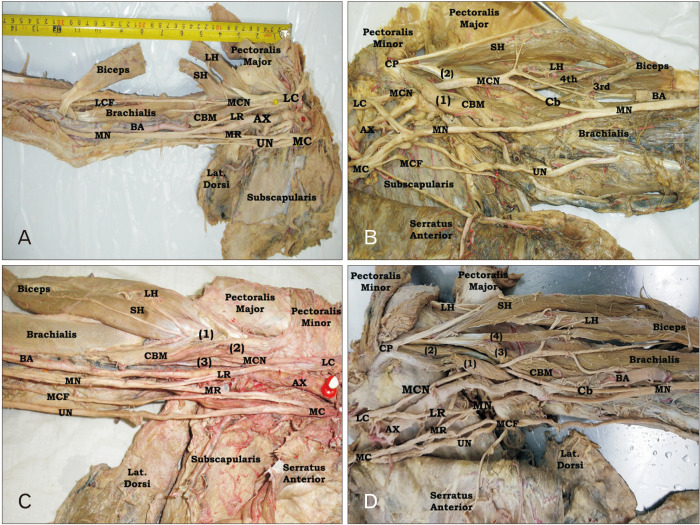
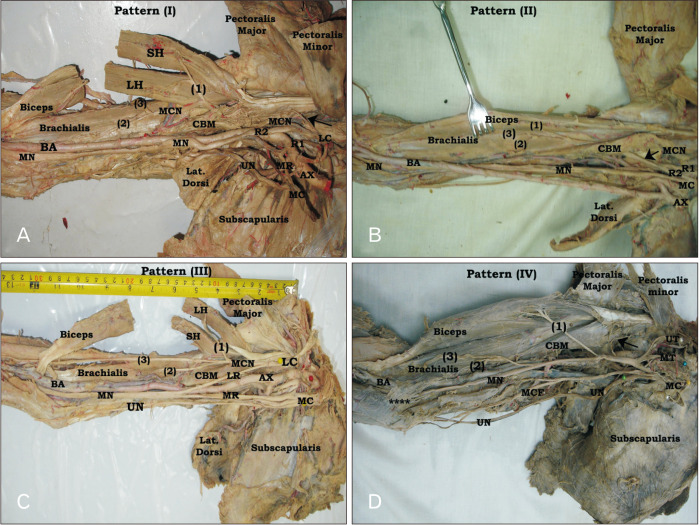
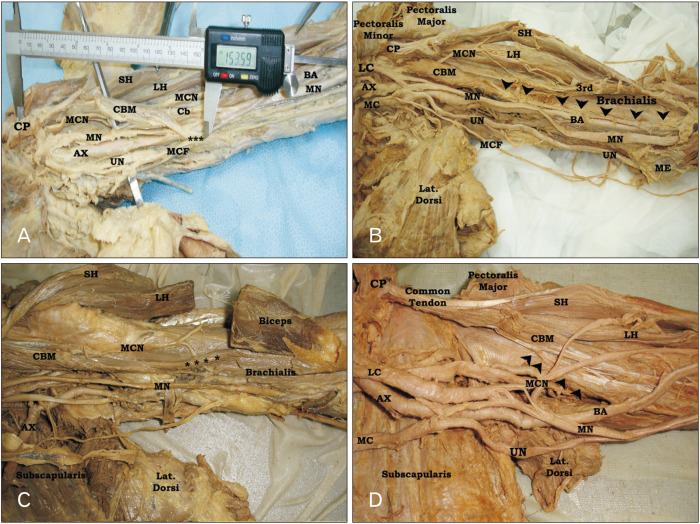
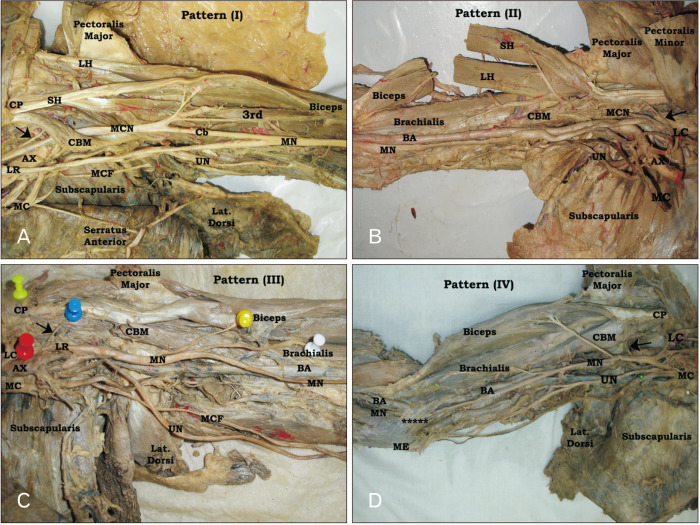
The anatomical variations of coracobrachialis muscle (CBM) are of great clinical importance. This study aimed to elucidate the morphological variations, innervation patterns and musculocutaneous nerve (MCN) relation to CBM. Upper limbs of fifty cadavers (30 males and 20 females) were examined for proximal and distal attachments, innervation pattern of CBM and its relation to MCN. Four morphological types of CBM were identified according to number of its heads. The commonest type was the two-headed (63.0%) followed by the single belly (22.0%), three-headed (12.0%) and lastly fourheaded (3.0%) type. Moreover, an abnormal insertion of CBM was observed in four left limbs (4.0%); one inserting into the medial humeral epicondyle, the second into the upper third of humeral shaft, the third one in the common tendon of biceps, and the fourth one showing a bifurcated insertion. Also, four different innervation patterns of CBM were identified including MCN (80.0%), lateral cord (14.0%), lateral root of median nerve (4.0%), and median nerve itself (2.0%). The course of MCN was superficial to the single belly CBM (19.0%) and in-between the heads in the other types (71.0%). Measurements of the length and original distance of CBM muscular branches originating from MCN revealed no sex or side significant difference. Awareness of the anatomic variations, innervation patterns, and MCN relation of CBM is imperative in recent diagnostic and surgical procedures to obtain definite diagnosis, effective management and good outcome.
肱二头肌(CBM)的解剖变异具有重要的临床意义。本研究旨在阐明其形态变异、神经支配模式以及肌皮神经(MCN)与CBM的关系。对50具尸体(30例男性和20例女性)的上肢进行检查,观察CBM的近端和远端附着点、神经支配模式及其与MCN的关系。根据CBM的头数确定了四种形态类型。最常见的类型是双头型(63.0%),其次是单腹型(22.0%)、三头型(12.0%),最后是四头型(3.0%)。此外,在4例左上肢(4.0%)中观察到CBM的异常附着;1例附着于肱骨内上髁,第2例附着于肱骨干上1/3处,第3例附着于肱二头肌的共同肌腱,第4例显示为分叉附着。还确定了CBM的四种不同神经支配模式,包括MCN(80.0%)、外侧束(14.0%)、正中神经外侧根(4.0%)和正中神经本身(2.0%)。MCN的走行在单腹型CBM的浅面(19.0%),在其他类型中位于头之间(71.0%)。对源自MCN的CBM肌支的长度和起始距离的测量显示,性别和左右侧均无显著差异。在近期的诊断和手术操作中,了解CBM的解剖变异、神经支配模式以及与MCN的关系对于获得明确诊断、有效治疗和良好预后至关重要。