Nguyen Geoffrey, Lin Benjamin, Sridhar Jayanth, Levin Moran R
University of Maryland School of Medicine, Baltimore, Maryland.
Bascom Palmer Eye Institute, Miami, Florida.
J Acad Ophthalmol (2017). 2023 Sep 25;15(2):e209-e214. doi: 10.1055/s-0043-1775576. eCollection 2023 Jul.
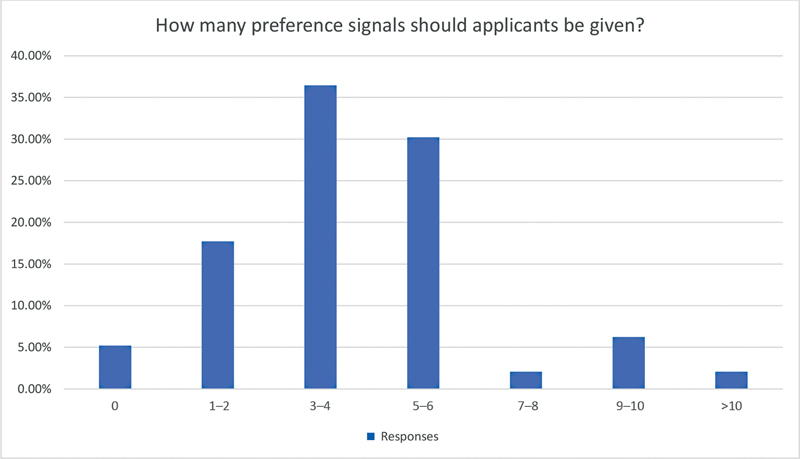
This article characterizes perspectives of ophthalmologists involved in the residency selection process regarding the potential impact of preference signaling on the ophthalmology residency match. An anonymous online questionnaire generated from SurveyMonkey was approved by the Association of University Professors of Ophthalmology (AUPO) Data Resource Committee for distribution to 391 individuals from the AUPO Departmental Chairs, Program Directors, and Directors of Medical Student Education email listservs in August 2022. A total of 96 (24.6%) ophthalmology faculty completed the questionnaire. The majority ( = 76, 79.2%) agreed or strongly agreed that preference signaling should be implemented in the ophthalmology residency application system. Most respondents agreed or strongly agreed that preference signaling will allow for more holistic reviews of applications ( = 55, 57.3%), agreed or strongly agreed that it will benefit applicants who do not have connections to home programs or faculty that can reach out to desired programs ( = 81, 84.4%), and agreed or strongly agreed that it will improve the distribution of interviews to applicants ( = 76, 79.2%). Participants agreed or strongly agreed that applicants who have signaled interest in their program will receive preference when offering interviews ( = 59, 61.5%), and those signals will be used as a tiebreaker for similar applications ( = 75, 78.1%). The majority of participants believed that the ideal number of preference signals' applicants should be given three to four signals ( = 35, 36.0%) or five to six signals ( = 29, 30.2%). A majority of ophthalmology faculty surveyed support the integration of preference signaling into the ophthalmology residency match.
本文描述了参与住院医师选拔过程的眼科医生对于偏好信号对眼科住院医师匹配可能产生的影响的看法。由SurveyMonkey生成的一份匿名在线调查问卷经眼科大学教授协会(AUPO)数据资源委员会批准,于2022年8月分发给来自AUPO系主任、项目主任和医学生教育主任电子邮件列表的391人。共有96名(24.6%)眼科教员完成了调查问卷。大多数人(n = 76,79.2%)同意或强烈同意应在眼科住院医师申请系统中实施偏好信号。大多数受访者同意或强烈同意偏好信号将允许对申请进行更全面的审查(n = 55,57.3%),同意或强烈同意这将有利于那些与家乡项目或能联系到心仪项目的教员没有关系的申请人(n = 81,84.4%),并同意或强烈同意这将改善面试分配给申请人的情况(n = 76,79.2%)。参与者同意或强烈同意,对其项目表示感兴趣的申请人在提供面试时将获得优先考虑(n = 59,61.5%),并且这些信号将被用作类似申请的决胜因素(n = 75,78.1%)。大多数参与者认为,理想情况下,偏好信号的申请人数量应为三到四个信号(n = 35,36.0%)或五到六个信号(n = 29,30.2%)。接受调查的大多数眼科教员支持将偏好信号纳入眼科住院医师匹配。