Ooghe Arthur, Liu Xiaoqian, Robbins Sarah, Eyles Jillian P, Deveza Leticia A, Branders Samuel, Clermont Frédéric, Pereira Alvaro, Hunter David J
Cognivia, 11 rue Granbonpré, Bte 9 - 1435 Mont-Saint-Guibert, Belgium.
Rheumatology Department, Royal North Shore Hospital, Northern Clinical School, Faculty of Medicine and Health, The University of Sydney, Australia.
Osteoarthr Cartil Open. 2024 Apr 27;6(2):100474. doi: 10.1016/j.ocarto.2024.100474. eCollection 2024 Jun.
The aim of this study was to compare the magnitude and the predictors of the placebo response in an internet versus onsite randomised controlled trials (RCTs) in people with hand osteoarthritis (HOA).
This study is a analysis based on one internet RCT (RADIANT) and previously published onsite RCTs for HOA identified through a rigorous searching and selection strategy. The magnitude of the placebo response in the two different types of RCTs were compared using heterogeneity statistics and forest plots visualisation. Classic placebo predictors as well as a combined model, defined with data from onsite RCTs, were tested to predict the placebo response.
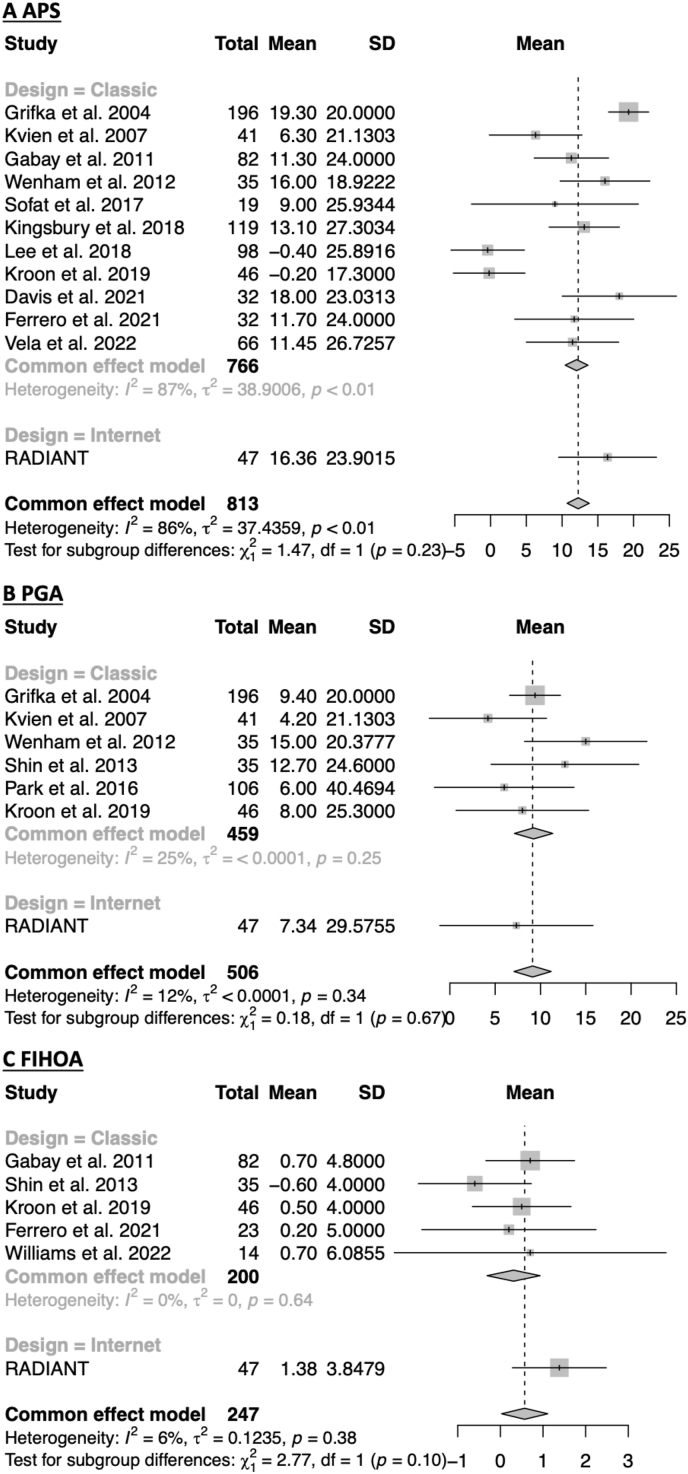
We analysed the dataset from RADIANT and fourteen previously published onsite RCTs. None of the analyses showed a significant difference between the placebo response for the internet versus onsite RCTs. The "classic" placebo predictors combined in a multivariate predictive model correlated significantly with the placebo response measured in RADIANT study.
Despite the absence of face-to-face interactions with the study personnel, there is no evidence that either the magnitude or the predictors of the placebo response of this internet RCT differ from those of onsite RCTs. This analysis is considered as a first step towards evaluating the difference between these designs and strengthens the argument that internet RCTs remain an acceptable alternative way to assess the efficacy of an active treatment in comparison to a placebo.
本研究旨在比较针对手部骨关节炎(HOA)患者的网络随机对照试验(RCT)与现场随机对照试验中安慰剂反应的程度及预测因素。
本研究是一项基于一项网络RCT(RADIANT)以及通过严格检索和筛选策略确定的先前发表的HOA现场RCT的分析。使用异质性统计和森林图可视化比较两种不同类型RCT中安慰剂反应的程度。对经典安慰剂预测因素以及根据现场RCT数据定义的组合模型进行测试,以预测安慰剂反应。
我们分析了RADIANT以及14项先前发表的现场RCT的数据集。所有分析均未显示网络RCT与现场RCT的安慰剂反应之间存在显著差异。多变量预测模型中组合的“经典”安慰剂预测因素与RADIANT研究中测量的安慰剂反应显著相关。
尽管缺乏与研究人员的面对面互动,但没有证据表明该网络RCT的安慰剂反应程度或预测因素与现场RCT不同。该分析被视为评估这些设计之间差异的第一步,并强化了这样的观点,即与安慰剂相比,网络RCT仍然是评估活性治疗疗效的一种可接受的替代方法。