Department of Neurology and Neurological Science, Graduate School of Medical and Dental Sciences, Tokyo Medical and Dental University, 1-5-45 Yushima, Bunkyo-Ku, Tokyo, 113-8519, Japan.
Center for Brain Integration Research, Tokyo Medical and Dental University, 1-5-45 Yushima, Bunkyo-Ku, Tokyo, 113-8519, Japan.
Acta Neuropathol Commun. 2024 May 14;12(1):75. doi: 10.1186/s40478-024-01766-3.
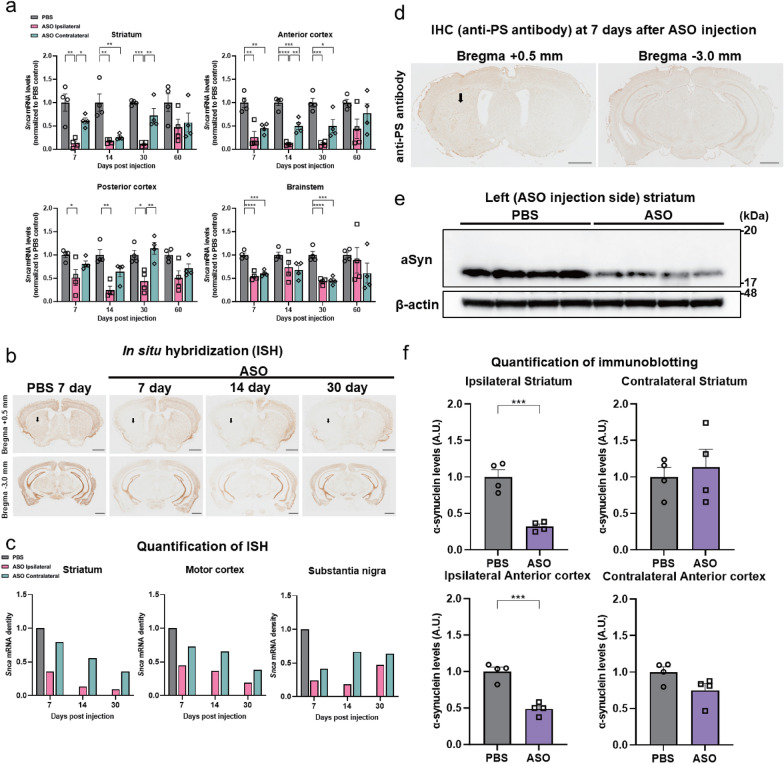
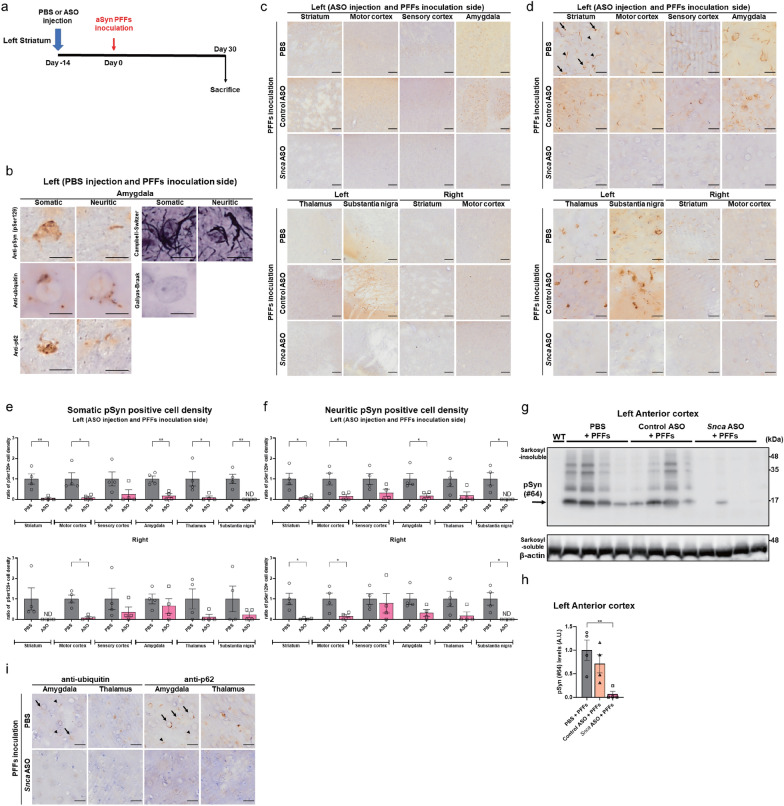
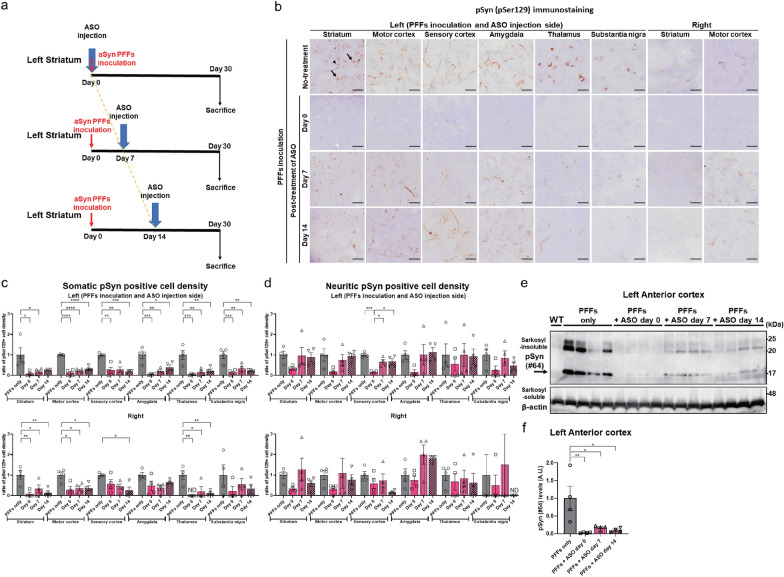
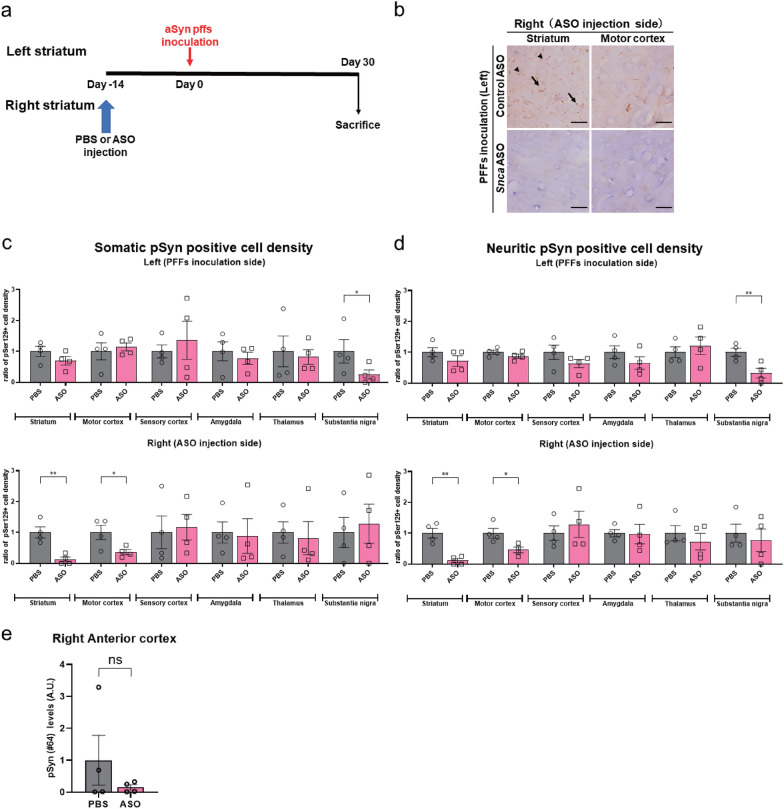
In Parkinson's disease and other synucleinopathies, fibrillar forms of α-synuclein (aSyn) are hypothesized to structurally convert and pathologize endogenous aSyn, which then propagates through the neural connections, forming Lewy pathologies and ultimately causing neurodegeneration. Inoculation of mouse-derived aSyn preformed fibrils (PFFs) into the unilateral striatum of wild-type mice causes widespread aSyn pathologies in the brain through the neural network. Here, we used the local injection of antisense oligonucleotides (ASOs) against Snca mRNA to confine the area of endogenous aSyn protein reduction and not to affect the PFFs properties in this model. We then varied the timing and location of ASOs injection to examine their impact on the initiation and propagation of aSyn pathologies in the whole brain and the therapeutic effect using abnormally-phosphorylated aSyn (pSyn) as an indicator. By injecting ASOs before or 0-14 days after the PFFs were inoculated into the same site in the left striatum, the reduction in endogenous aSyn in the striatum leads to the prevention and inhibition of the regional spread of pSyn pathologies to the whole brain including the contralateral right hemisphere. ASO post-injection inhibited extension from neuritic pathologies to somatic ones. Moreover, injection of ASOs into the right striatum prevented the remote regional spread of pSyn pathologies from the left striatum where PFFs were inoculated and no ASO treatment was conducted. This indicated that the reduction in endogenous aSyn protein levels at the propagation destination site can attenuate pSyn pathologies, even if those at the propagation initiation site are not inhibited, which is consistent with the original concept of prion-like propagation that endogenous aSyn is indispensable for this regional spread. Our results demonstrate the importance of recruiting endogenous aSyn in this neural network propagation model and indicate a possible potential for ASO treatment in synucleinopathies.
在帕金森病和其他突触核蛋白病中,α-突触核蛋白(aSyn)的纤维形式被假设为结构转化和病理化内源性 aSyn,然后通过神经网络传播,形成路易体病变,最终导致神经退行性变。将源自小鼠的 aSyn 预形成纤维(PFF)注入野生型小鼠的单侧纹状体中,通过神经网络导致大脑中广泛的 aSyn 病变。在这里,我们使用针对 Snca mRNA 的反义寡核苷酸(ASO)局部注射来限制内源性 aSyn 蛋白减少的区域,而不影响该模型中的 PFF 特性。然后,我们改变 ASO 注射的时间和位置,以检查它们对整个大脑中 aSyn 病变的起始和传播的影响,并使用异常磷酸化的 aSyn(pSyn)作为指标来评估治疗效果。通过在 PFF 接种到左侧纹状体相同部位之前或 0-14 天内注射 ASO,纹状体中内源性 aSyn 的减少导致 pSyn 病变的区域性传播到整个大脑(包括对侧右侧半球)的预防和抑制。ASO 后注射抑制了从神经突病变到体病变的延伸。此外,将 ASO 注射到右侧纹状体可防止 pSyn 病变从左侧纹状体(未进行 ASO 治疗)的远程区域传播,而左侧纹状体接种了 PFF。这表明,即使在传播起始部位未抑制的情况下,在传播目的地部位降低内源性 aSyn 蛋白水平可以减轻 pSyn 病变,这与朊病毒样传播的原始概念一致,即内源性 aSyn 对这种区域性传播是必不可少的。我们的结果表明,在这个神经网络传播模型中招募内源性 aSyn 的重要性,并表明 ASO 治疗在突触核蛋白病中的潜在可能性。