Au Thanh-Thuy-Dung, Ho Yu-Ling, Chang Yuan-Shiun
Department of Chinese Pharmaceutical Sciences and Chinese Medicine Resources, College of Chinese Medicine, China Medical University, Taichung, Taiwan.
Department of Nursing, Hungkuang University, Taichung, Taiwan.
Front Pharmacol. 2024 Apr 30;15:1364460. doi: 10.3389/fphar.2024.1364460. eCollection 2024.
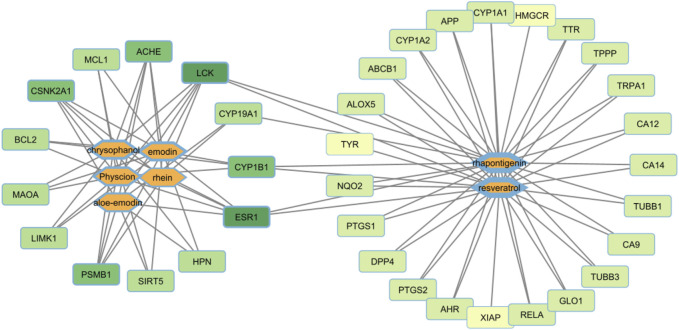
Rhubarb is a traditional Chinese medicine (TCM) used to release heat and has cathartic effects. Official rhubarb in Taiwan Herbal Pharmacopeias 4th edition (THP 4th) and China Pharmacopeia 2020 (CP 2020) are the roots and rhizomes of L., Maxim. ex Balf., and Baill. However, the genus is a large genus with many different species, and owing to the similarity in appearance and taste with official rhubarb, there needs to be more clarity in the distinction between the species of rhubarb and their applications. Given the time-consuming and complicated extraction and chromatography methods outlined in pharmacopeias, we improved the qualitative analysis and quantitative analysis methods for rhubarb in the market. Hence, we applied our method to identify the species and quality of official and unofficial rhubarb. We analyzed 21 rhubarb samples from the Taiwanese market using a proposed HPLC-based extraction and qualitative analysis employing eight markers: aloe-emodin, rhein, emodin, chrysophanol, physcion, rhapontigenin, rhaponticin, and resveratrol. Additionally, we developed a TLC method for the analysis of rhubarb. KEGG pathway analysis was used to clarify the phytochemical and pharmacological knowledge of official and unofficial rhubarb. Rhein and rhapontigenin emerged as key markers to differentiate official and unofficial rhubarb. Rhapontigenin is abundant in unofficial rhubarb; however, rhein content was low. In contrast, their contents in official rhubarb were opposite to their contents in unofficial rhubarb. The TLC analysis used rhein and rhapontigenin to identify rhubarb in Taiwan's markets, whereas the KEGG pathway analysis revealed that anthraquinones and stilbenes affected different pathways. Eight reference standards were used in this study to propose a quality control method for rhubarb in Taiwanese markets. We propose a rapid extraction method and quantitative analysis of rhubarb to differentiate between official and unofficial rhubarb.
大黄是一种用于清热且有泻下作用的传统中药。台湾《中华草药典》第4版(THP 4)和《中国药典》2020年版(CP 2020)中的正品大黄为掌叶大黄、唐古特大黄和药用大黄的根及根茎。然而,大黄属是一个大属,有许多不同的物种,由于与正品大黄在外观和味道上相似,大黄不同物种之间的区分及其应用需要更明确。鉴于药典中概述的提取和色谱方法耗时且复杂,我们改进了市售大黄的定性分析和定量分析方法。因此,我们应用我们的方法来鉴定正品大黄和非正品大黄的物种及质量。我们使用一种基于高效液相色谱的提取方法和采用芦荟大黄素、大黄酸、大黄素、 Chrysophanol、大黄酚、 rhapontigenin、 rhaponticin和白藜芦醇这八个标志物的定性分析方法,分析了来自台湾市场的21个大黄样品。此外,我们开发了一种用于分析大黄的薄层色谱法。KEGG通路分析用于阐明正品大黄和非正品大黄的植物化学和药理学知识。大黄酸和rhapontigenin成为区分正品大黄和非正品大黄的关键标志物。 Rhapontigenin在非正品大黄中含量丰富;然而,大黄酸含量较低。相比之下,它们在正品大黄中的含量与在非正品大黄中的含量相反。薄层色谱分析使用大黄酸和rhapontigenin来鉴定台湾市场上的大黄,而KEGG通路分析表明蒽醌类和芪类影响不同的通路。本研究使用八种参考标准品来提出台湾市场大黄的质量控制方法。我们提出了一种快速提取方法和大黄的定量分析方法,以区分正品大黄和非正品大黄。