Chen Chuankai, Jiang Ya-Ping, You Inchul, Gray Nathanael S, Lin Richard Z
Department of Physiology & Biophysics, Stony Brook University, Stony Brook, New York, USA.
Graduate Program in Genetics, Stony Brook University, New York, USA.
bioRxiv. 2024 May 5:2024.05.03.592345. doi: 10.1101/2024.05.03.592345.
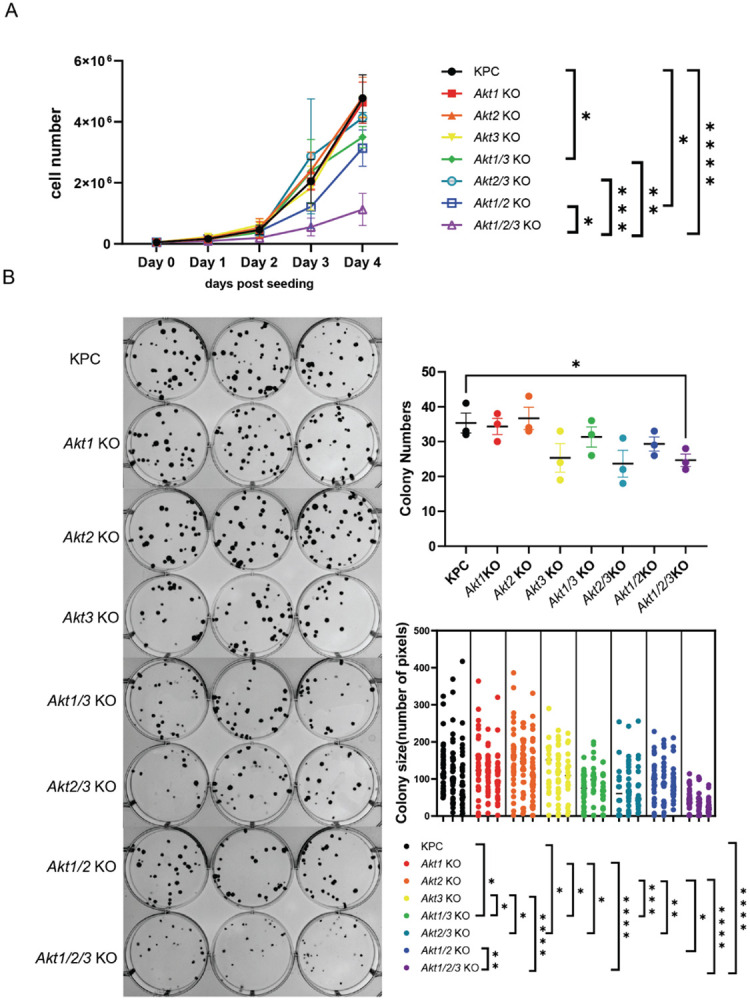
Serine/threonine kinase AKT isoforms play a well-established role in cell metabolism and growth. Most pancreatic adenocarcinoma (PDAC) harbors activation mutations of KRAS, which activates the PI3K/AKT signaling pathway. However, AKT inhibitors are not effective in the treatment of pancreatic cancer. To better understand the role of AKT signaling in mutant-KRAS pancreatic tumors, this study utilizes proteolysis-targeting chimeras (PROTACs) and CRISPR-Cas9-genome editing to investigate AKT proteins. PROTAC down-regulation of AKT proteins markedly slowed the growth of three pancreatic tumor cell lines harboring mutant KRAS. In contrast, inhibition of AKT kinase activity alone had very little effect on the growth of these cell lines. Concurrent genetic deletion of all AKT isoforms (AKT1, AKT2, and AKT3) in the KPC (; ; ) pancreatic cancer cell line also dramatically slowed its growth and when orthotopically implanted in syngeneic mice. Surprisingly, insulin-like growth factor-1 (IGF-1), but not epidermal growth factor (EGF), restored KPC cell growth in serum-deprived conditions and the IGF-1 growth stimulation effect was AKT dependent. RNA-seq analysis of AKT1/2/3-deficient KPC cells suggested that reduced cholesterol synthesis may be responsible for the decreased response to IGF-1 stimulation. These results indicate that the presence of all three AKT isoforms supports pancreatic tumor cell growth and pharmacological degradation of AKT proteins may be more effective than AKT catalytic inhibitors for treating pancreatic cancer.
丝氨酸/苏氨酸激酶AKT亚型在细胞代谢和生长中发挥着既定作用。大多数胰腺腺癌(PDAC)存在KRAS激活突变,其激活PI3K/AKT信号通路。然而,AKT抑制剂对胰腺癌治疗无效。为了更好地理解AKT信号在突变KRAS胰腺肿瘤中的作用,本研究利用靶向蛋白水解嵌合体(PROTACs)和CRISPR-Cas9基因组编辑来研究AKT蛋白。PROTAC介导的AKT蛋白下调显著减缓了三种携带突变KRAS的胰腺肿瘤细胞系的生长。相比之下,单独抑制AKT激酶活性对这些细胞系的生长影响很小。在KPC(;;)胰腺癌细胞系中同时基因缺失所有AKT亚型(AKT1、AKT2和AKT3),当其原位植入同基因小鼠时,也显著减缓了其生长。令人惊讶的是,胰岛素样生长因子-1(IGF-1)而非表皮生长因子(EGF)在血清剥夺条件下恢复了KPC细胞生长,且IGF-1的生长刺激作用依赖于AKT。对AKT1/2/3缺陷的KPC细胞进行RNA测序分析表明,胆固醇合成减少可能是对IGF-1刺激反应降低的原因。这些结果表明,所有三种AKT亚型的存在支持胰腺肿瘤细胞生长,并且AKT蛋白的药理学降解可能比AKT催化抑制剂治疗胰腺癌更有效。