Physiology Department, FHU SENEC, Henri Mondor Hospital, Assistance Publique Hôpitaux de Paris (AP-HP), Créteil, France.
INSERM IMRB U955, Université Paris Est (UPEC), 51 Avenue du Maréchal de Lattre de Tassigny, 94010, Créteil, France.
Sci Rep. 2024 May 15;14(1):11095. doi: 10.1038/s41598-024-61689-w.
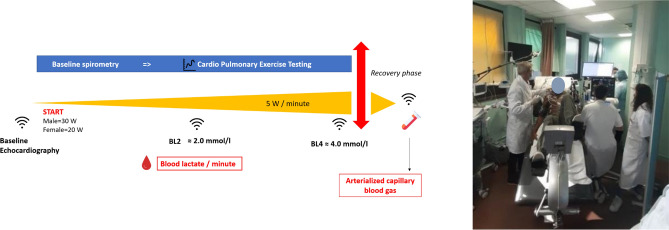
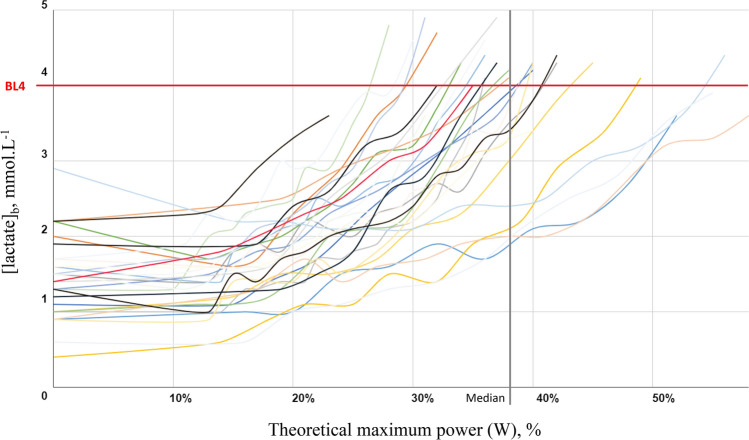
This pilot study focusing on Sickle Cell Anemia (SCA) patients offers a comprehensive and integrative evaluation of respiratory, cardiovascular, hemodynamic, and metabolic variables during exercise. Knowing that diastolic dysfunction is frequent in this population, we hypothesize that a lack of cardiac adaptation through exercise might lead to premature increase in blood lactate concentrations in SCA patients, a potential trigger for acute disease complication. SCA patients were prospectively included in PHYSIO-EXDRE study and underwent a comprehensive stress test with a standardized incremental exercise protocol up to 4 mmol L blood lactate concentration (BL4). Gas exchange, capillary lactate concentration and echocardiography were performed at baseline, during stress test (at ∼ 2 mmol L) and BL4. The population was divided into two groups and compared according to the median value of percentage of theoretical peak oxygen uptake (% ) at BL4. Twenty-nine patients were included (42 ± 12 years old, 48% of women). Most patients reached BL4 at low-intensity exercise [median value of predicted power output (W) was 37%], which corresponds to daily life activities. The median value of % at BL4 was 39%. Interestingly, diastolic maladaptation using echocardiography during stress test along with hemoglobin concentration were independently associated to early occurrence of BL4. As BL4 occurs for low-intensity exercises, SCA patients may be subject to acidosis-related complications even during their daily life activities. Beyond assessing physical capacities, our study underlines that diastolic maladaptation during exercise is associated with an early increase in blood lactate concentration.
这项针对镰状细胞贫血 (SCA) 患者的初步研究全面综合评估了运动期间的呼吸、心血管、血液动力学和代谢变量。鉴于舒张功能障碍在该人群中很常见,我们假设运动时心脏适应性不足可能导致 SCA 患者血液乳酸浓度过早升高,这可能是急性疾病并发症的一个潜在诱因。SCA 患者前瞻性纳入 PHYSIO-EXDRE 研究,并接受了一项全面的应激测试,采用标准化递增运动方案直至血液乳酸浓度达到 4mmol/L(BL4)。在基线、应激测试期间(约 2mmol/L)和 BL4 时进行气体交换、毛细血管乳酸浓度和超声心动图检查。根据 BL4 时理论峰值摄氧量百分比(% )的中位数将人群分为两组并进行比较。共纳入 29 例患者(42±12 岁,48%为女性)。大多数患者在低强度运动时达到 BL4[预测功率输出(W)的中位数为 37%],这相当于日常生活活动。BL4 时的%中位数为 39%。有趣的是,应激测试时超声心动图显示的舒张适应性不良以及血红蛋白浓度与 BL4 的早期发生独立相关。由于 BL4 发生在低强度运动时,即使在日常生活活动中,SCA 患者也可能发生酸中毒相关并发症。除了评估身体能力外,我们的研究还强调,运动期间的舒张适应性不良与血液乳酸浓度的早期升高有关。