Bittner Beate, Munoz Francisco Javier, Odonoghue James, Ordonez Jose Manuel, Schmidt Johannes, Schmitt Kathrin, Stassen Katja
Global Product Strategy, Product Optimization, F. Hoffmann-La Roche Ltd., Basel 4070, Switzerland.
Healthcare Ipsos SA, Basel 4058, Switzerland.
ACS Pharmacol Transl Sci. 2024 Apr 26;7(5):1310-1319. doi: 10.1021/acsptsci.3c00377. eCollection 2024 May 10.
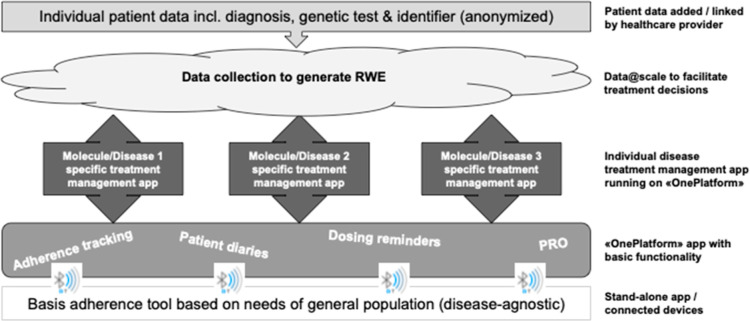
The value of connected devices and health apps with features such as adherence trackers, dosing reminders, and remote communication tools for users and healthcare providers has been assessed to support home-based subcutaneous administration. A comprehensive survey was conducted with 605 participants, including users and caregivers, from eight countries. Medical conditions encompassed ankylosing spondylitis, asthma, cerebral palsy, cluster headaches, Crohn's disease, hemophilia, lupus, migraine, multiple sclerosis, Parkinson's disease, plaque psoriasis, psoriatic arthritis, rheumatoid arthritis, spasticity, spondyloarthritis, and ulcerative colitis. Utilizing a maximum difference scaling methodology, the survey gauged participant preferences regarding specific attributes and features of connected drug delivery devices. Irrespective of demographic factors like age, gender, nationality, or the specific medical condition, the device's ability to verify a successful injection stood out as universally valued. The second and third most valued attributes pertained to temperature-related indicators or warnings. These features do not necessitate the use of a connected device and can be integrated into existing autoinjector platforms. The survey findings support the development of a universal adherence tool for at-home subcutaneous dosing, independent of a specific medical condition. This tool may be gradually improved with disease-specific features. Once established as a platform, manufacturers can launch any subcutaneous medication and later integrate real-world evidence for enhanced educational, treatment, and diagnostic capabilities. This approach is crucial for advancing connected adherence tools in decentralized healthcare, aligning with user and healthcare system needs while translating scientific innovation into practical solutions.
具有诸如依从性追踪器、给药提醒以及供用户和医疗服务提供者使用的远程通信工具等功能的联网设备和健康应用程序,其价值已得到评估,以支持家庭皮下给药。对来自八个国家的605名参与者(包括用户和护理人员)进行了全面调查。医疗状况包括强直性脊柱炎、哮喘、脑瘫、丛集性头痛、克罗恩病、血友病、狼疮、偏头痛、多发性硬化症、帕金森病、斑块状银屑病、银屑病关节炎、类风湿关节炎、痉挛、脊柱关节炎和溃疡性结肠炎。该调查采用最大差异标度法,衡量了参与者对联网给药设备的特定属性和功能的偏好。无论年龄、性别、国籍等人口统计学因素,还是具体的医疗状况如何,设备验证注射成功的能力都普遍受到重视。第二和第三受重视的属性与温度相关指标或警告有关。这些功能无需使用联网设备,可集成到现有的自动注射器平台中。调查结果支持开发一种适用于家庭皮下给药的通用依从性工具,而不依赖于特定的医疗状况。该工具可通过特定疾病的功能逐步改进。一旦确立为一个平台,制造商就可以推出任何皮下药物,随后整合实际证据以增强教育、治疗和诊断能力。这种方法对于在分散式医疗中推进联网依从性工具至关重要,既符合用户和医疗系统的需求,又能将科学创新转化为实际解决方案。