Van Wylick Carly, Lewis Lauren, Mulder Daniel J
Pediatrics, Queen's University, Kingston, CAN.
Cureus. 2024 Apr 15;16(4):e58307. doi: 10.7759/cureus.58307. eCollection 2024 Apr.
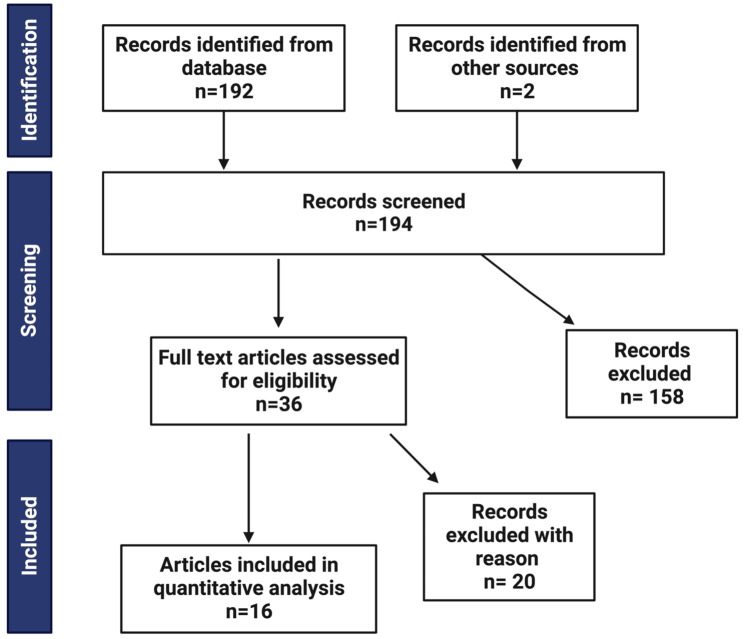
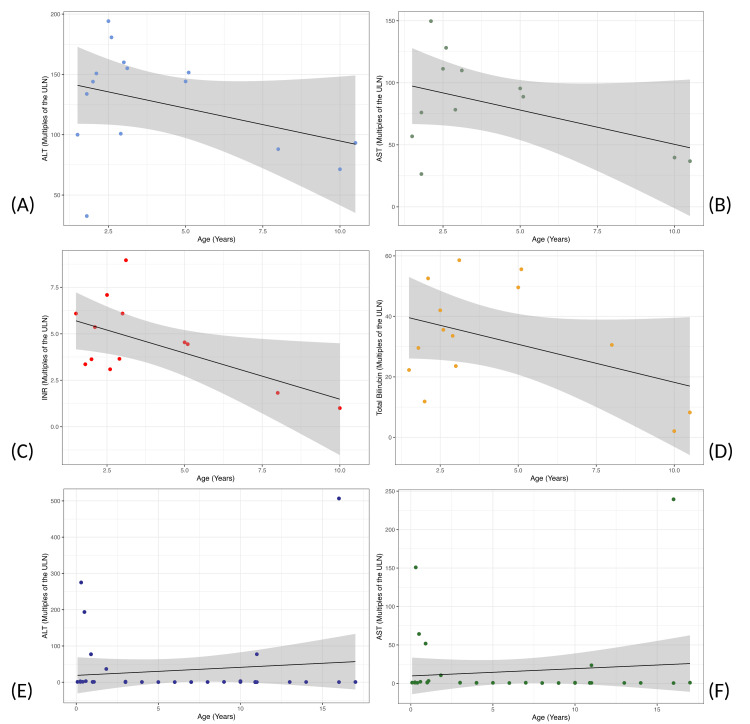
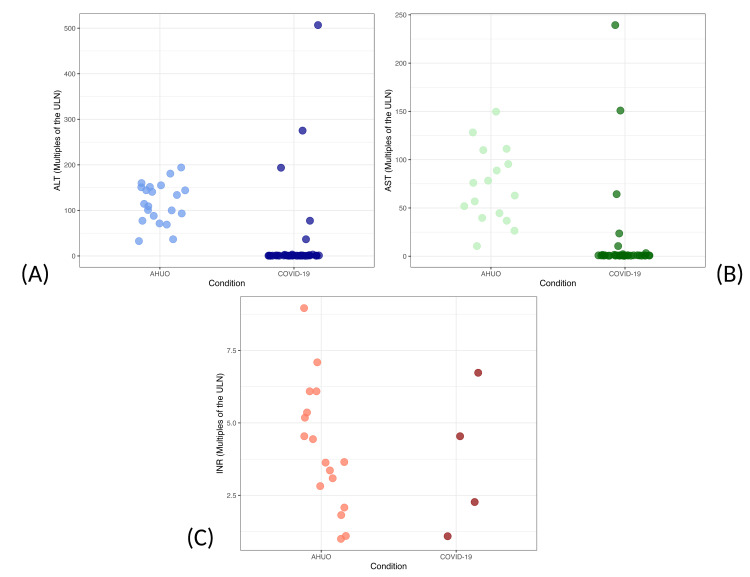
In 2021 and 2022, there were noted to be clusters of pediatric acute hepatitis of unknown origin (AHUO) occurring across the globe. While there was not necessarily a global increase in cases, understanding the pattern of liver injury in AHUO is crucial to properly identify cases of this unexplained phenomenon, especially since it occurred simultaneously with a global resurgence of COVID-19. The objective of this study was to contrast the patterns in liver-relevant biochemical data from COVID-19 patients and AHUO. Studies reporting liver chemistries for cases of AHUO and COVID-19 were identified by a systematic review and search of the literature. For each case, alanine aminotransferase (ALT), aspartate aminotransferase (AST), total bilirubin, direct bilirubin, and international normalized ratio (INR) levels were extracted as available. These were normalized to multiples of the upper limit of normal by patient age. There were statistically significant greater elevations of ALT and AST in patients with AHUO than in those with COVID-19. Only a subset of patients with COVID-19 had an AST or ALT greater than the normal range. INR elevation could be substantial for both conditions but was also statistically higher in the AHUO group. Liver chemistry changes were not statistically correlated with age. The pattern of liver chemistry changes between AHUO and COVID-19 have some distinctions, which suggests that AHUO is not a phenomenon driven primarily by SARS-CoV-2 infection alone. Differentiating AHUO and COVID-19 would be challenging based on patterns of liver chemistry changes alone.
在2021年和2022年,全球出现了多起不明原因的儿童急性肝炎(AHUO)病例群。虽然病例数不一定在全球范围内增加,但了解AHUO中的肝损伤模式对于正确识别这一无法解释现象的病例至关重要,特别是因为它与COVID-19在全球的再度流行同时发生。本研究的目的是对比COVID-19患者和AHUO患者肝脏相关生化数据的模式。通过系统回顾和文献检索,确定了报告AHUO和COVID-19病例肝脏化学指标的研究。对于每个病例,尽可能提取丙氨酸氨基转移酶(ALT)、天冬氨酸氨基转移酶(AST)、总胆红素、直接胆红素和国际标准化比值(INR)水平。这些指标根据患者年龄进行标准化,以正常上限的倍数表示。AHUO患者的ALT和AST升高幅度在统计学上显著高于COVID-19患者。只有一部分COVID-19患者的AST或ALT高于正常范围。两种情况的INR升高都可能很显著,但在AHUO组中在统计学上也更高。肝脏化学指标变化与年龄在统计学上无相关性。AHUO和COVID-19之间肝脏化学指标变化模式存在一些差异,这表明AHUO并非主要由单纯的SARS-CoV-2感染驱动的现象。仅根据肝脏化学指标变化模式来区分AHUO和COVID-19具有挑战性。