College of Grassland, Resource and Environment, Inner Mongolia Agricultural University, 306 Zhaowuda Road, Saihan District, Hohhot, 010019, China.
Institute of Grassland Research, Chinese Academy of Agricultural Science, Hohhot, 010020, China.
BMC Plant Biol. 2024 May 17;24(1):408. doi: 10.1186/s12870-024-05127-z.
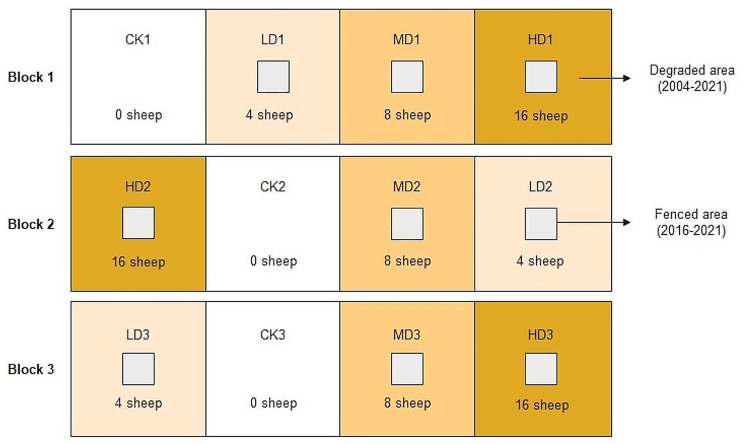
Grazing exclusion is an efficient practice to restore degraded grassland ecosystems by eliminating external disturbances and improving ecosystems' self-healing capacities, which affects the ecological processes of soil-plant systems. Grassland degradation levels play a critical role in regulating these ecological processes. However, the effects of vegetation and soil states at different degradation stages on grassland ecosystem restoration are not fully understood. To better understand this, desert steppe at three levels of degradation (light, moderate, and heavy degradation) was fenced for 6 years in Inner Mongolia, China. Community characteristics were investigated, and nutrient concentrations of the soil (0-10 cm depth) and dominant plants were measured.
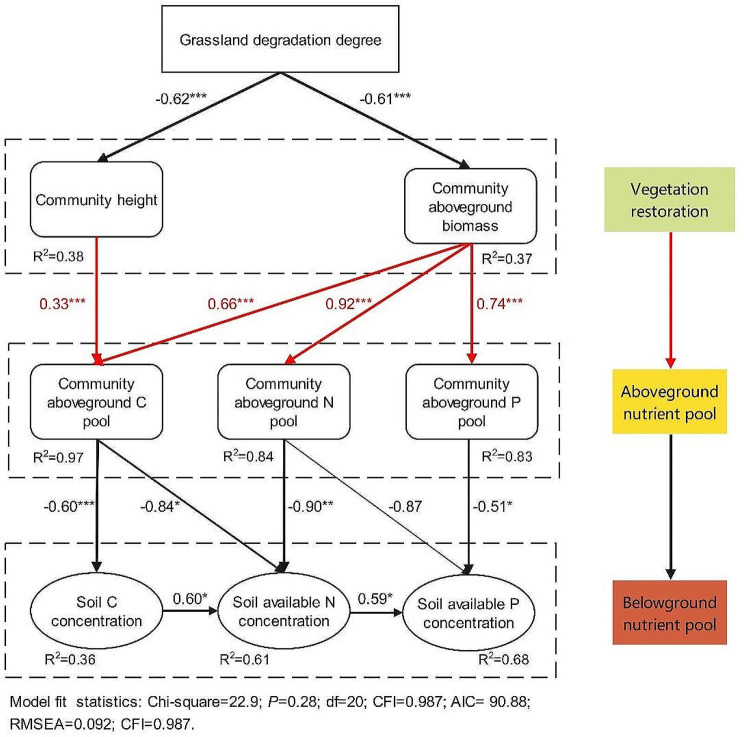
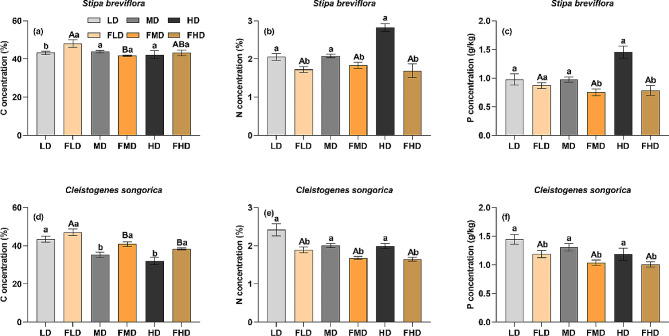
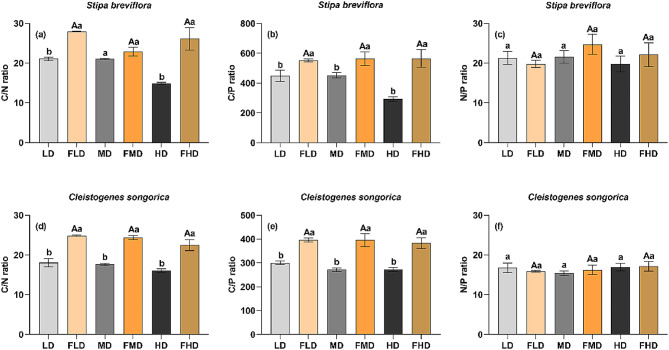
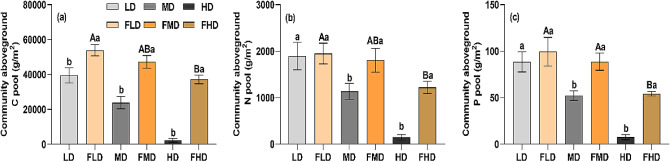
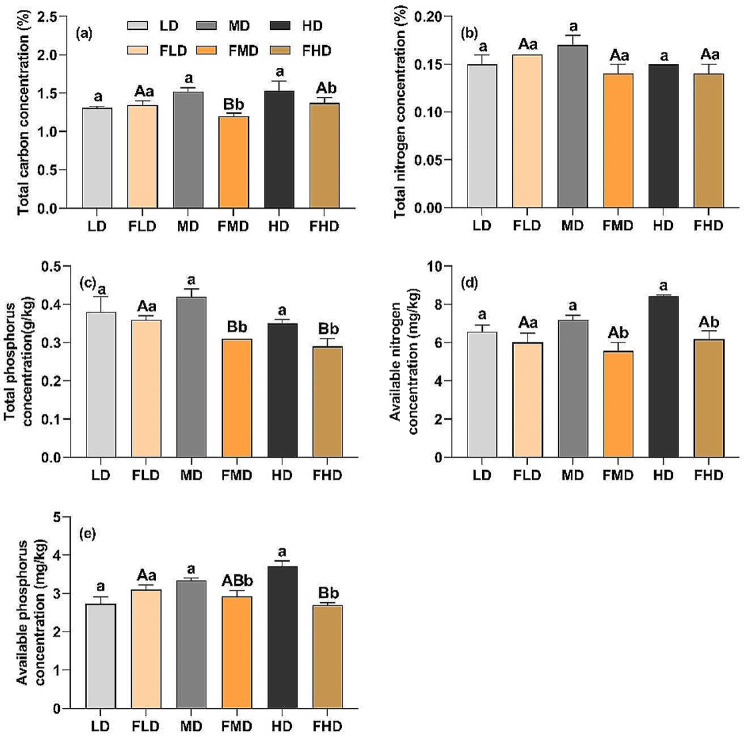
We found that grazing exclusion increased shoots' carbon (C) concentrations, C/N, and C/P, but significantly decreased shoots' nitrogen (N) and phosphorus (P) concentrations for Stipa breviflora and Cleistogenes songorica. Interestingly, there were no significant differences in nutrient concentrations of these two species among the three degraded desert steppes after grazing exclusion. After grazing exclusion, annual accumulation rates of aboveground C, N, and P pools in the heavily degraded area were the highest, but the aboveground nutrient pools were the lowest among the three degraded grasslands. Similarly, the annual recovery rates of community height, cover, and aboveground biomass in the heavily degraded desert steppe were the highest among the three degraded steppes after grazing exclusion. These results indicate that grazing exclusion is more effective for vegetation restoration in the heavily degraded desert steppe. The soil total carbon, total nitrogen, total phosphorus, available nitrogen, and available phosphorus concentrations in the moderately and heavily degraded desert steppes were significantly decreased after six years of grazing exclusion, whereas these were no changes in the lightly degraded desert steppe. Structural equation model analysis showed that the grassland degradation level mainly altered the community aboveground biomass and aboveground nutrient pool, driving the decrease in soil nutrient concentrations and accelerating nutrient transfer from soil to plant community, especially in the heavily degraded grassland.
Our study emphasizes the importance of grassland degradation level in ecosystem restoration and provides theoretical guidance for scientific formulation of containment policies.
放牧禁牧是一种通过消除外部干扰和提高生态系统自我修复能力来恢复退化草地生态系统的有效方法,它会影响土壤-植物系统的生态过程。草地退化程度在调节这些生态过程中起着关键作用。然而,不同退化阶段的植被和土壤状态对草地生态系统恢复的影响还不完全清楚。为了更好地了解这一点,在中国内蒙古对退化程度为轻度、中度和重度的荒漠草原进行了 6 年的围栏封育。调查了群落特征,并测量了土壤(0-10cm 深度)和优势植物的养分浓度。
我们发现,放牧禁牧增加了短花针茅和无芒隐子草地上部分的碳(C)浓度、C/N 和 C/P,但显著降低了地上部分的氮(N)和磷(P)浓度。有趣的是,在放牧禁牧后,这两种植物在三种退化荒漠草原中的养分浓度没有显著差异。放牧禁牧后,重度退化区地上 C、N 和 P 库的年积累速率最高,但三种退化草地中地上养分库最低。同样,在放牧禁牧后,重度退化荒漠草原的群落高度、盖度和地上生物量的年恢复率最高。这些结果表明,放牧禁牧对重度退化荒漠草原的植被恢复更为有效。中度和重度退化荒漠草原的土壤总碳、总氮、总磷、有效氮和有效磷浓度在放牧禁牧六年之后显著下降,而轻度退化荒漠草原则没有变化。结构方程模型分析表明,草地退化程度主要改变了群落地上生物量和地上养分库,导致土壤养分浓度降低,并加速了养分从土壤向植物群落的转移,尤其是在重度退化草地。
本研究强调了草地退化程度在生态系统恢复中的重要性,为科学制定封禁政策提供了理论指导。