Graduate School of Dalian Medical University, Liaoning, 116044, China.
Department of Anesthesiology, Nanjing Medical University Affiliated, Changzhou No. 2 People's Hospital, Changzhou, 213003, China.
J Clin Monit Comput. 2024 Oct;38(5):1079-1087. doi: 10.1007/s10877-024-01165-y. Epub 2024 May 17.
This study aims to analyze the risk factors for early postoperative brain injury in patients undergoing cardiovascular surgery and explore the predictive value of transcranial color Doppler (TCCD) and regional cerebral oxygen saturation (rSO) for detecting early postoperative brain injury in cardiovascular surgery patients.
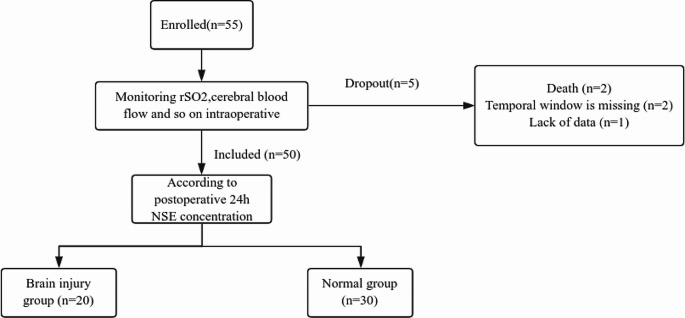
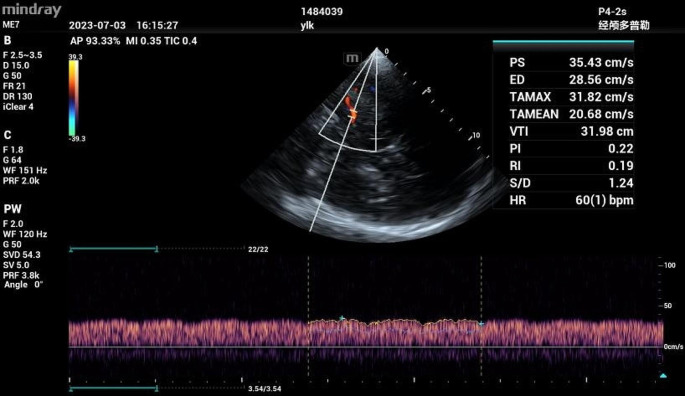
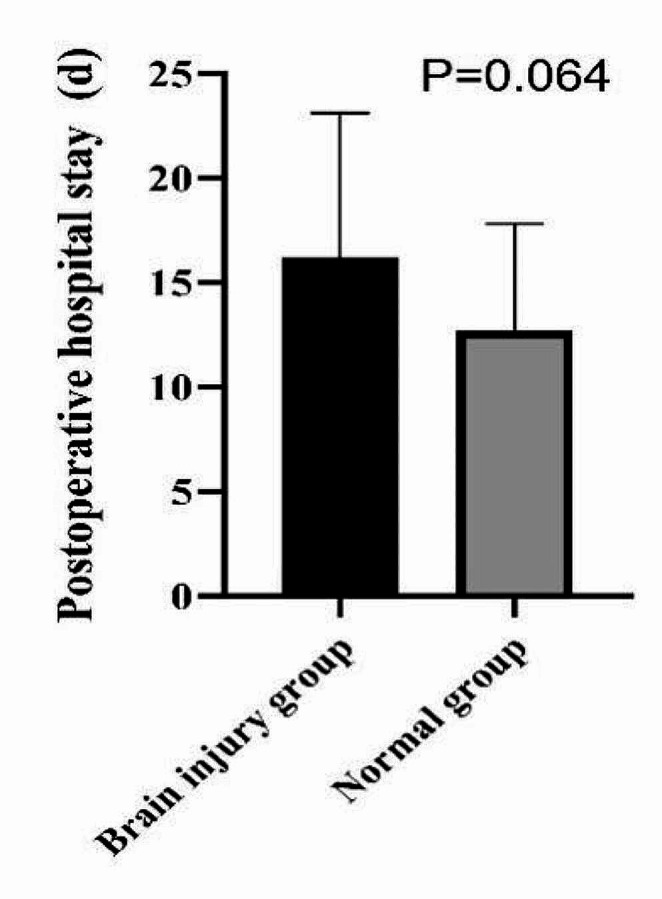
A total of 55 patients undergoing cardiovascular surgery with cardiopulmonary bypass in Changzhou No.2 The People's Hospital of Nanjing Medical University were included in this study. Neuron-specific enolase (NSE) concentration was measured 24 h after operation. Patients were divided into brain injury (NSE ≥ 16.3 ng/mL) and normal (0 < NSE < 16.3 ng/mL) groups according to the measured NSE concentration. The clinical outcomes between the two groups were compared, including decreased rSO and cerebral blood flow (as measured by TCCD) levels. The risk factors of early postoperative brain injury were analyzed by multivariate logistic regression analysis, and the significant variables were analyzed by receiver operating characteristic (ROC) analysis.
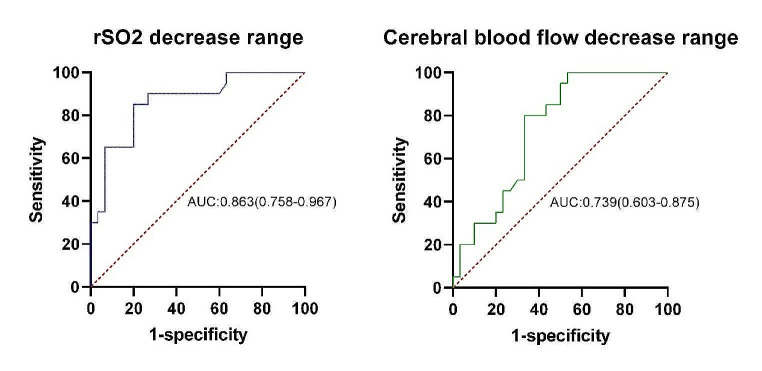
A total of 50 patients were included in this study, with 20 patients in the brain injury group and 30 patients in the normal group. Cardiopulmonary bypass time (min) (107 ± 29 vs. 90 ± 28, P = 0.047) and aortic occlusion time (min) (111 (IQR 81-127) vs. 87 (IQR 72-116), P = 0.010) were significantly longer in the brain injury group than in the normal group. Patients in the brain injury group had greater decreased rSO (%) (27.0 ± 7.3 vs. 17.5 ± 6.1, P < 0.001) and cerebral blood flow (%) (44.9 (IQR 37.8-69.2) vs. 29.1 (IQR 12.0-48.2), P = 0.004) levels. Multivariate logistic regression analysis suggested that decreased rSO and cerebral blood flow levels, aortic occlusion time, and history of atrial fibrillation were independent risk factors for early postoperative brain injury (P < 0.05). ROC analysis reported that the best cutoff values for predicting early postoperative brain injury were 21.4% and 37.4% for decreased rSO and cerebral blood flow levels, respectively (P < 0.05).
The decreased rSO and cerebral blood flow levels, aorta occlusion time, and history of atrial fibrillation were independent risk factors for early postoperative brain injury. TCCD and rSO could effectively monitor brain metabolism and cerebral blood flow and predict early postoperative brain injury.
本研究旨在分析心血管手术患者术后早期脑损伤的危险因素,并探讨经颅彩色多普勒(TCCD)和局部脑氧饱和度(rSO)对检测心血管手术患者术后早期脑损伤的预测价值。
本研究共纳入南京医科大学附属常州第二人民医院行体外循环心血管手术的 55 例患者。术后 24 h 测量神经元特异性烯醇化酶(NSE)浓度。根据测量的 NSE 浓度,患者分为脑损伤(NSE≥16.3 ng/mL)和正常(0<NSE<16.3 ng/mL)组。比较两组的临床结局,包括 rSO 和脑血流(TCCD 测量)水平降低。采用多变量逻辑回归分析术后早期脑损伤的危险因素,对有意义的变量进行受试者工作特征(ROC)分析。
本研究共纳入 50 例患者,其中脑损伤组 20 例,正常组 30 例。脑损伤组的体外循环时间(min)(107±29 比 90±28,P=0.047)和主动脉阻断时间(min)(111(IQR 81-127)比 87(IQR 72-116),P=0.010)明显长于正常组。脑损伤组 rSO 降低百分比(27.0±7.3 比 17.5±6.1,P<0.001)和脑血流降低百分比(44.9(IQR 37.8-69.2)比 29.1(IQR 12.0-48.2),P=0.004)也更高。多变量逻辑回归分析表明,rSO 降低和脑血流降低、主动脉阻断时间、心房颤动史是术后早期脑损伤的独立危险因素(P<0.05)。ROC 分析报告 rSO 和脑血流降低的最佳截断值分别为 21.4%和 37.4%(P<0.05)。
rSO 和脑血流降低、主动脉阻断时间、心房颤动史是术后早期脑损伤的独立危险因素。TCCD 和 rSO 可以有效监测脑代谢和脑血流,预测术后早期脑损伤。