Faculty of Health and Medical Sciences, Department of Biomedical Sciences, University of Copenhagen, Blegdamsvej 3B, 2200 Copenhagen, Denmark.
West German Heart and Vascular Center, Institute of Pharmacology, University Duisburg-Essen, Germany.
Europace. 2024 Jun 3;26(6). doi: 10.1093/europace/euae132.
Pulmonary vein isolation (PVI) is the corner stone of modern rhythm control strategies in patients with atrial fibrillation (AF). Sleep-disordered breathing (SDB) is prevalent in more than 50% of patients undergoing AF ablation, and studies have indicated a greater recurrence rate after PVI in patients with SDB. Herein, we study the effect of catheter-based PVI on AF in a pig model for SDB.
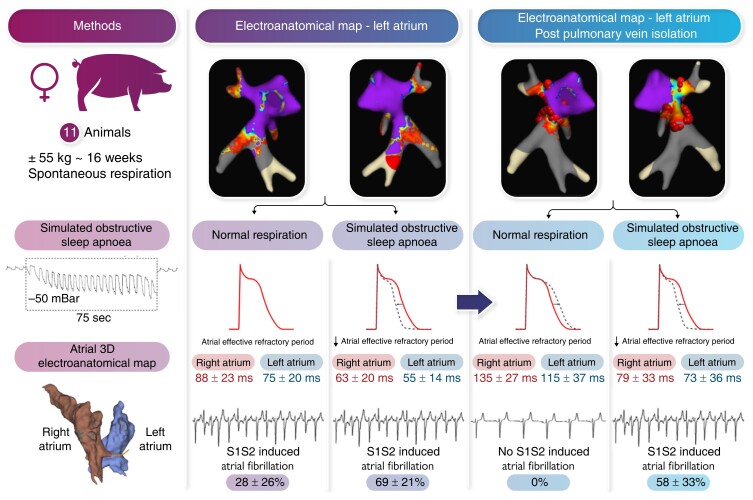
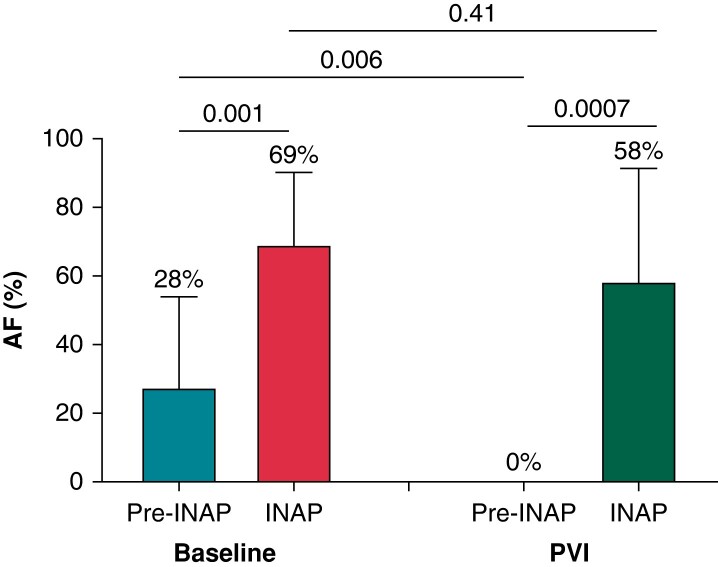
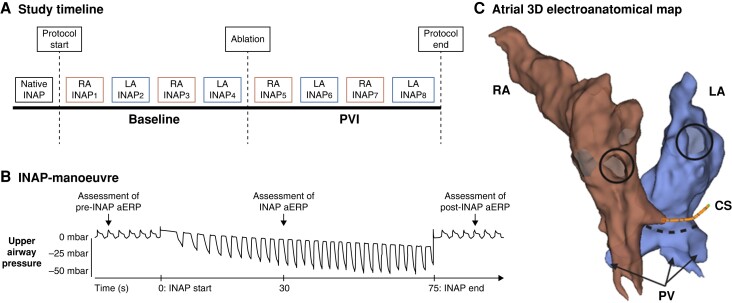
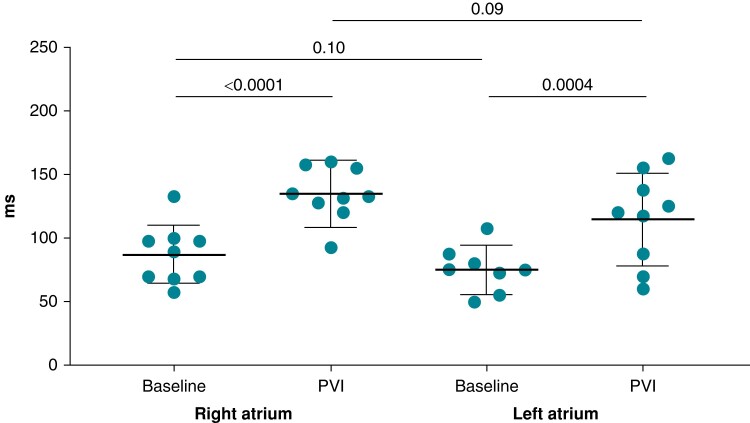
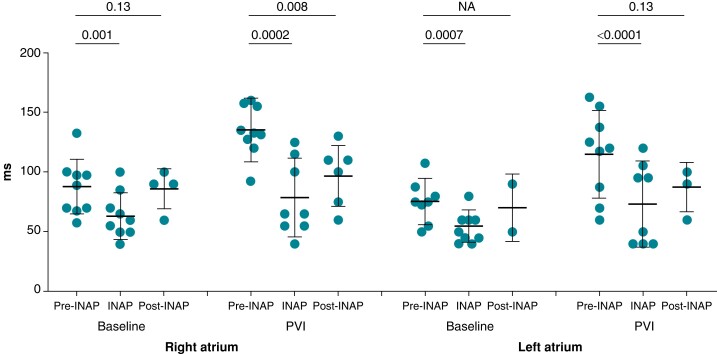
In 11 sedated spontaneously breathing pigs, obstructive apnoeas were simulated by 75 s of intermittent negative upper airway pressure (INAP) applied by a negative pressure device connected to the endotracheal tube. Intermittent negative upper airway pressures were performed before and after PVI. AF-inducibility and atrial effective refractory periods (aERPs) were determined before and during INAP by programmed atrial stimulation. Pulmonary vein isolation prolonged the aERP by 48 ± 27 ms in the right atrium (RA) (P < 0.0001) and by 40 ± 34 ms in the left atrium (LA) (P = 0.0004). Following PVI, AF-inducibility dropped from 28 ± 26% to 0% (P = 0.0009). Intermittent negative upper airway pressure was associated with a transient aERP-shortening (ΔaERP) in both atria, which was not prevented by PVI (INAP indued ΔaERP after PVI in the RA: -57 ± 34 ms, P = 0.0002; in the LA: -42 ± 24 ms, P < 0.0001). Intermittent negative upper airway pressure was associated with a transient increase in AF-inducibility (from 28 ± 26% to 69 ± 21%; P = 0.0008), which was not attenuated by PVI [INAP-associated AF-inducibility after PVI: 58 ± 33% (P = 0.5)].
Transient atrial arrhythmogenic changes related to acute obstructive respiratory events are not prevented by electrical isolation of the pulmonary veins, which partially explains the increased AF recurrence in patients with SDB after PVI procedures.
肺静脉隔离(PVI)是心房颤动(AF)患者现代节律控制策略的基石。睡眠呼吸障碍(SDB)在接受 AF 消融治疗的患者中超过 50%普遍存在,并且研究表明 SDB 患者在 PVI 后复发率更高。在此,我们研究了基于导管的 PVI 在 SDB 猪模型中对 AF 的影响。
在 11 只镇静、自主呼吸的猪中,通过与气管内导管相连的负压装置施加 75s 的间歇性负上气道压力(INAP)来模拟阻塞性呼吸暂停。在 PVI 前后进行间歇性负上气道压力。通过程控心房刺激在 INAP 前后测定 AF 易感性和心房有效不应期(aERP)。PVI 使右心房(RA)的 aERP 延长 48 ± 27ms(P < 0.0001),左心房(LA)延长 40 ± 34ms(P = 0.0004)。PVI 后,AF 易感性从 28 ± 26%降至 0%(P = 0.0009)。间歇性负上气道压力导致两心房的 aERP 短暂缩短(ΔaERP),PVI 并不能预防这种缩短(PVI 后 RA 中 INAP 引起的 ΔaERP:-57 ± 34ms,P = 0.0002;LA:-42 ± 24ms,P < 0.0001)。间歇性负上气道压力与 AF 易感性的短暂增加相关(从 28 ± 26%增加到 69 ± 21%;P = 0.0008),PVI 并不能减弱这种增加[PVI 后 INAP 相关的 AF 易感性:58 ± 33%(P = 0.5)]。
肺静脉电隔离不能预防与急性阻塞性呼吸事件相关的短暂性心房致心律失常变化,这部分解释了 SDB 患者 PVI 后 AF 复发率增加的原因。