Tian Yishu, Zhong Zixing, Dougarem Djouhayna, Sun Litao
Center for Reproductive Medicine, Department of Ultrasound Medicine, Zhejiang Provincial People's Hospital (Affiliated People's Hospital, Hangzhou Medical College), Hangzhou, Zhejiang, China.
Center for Reproductive Medicine, Department of Obstetrics, Zhejiang Provincial People's Hospital (Affiliated People's Hospital, Hangzhou Medical College), Hangzhou, Zhejiang, China.
Heliyon. 2024 May 3;10(9):e30582. doi: 10.1016/j.heliyon.2024.e30582. eCollection 2024 May 15.
To comprehensively evaluate the efficacy of Ultrasound-guided technique for peripheral intravenous catheter placement by nurses in their daily practice.
Peripheral intravenous catheter insertion is a common clinical procedure in healthcare settings. Ultrasound-guided peripheral intravenous placement has emerged in recent decades and was recognized as particularly useful in some specific patient groups.
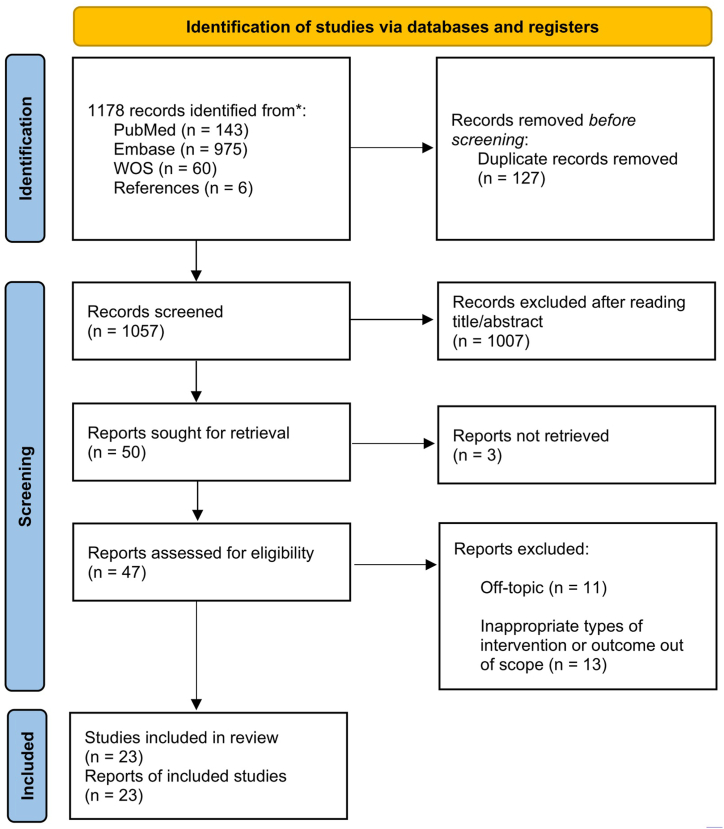
Studies that had compared the ultrasound-guided and traditional approaches were eligible for inclusion and further analysis. The primary outcome was the success rate on the first intravenous insertion attempt. The secondary outcomes included the time needed for successful insertion, and the average number of attempts to establish the IV access. We systematically assess all studies using Cochrane Collaboration's Risk of Bias tool and the Newcastle-Ottawa Scale. We calculated the odds ratio and standardized mean difference with 95 % confidence intervals for the outcomes. Data were analyzed and visualized on Review Manager 5.3.4 and Stata 16.0.
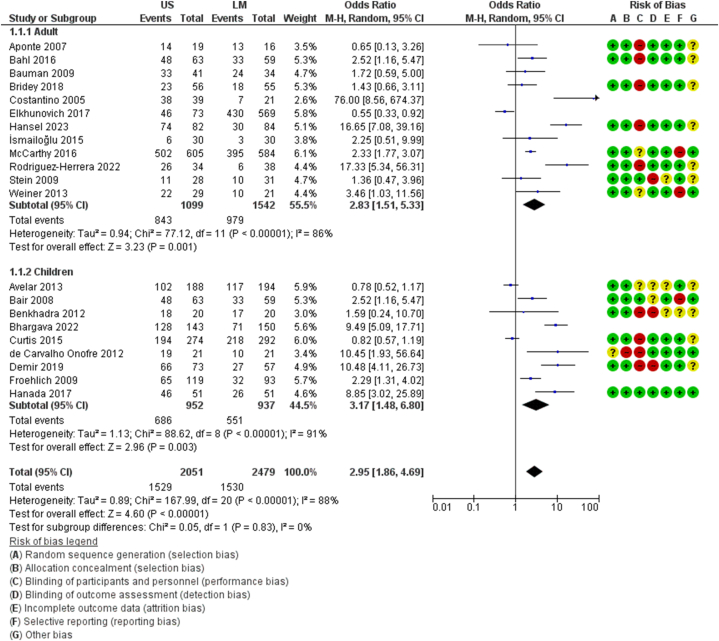
23 studies were included (17 randomized controlled trials and six cohort studies) with a population of 2051 patients offered ultrasound-assisted technique and 2479 treated with the conventional approach for comparison. The former approach was associated with a higher success rate on the first attempt in comparison (OR = 2.95, 95 % CI: 1.86, 4.69). This technique also took less time and less acupuncture to patients' skin (SMD = -0.62, 95 % CI: 1.01, -0.23; SMD = -0.55, 95 % CI: 0.92, -0.18). In the sub-group analyses, children were more likely to benefit from ultrasound guided technique. Ultrasound guided technique demonstrated consistent and significant benefits in emergency clinical settings. Hospitals from different geographical locations exhibited similar trends in the three outcomes. Year of publication and study design revealed inconsistent and insignificant outcomes.
Ultrasound-guided technique can be a safer, faster, and more effective alternative to the traditional approach for nurses to establish intravenous access across different clinical settings and age groups.
全面评估护士在日常实践中采用超声引导技术进行外周静脉置管的疗效。
外周静脉置管是医疗机构中常见的临床操作。近几十年来,超声引导下的外周静脉置管技术应运而生,并被认为在某些特定患者群体中特别有用。
比较超声引导和传统方法的研究符合纳入标准并进行进一步分析。主要结局是首次静脉穿刺尝试的成功率。次要结局包括成功穿刺所需时间以及建立静脉通路的平均尝试次数。我们使用Cochrane协作网的偏倚风险工具和纽卡斯尔-渥太华量表对所有研究进行系统评估。我们计算了结局的比值比和标准化均数差以及95%置信区间。在Review Manager 5.3.4和Stata 16.0上对数据进行分析和可视化处理。
纳入23项研究(17项随机对照试验和6项队列研究),共有2051例患者接受超声辅助技术,2479例采用传统方法进行比较。与传统方法相比,前者首次尝试成功率更高(比值比=2.95,95%置信区间:1.86,4.69)。该技术所需时间也更短,对患者皮肤的针刺次数更少(标准化均数差=-0.62,95%置信区间:-1.01,-0.23;标准化均数差=-0.55,95%置信区间:-0.92,-0.18)。在亚组分析中,儿童更有可能从超声引导技术中获益。超声引导技术在急诊临床环境中显示出一致且显著的益处。不同地理位置的医院在这三个结局方面呈现出相似趋势。发表年份和研究设计显示出不一致且不显著的结果。
对于护士在不同临床环境和年龄组中建立静脉通路而言,超声引导技术相对于传统方法可能是一种更安全、更快且更有效的选择。