Valencia López María José, Stephan Brigitte, Meineke Anna, Wolf Sandra, Thaci Diamant, Mrowietz Ulrich, Andrees Valerie, Rustenbach Stephan Jeff, Reich Kristian, Thalmann Linus, Bogena Henriette, Staubach Petra, von Kiedrowski Ralph Michael, Augustin Matthias
Institute for Health Services Research in Dermatology and Nursing (IVDP), University Medical Center Hamburg-Eppendorf (UKE), Hamburg, Germany.
Institute and Comprehensive Center for Inflammation Medicine, University of Lübeck, Lübeck, Germany.
Psoriasis (Auckl). 2024 May 14;14:29-38. doi: 10.2147/PTT.S451666. eCollection 2024.
Limited data are available characterizing the impact of the SARS-CoV-2 pandemic on psoriasis care for patients in Germany.
To analyze patient perception and impact of the pandemic on well-being and psoriasis management of German patients with moderate-to-severe psoriasis or psoriasis arthritis under systemic therapies.
The CoronaBest registry captures events of SARS-CoV-2 infections and analyzes the impact of the pandemic on patients with psoriasis or psoriasis arthritis. In June 2020, and independently in February 2022, patients with psoriasis or psoriasis arthritis received a standardized questionnaire for current treatment, protective measures, well-being, and individual risks for COVID-19, among others.
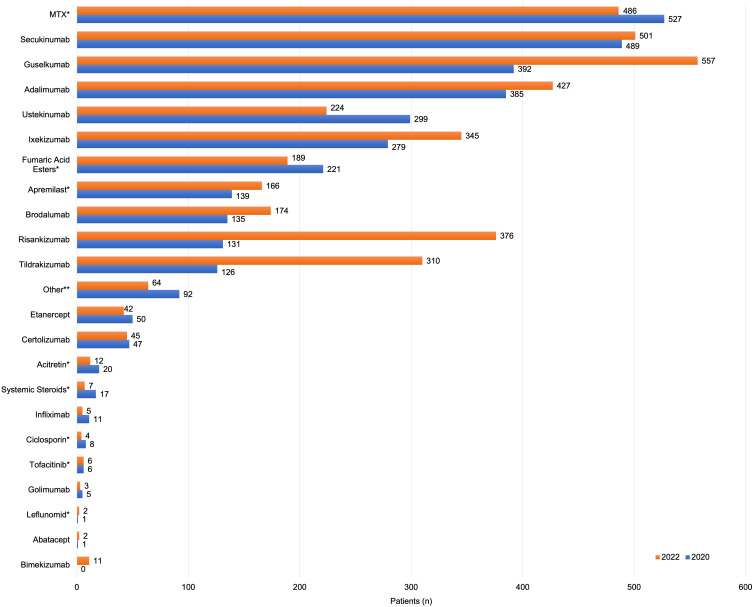
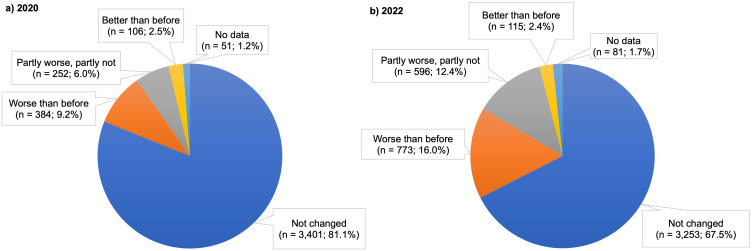
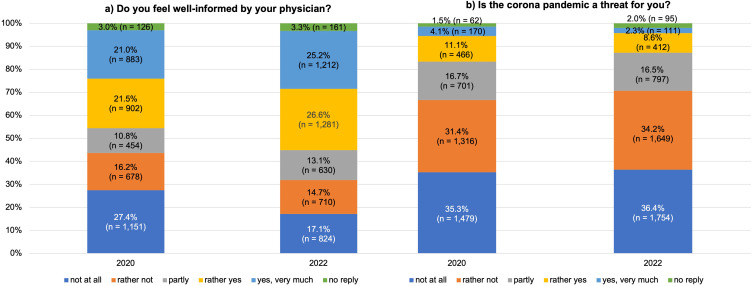
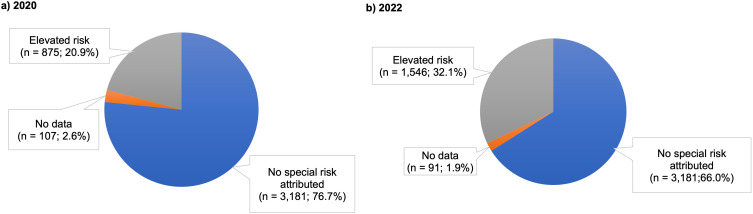
Included were 4,194 patients in 2020 (mean age of 47.7 years and 41.8% women) and 4,818 patients in 2022 (mean age of 56.4 and 42.9% women). Treatment discontinuations were observed in 2.7% and 1.7% of patients in 2020 and 2022, respectively. In the vast majority of the cases (>92%), no additional measures were taken concerning the management of psoriasis treatments in either 2020 or 2022. Those patients with changes reported most frequently: telephone calls instead of face-to-face visits (80.2%, in 2020 vs 40.5% in 2022) or more frequent controls (27.1%, 2020 vs 22.0%, 2022). A majority (66.7%, 2020, and 70.6%, 2022) did not perceive the virus as a considerable threat. The proportion of patients feeling well informed about COVID-19 by physicians increased from 42.6% in 2020 to 51.8% in 2022. About 81.1% of patients in 2020 and 67.5% in 2022 stated that their overall personal condition was not affected due to the pandemic. Physicians attributed no special risk of contracting SARS-CoV-2 in most of the patients.
A high rate of systemic treatment persistence and awareness of risks and protective measures indicate that health care for psoriasis largely followed current national and international recommendations during the COVID-19 pandemic.
关于严重急性呼吸综合征冠状病毒2(SARS-CoV-2)大流行对德国银屑病患者治疗影响的数据有限。
分析患者对大流行的认知以及其对接受全身治疗的德国中重度银屑病或银屑病关节炎患者的幸福感和银屑病管理的影响。
CoronaBest注册库记录SARS-CoV-2感染事件,并分析大流行对银屑病或银屑病关节炎患者的影响。2020年6月以及2022年2月,银屑病或银屑病关节炎患者分别收到一份关于当前治疗、防护措施、幸福感以及感染2019冠状病毒病(COVID-19)的个人风险等内容的标准化问卷。
2020年纳入4194例患者(平均年龄47.7岁,女性占41.8%),2022年纳入4818例患者(平均年龄56.4岁,女性占42.9%)。2020年和2022年分别有2.7%和1.7%的患者中断治疗。在绝大多数情况下(>92%),2020年和2022年在银屑病治疗管理方面均未采取额外措施。报告有变化的患者中,最常见的情况是:采用电话问诊而非面对面就诊(2020年为80.2%,2022年为40.5%)或增加检查频率(2020年为27.1%,2022年为22.0%)。大多数患者(2020年为66.7%,2022年为70.6%)不认为该病毒构成重大威胁。认为医生让其充分了解COVID-19的患者比例从2020年的42.6%增至2022年的51.8%。2020年约81.1%的患者和2022年67.5%的患者表示其总体个人状况未受大流行影响。医生认为大多数患者感染SARS-CoV-2无特殊风险。
全身治疗持续率高以及对风险和防护措施的认知表明,在COVID-19大流行期间,银屑病的医疗护理基本遵循了当前国家和国际建议。