Kalita Iva R, Kannusamy Veena, Mouttapa Fredrick, Singh Harsh V
Department of Ophthalmology, A.I.I.M.S., Guwahati, Assam, India.
Paediatric Ophthalmology and Strabismus Service, Aravind Eye Hospital, Pondicherry, India.
Indian J Ophthalmol. 2024 Dec 1;72(12):1745-1749. doi: 10.4103/IJO.IJO_2471_23. Epub 2024 May 20.
This study was conducted in continuation of Primary Eyecare in Paediatrics Population (PREPP-I) and was aimed to assess parents' satisfaction with pediatric-eye-care services across six vision centers (VCs) of a tertiary eye hospital in Southern India. The barriers among the parents for not attending the base hospital (BH) when referred from these VCs were also evaluated.
A standard-validated-satisfaction questionnaire (VSQ) was used to assess patient satisfaction. Responses were assessed on a 5-point Likert scale: 0 (very dissatisfied) to 4 (very satisfied) against each response. Responses were expressed as percentages with 0 (very dissatisfied) and 100% (very satisfied). Patients were referred with a form mentioning reasons for referral (urgent/non-urgent). All referrals were evaluated by the principal investigator. In case of failure to report, parents were enquired about the barrier based on the validated barrier questionnaire (VBQ) over a telephonic conversation.
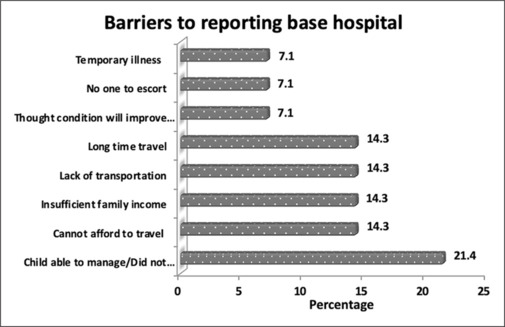
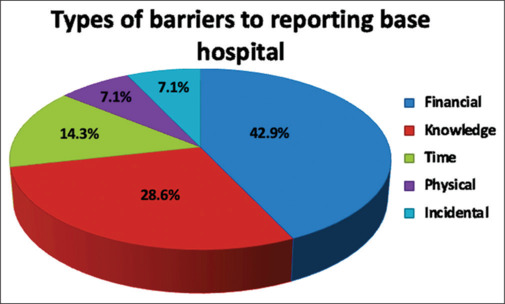
All 250 patients of the PREPP-1 study were included in the satisfaction study. Different domains were evaluated using VSQ (accessibility of VC, waiting hours, financial aspects, spectacle dispensing service, and teleophthalmology). The overall satisfaction was 75%. The most common reason for dissatisfaction was the lack of meeting the ophthalmologist in person, followed by waiting time. 58 patients wanted to visit BH to consult a pediatric ophthalmologist in person (23%). For the barrier study, 14 out of 47 referrals did not report and were evaluated using VBQ (knowledge, physical, time, and financial barriers). The majority had a financial barrier (43%), followed by knowledge (28.6%) and time barrier (14%).
PREPP-II demonstrated that 3/4 th of pediatric patients are happy to be treated at VC with teleophthalmology services. However, a significant percentage want to consult a specialist at BH. One-fourth of total referrals did not report to BH due to financial constraints and a lack of awareness of the child's condition.
本研究是《儿科人群初级眼保健》(PREPP - I)的延续,旨在评估印度南部一家三级眼科医院的六个视力中心(VC)的家长对儿科眼保健服务的满意度。同时还评估了这些视力中心转诊后家长未前往总院(BH)的障碍因素。
采用标准效度验证的满意度问卷(VSQ)评估患者满意度。根据5分李克特量表对回答进行评估:每个回答对应0(非常不满意)至4(非常满意)。回答以百分比表示,0(非常不满意)和100%(非常满意)。患者转诊时会附上一份提及转诊原因(紧急/非紧急)的表格。所有转诊均由首席研究员进行评估。若患者未报到,通过电话联系家长,依据效度验证的障碍问卷(VBQ)询问障碍因素。
PREPP - 1研究的所有250名患者均纳入满意度研究。使用VSQ评估不同领域(视力中心的可达性、等待时间、财务方面、眼镜配镜服务和远程眼科)。总体满意度为75%。最常见的不满原因是未能亲自见到眼科医生,其次是等待时间。58名患者希望前往总院亲自咨询儿科眼科医生(23%)。对于障碍因素研究,47例转诊中有14例未报到,使用VBQ进行评估(知识、身体、时间和财务障碍)。大多数存在财务障碍(43%),其次是知识障碍(28.6%)和时间障碍(14%)。
PREPP - II表明,四分之三的儿科患者乐于在视力中心接受远程眼科服务治疗。然而,相当比例的患者希望在总院咨询专科医生。由于经济限制和对孩子病情缺乏了解,转诊患者中有四分之一未前往总院报到。