Department of Epidemiology, College of Public Health and Health Professions University of Florida, Gainesville.
College of Medicine, University of Florida, Gainesville.
JAMA Netw Open. 2024 May 1;7(5):e2411987. doi: 10.1001/jamanetworkopen.2024.11987.
Recent studies in Canadian and Mexican populations suggest an association of higher prenatal fluoride exposure with poorer neurobehavioral development, but whether this association holds for US-based populations is unknown.
To examine associations of third trimester maternal urinary fluoride (MUF) with child neurobehavior at age 3 years in the US.
DESIGN, SETTING, AND PARTICIPANTS: This prospective cohort study utilized urine samples archived from 2017 to 2020 and neurobehavioral data assessed from 2020 to 2023 from the Maternal and Developmental Risks from Environmental and Social Stressors (MADRES) pregnancy cohort, which consisted of predominately Hispanic women residing in Los Angeles, California. Cohort eligibility criteria at recruitment included being 18 years of age or older, less than 30 weeks' gestation, and a fluent English or Spanish speaker. Exclusion criteria included having a disability preventing participation or provision of informed consent, being HIV positive or incarcerated, and having a multiple gestation pregnancy. There were 263 mother-child pairs who completed the 3-year study visit. In this analysis, women who reported prenatal smoking were excluded. Data analysis was conducted from October 2022 to March 2024.
Specific gravity-adjusted MUF (MUFSG), a biomarker of prenatal fluoride exposure.
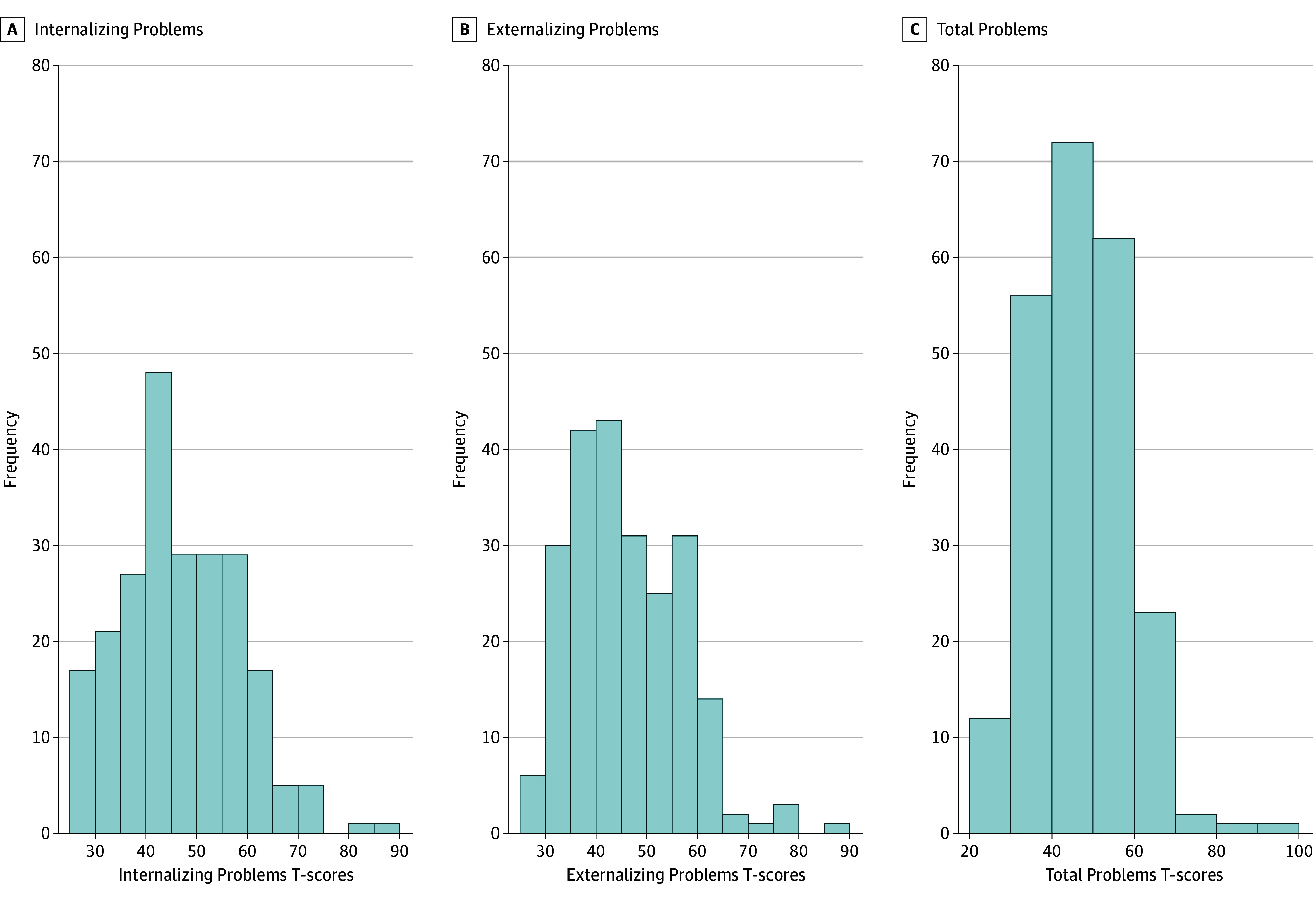
Neurobehavior was quantified using the Preschool Child Behavior Checklist (CBCL), which included composite scores for Total Problems, Internalizing Problems, and Externalizing Problems. CBCL composite T scores range from 28 to 100. T scores from 60 to 63 are in the borderline clinical range, whereas scores above 63 are in the clinical range. Linear and logistic regression models adjusted for covariates were conducted.
A total of 229 mother-child pairs (mean [SD] maternal age, 29.45 [5.67] years; 116 female children [50.7%] and 113 male children [49.3%]) who had MUFSG measured were included in the study. Median (IQR) MUFSG was 0.76 (0.51-1.19) mg/L, and 32 participants (14.0%) had a Total Problems T score in the borderline clinical or clinical range. A 1-IQR (0.68 mg/L) increase in MUFSG was associated with nearly double the odds of the Total Problems T score being in the borderline clinical or clinical range (odds ratio, 1.83; 95% CI, 1.17-2.86; P = .008), as well as with a 2.29-point increase in T score for the Internalizing Problems composite (B = 2.29; 95% CI, 0.47-4.11; P = .01) and a 2.14-point increase in T score for the Total Problems composite (B = 2.14; 95% CI, 0.29-3.98; P = .02).
In this prospective cohort study of mother-child pairs in Los Angeles, California, prenatal fluoride exposure was associated with increased neurobehavioral problems. These findings suggest that there may be a need to establish recommendations for limiting fluoride exposure during the prenatal period.
最近在加拿大和墨西哥人群中进行的研究表明,较高的产前氟暴露与神经行为发育较差有关,但这种关联是否适用于美国人群尚不清楚。
在美国人群中,检查第三孕期母体尿液氟化物(MUF)与 3 岁儿童神经行为之间的关联。
设计、地点和参与者:这项前瞻性队列研究利用了 2017 年至 2020 年存档的尿液样本和 2020 年至 2023 年从母亲和发育风险来自环境和社会压力源(MADRES)妊娠队列评估的神经行为数据,该队列主要由居住在加利福尼亚州洛杉矶的西班牙裔女性组成。招募时的队列入选标准包括年龄在 18 岁或以上、妊娠不到 30 周、能流利讲英语或西班牙语。排除标准包括有残疾妨碍参与或提供知情同意、HIV 阳性或被监禁、以及多胎妊娠。共有 263 对母子完成了 3 年的研究访问。在这项分析中,排除了报告产前吸烟的女性。数据分析于 2022 年 10 月至 2024 年 3 月进行。
特异性重量调整后的 MUF(MUFSG),产前氟暴露的生物标志物。
使用学前儿童行为检查表(CBCL)量化神经行为,该检查表包括总问题、内部化问题和外部化问题的综合评分。CBCL 综合 T 分数范围从 28 到 100。60 到 63 的 T 分数处于边缘临床范围,而高于 63 的分数处于临床范围。进行了调整协变量的线性和逻辑回归模型。
共有 229 对母子(平均[标准差]母亲年龄,29.45[5.67]岁;116 名女性儿童[50.7%]和 113 名男性儿童[49.3%])纳入了研究。中位数(IQR)MUFSG 为 0.76(0.51-1.19)mg/L,32 名参与者(14.0%)的总问题 T 分数处于边缘临床或临床范围内。MUFSG 增加 1-IQR(0.68mg/L)与总问题 T 分数处于边缘临床或临床范围内的几率几乎增加一倍(比值比,1.83;95%置信区间,1.17-2.86;P=0.008),以及内部化问题综合评分增加 2.29 分(B=2.29;95%置信区间,0.47-4.11;P=0.01)和总问题综合评分增加 2.14 分(B=2.14;95%置信区间,0.29-3.98;P=0.02)。
在加利福尼亚州洛杉矶的这项前瞻性母子队列研究中,产前氟暴露与神经行为问题增加有关。这些发现表明,可能需要制定限制产前氟暴露的建议。