
揭开模仿面纱:色素性紫癜样蕈样肉芽肿最初误诊为色素性紫癜的具有挑战性的诊断
Mimicry unveiled: The challenging diagnosis of pigmented purpura-like mycosis fungoides initially misdiagnosed as pigmented purpura.
作者信息
Aryal Sabita, Zhu-Qian Jiang, Qiang Liu Ye, Haque Md Ariful
机构信息
Department of Dermatology, Shanghai Skin Diseases Hospital Tongji University Shanghai China.
Shanghai Skin Diseases Hospital, School of Medicine Tongji University Shanghai China.
出版信息
Clin Case Rep. 2024 May 20;12(5):e8847. doi: 10.1002/ccr3.8847. eCollection 2024 May.
KEY CLINICAL MESSAGE
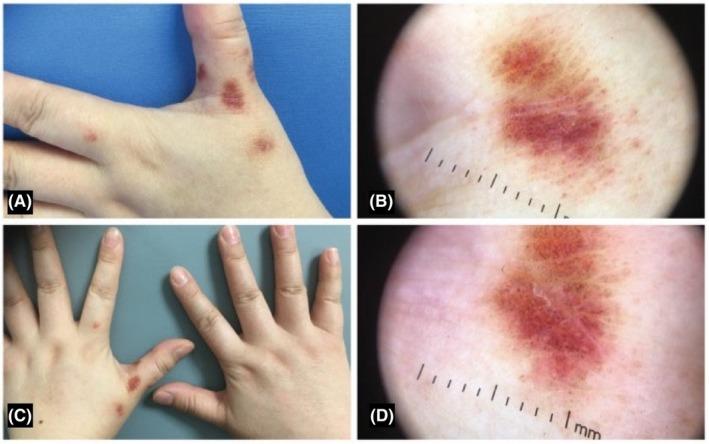
Unlike most cases, the lesions were localized to the dorsum of the hand, lacked pruritus (itching), and did not exhibit "sperm-like blood vessels," which are typically pathognomonic to classical MF.
ABSTRACT
The study presents a rare case involving a 44-year-old woman who developed a skin condition on the base of her left thumb. Initially misdiagnosed as pigmented purpura, the need for further investigation arose to determine the nature of the condition accurately. The medical evaluation encompassed a comprehensive analysis of the patient's skin ailment. A series of diagnostic examinations were conducted to ascertain the underlying cause. Although routine blood tests yielded unremarkable results, the distinct characteristics of the rash prompted a more thorough investigation. Subsequent assessment revealed that the skin condition was not pigmented purpura, as initially presumed, but rather a manifestation of cutaneous T-cell lymphoma (CTCL) known as mycosis fungoides (MF). MF is an infrequent lymphoma predominantly affecting individuals aged 45-65, exhibiting a male-to-female sex ratio of 2:1. The annual incidence of MF ranges from 0.3 to 0.96 cases per 100,000 individuals. The woman's skin exhibited discrete patches adorned with colored dots, progressively thickening and pigmentation. Notably, the absence of pruritus did not dispel suspicion. This case underscores the significance of accurately diagnosing uncommon dermatological disorders to facilitate appropriate medical intervention. The unique appearance of the rash and its distinctive features, despite normal blood results, enabled the identification of MF. The patient's treatment encompassed a combination of steroids and narrowband UV therapy. Vigilance, continued research, and heightened awareness are paramount for early intervention and improved patient outcomes. Such efforts contribute to an enhanced understanding of the complexities of this condition.
关键临床信息
与大多数病例不同,这些皮损局限于手背,无瘙痒症状,且未出现典型蕈样肉芽肿(MF)所特有的“精子样血管”。
摘要
本研究报告了一例罕见病例,一名44岁女性左手拇指基部出现皮肤病变。最初被误诊为色素性紫癜,因此需要进一步检查以准确确定病情性质。医学评估包括对患者皮肤疾病的全面分析。进行了一系列诊断检查以查明潜在病因。尽管常规血液检查结果无异常,但皮疹的独特特征促使进行更深入的调查。随后的评估显示,皮肤状况并非如最初推测的色素性紫癜,而是一种称为蕈样肉芽肿(MF)的皮肤T细胞淋巴瘤(CTCL)表现。MF是一种罕见的淋巴瘤,主要影响45至65岁的人群,男女比例为2:1。MF的年发病率为每10万人0.3至0.96例。该女性的皮肤出现散在的斑块,伴有彩色斑点,逐渐增厚并色素沉着。值得注意的是,无瘙痒症状并不能消除疑虑。该病例强调了准确诊断罕见皮肤病以促进适当医疗干预的重要性。尽管血液检查结果正常,但皮疹的独特外观及其特征有助于识别MF。患者的治疗包括类固醇和窄谱紫外线疗法。警惕、持续研究和提高认识对于早期干预和改善患者预后至关重要。这些努力有助于加深对这种疾病复杂性的理解。

 Zotero 插件