Uneno Yu, Fukuyama Keita, Nishimura Ayumi, Eguchi Kana, Kojima Hideki, Umino Takeshi, Miyazaki Kikuko, Negora Eiju, Minashi Keiko, Sugiyama Osamu, Shimazu Taichi, Muto Manabu, Matsumoto Shigemi
Department of Medical Oncology, Graduate School of Medicine, Kyoto University, Kyoto, JPN.
Division of Medical Information Technology and Administration Planning, Kyoto University Hospital, Kyoto, JPN.
Cureus. 2024 Apr 19;16(4):e58611. doi: 10.7759/cureus.58611. eCollection 2024 Apr.
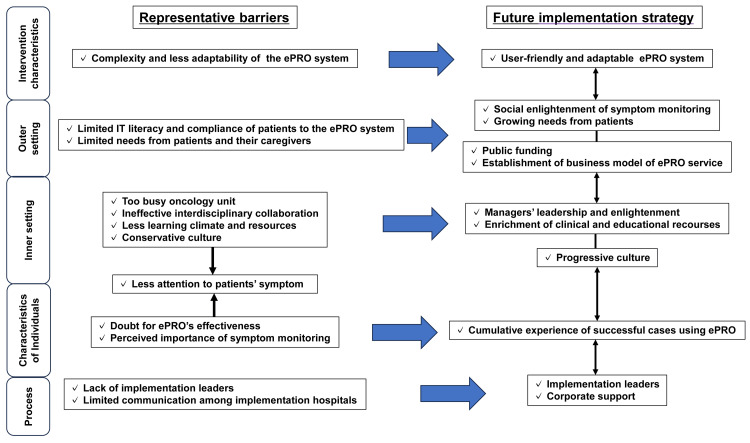
Background and objective Implementing electronic patient-reported outcomes (ePROs) in oncology practice has shown substantial clinical benefits. However, it can be challenging in routine practice, warranting strategies to adapt to different clinical contexts. In light of this, this study aimed to describe the implementation process of the ePRO system and elucidate the provider-level implementation barriers and facilitators to a novel ePRO system at cancer hospitals in Japan. Methods We implemented an ePRO system linked to electronic medical records at three cancer hospitals. Fifteen patients with solid cancers at the outpatient oncology unit were asked to regularly complete the Patient-Reported Outcomes version of the Common Terminology Criteria for Adverse Events (PRO-CTCAE™) questionnaire and European Organization for Research and Treatment Core Quality of Life questionnaire (EORTC QLQ C30) by using the smartphone app between October 2021 and June 2022. Thirteen healthcare professionals were interviewed to identify implementation barriers and facilitators to the ePRO system by using the Consolidated Framework for Implementation Research framework. Results The healthcare professionals identified a lack of clinical resources and a culture and system that emphasizes treatment over care as the main barriers; however, the accumulation of successful cases, the leadership of managers, and the growing needs of patients can serve as facilitators to the implementation. Conclusions Our experience implementing an ePRO system in a few Japanese oncology practices revealed comprehensive barriers and facilitators. Further efforts are warranted to develop more successful implementation strategies.
背景与目的 在肿瘤学实践中实施电子患者报告结局(ePROs)已显示出显著的临床益处。然而,在常规实践中可能具有挑战性,需要采取策略以适应不同的临床环境。有鉴于此,本研究旨在描述ePRO系统的实施过程,并阐明日本癌症医院中新型ePRO系统在提供者层面的实施障碍和促进因素。方法 我们在三家癌症医院实施了一个与电子病历相关联的ePRO系统。2021年10月至2022年6月期间,要求肿瘤门诊科室的15名实体癌患者使用智能手机应用程序定期完成不良事件通用术语标准患者报告结局版本(PRO-CTCAE™)问卷和欧洲癌症研究与治疗组织核心生活质量问卷(EORTC QLQ C30)。通过使用实施研究综合框架,对13名医疗保健专业人员进行了访谈,以确定ePRO系统的实施障碍和促进因素。结果 医疗保健专业人员将临床资源的缺乏以及强调治疗而非护理的文化和系统确定为主要障碍;然而,成功案例的积累、管理人员的领导作用以及患者不断增长的需求可作为实施的促进因素。结论 我们在日本一些肿瘤学实践中实施ePRO系统的经验揭示了全面的障碍和促进因素。有必要进一步努力制定更成功的实施策略。