Lachmann Björn, Schweigert Michael, Almeida Ana Beatriz, Spieth Stephanie, Rössel Thomas, Richter Torsten
Department of Anaesthesiology and Intensive Care Medicine, University Hospital Carl Gustav Carus Dresden, Technische Universität Dresden, Fetscherstr. 74, 01307, Dresden, Germany.
Department of Thoracic Surgery, University Hospital Schleswig-Holstein, Campus Lübeck, Ratzeburger Allee 160, 23538, Lübeck, Germany.
Surg Case Rep. 2024 May 22;10(1):127. doi: 10.1186/s40792-024-01930-w.
Mediastinal paragangliomas are rare. Their dangerousness may unfold during surgery, especially if hormonal activity was previously unknown. We report our experience with this case in context to the incidence and localization of atypically located mediastinal paragangliomas in the literature.
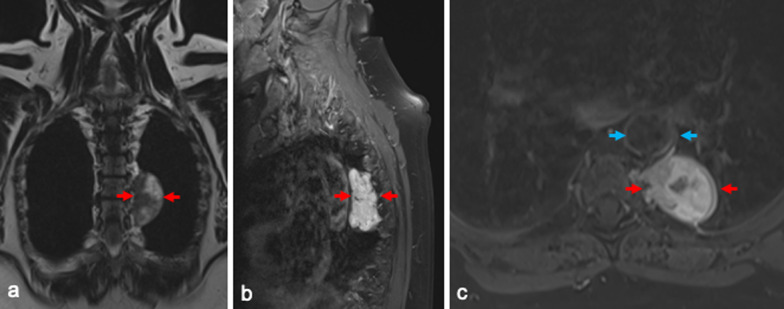
A 69-year-old female patient who was scheduled for thoracoscopic resection due to a posterior mediastinal tumor that had been progressing in size for several years and increasing symptoms. The induction of anesthesia, the ventilation of the lungs and the gas exchange after lung separation was uneventful. After initially stable circulatory conditions, there was a sudden increase in blood pressure up to 300/130 mmHg and tachycardia up to 130/min. This hypertensive phase was difficult to influence and required a rapid and consistent use of antihypertensive medication to bring down the blood pressure to reasonable values. The patient stabilized after tumor resection. The postoperative course was unremarkable. During the intraoperative blood pressure crisis, blood was drawn for analysis. These samples showed elevated concentrations of normetanephrine and metanephrine. The tumor subsequently presented as a catecholamine-secreting paraganglioma.
In order to avoid life-threatening blood pressure crises, hormone activity should be ruled out preoperatively in the case of mediastinal tumor, in which a paraganglioma could be considered in the differential diagnosis, especially if there are indications of hypertension in the medical history. Robotic-assisted thoracoscopic resection of the posterior mediastinal tumor was a feasible surgical method, even in the case of unexpected functional paraganglioma.
纵隔副神经节瘤较为罕见。其危险性可能在手术过程中显现,尤其是在之前未知其激素活性的情况下。我们结合文献中不典型定位的纵隔副神经节瘤的发病率和定位情况,报告我们对该病例的经验。
一名69岁女性患者,因后纵隔肿瘤多年来体积不断增大且症状加重,计划行胸腔镜切除术。麻醉诱导、肺通气及肺分离后的气体交换过程顺利。最初循环状况稳定后,血压突然升至300/130 mmHg,心率加快至130次/分钟。这个高血压阶段难以控制,需要迅速且持续使用抗高血压药物将血压降至合理水平。肿瘤切除后患者病情稳定。术后病程平稳。术中血压危机期间,采集血液进行分析。这些样本显示去甲肾上腺素和肾上腺素浓度升高。该肿瘤随后被诊断为分泌儿茶酚胺的副神经节瘤。
为避免危及生命的血压危机,对于纵隔肿瘤,在鉴别诊断中可能考虑副神经节瘤时,尤其是病史中有高血压迹象时,术前应排除激素活性。即使是意外发现的功能性副神经节瘤,机器人辅助胸腔镜切除后纵隔肿瘤也是一种可行的手术方法。