Zhang Haiguang, Xing Jiajian, Wei Gaoliang, Wang Xu, Chen Shuo, Quan Xie
Key Laboratory of Industrial Ecology and Environmental Engineering (Ministry of Education, China), School of Environmental Science and Technology, Dalian University of Technology, Dalian, 116024, China.
Nat Commun. 2024 May 21;15(1):4324. doi: 10.1038/s41467-024-48681-8.
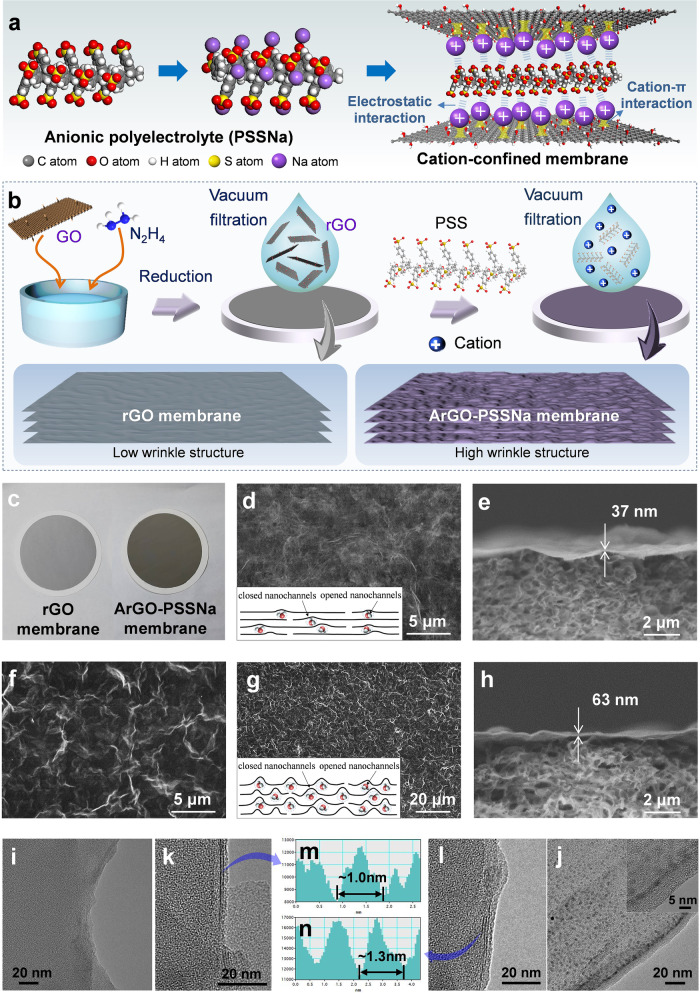
Constructing nanolaminate membranes made of two-dimensional graphene oxide nanosheets has gained enormous interest in recent decades. However, a key challenge facing current graphene-based membranes is their poor rejection for monovalent salts due to the swelling-induced weak nanoconfinement and the transmembrane co-transport of anions and cations. Herein, we propose a strategy of electrostatic-induced ion-confined partitioning in a reduced graphene oxide membrane for breaking the correlation of anions and cations to suppress anion-cation co-transport, substantially improving the desalination performance. The membrane demonstrates a rejection of 95.5% for NaCl with a water permeance of 48.6 L m h bar in pressure-driven process, and it also exhibits a salt rejection of 99.7% and a water flux of 47.0 L m h under osmosis-driven condition, outperforming the performance of reported graphene-based membranes. The simulation and calculation results unveil that the strong electrostatic attraction of membrane forces the hydrated Na to undergo dehydration and be exclusively confined in the nanochannels, strengthening the intra-nanochannel anion/cation partitioning, which refrains from the dynamical anion-cation correlations and thereby prevents anions and cations from co-transporting through the membrane. This study provides guidance for designing advanced desalination membranes and inspires the future development of membrane-based separation technologies.
近几十年来,构建由二维氧化石墨烯纳米片制成的纳米层压膜引起了极大的关注。然而,当前基于石墨烯的膜面临的一个关键挑战是,由于溶胀导致的纳米限域作用较弱以及阴离子和阳离子的跨膜共转运,它们对单价盐的截留率较低。在此,我们提出了一种在还原氧化石墨烯膜中通过静电诱导离子限域分配的策略,以打破阴离子和阳离子的相关性,抑制阴离子 - 阳离子共转运,从而大幅提高脱盐性能。在压力驱动过程中,该膜对氯化钠的截留率为95.5%,水渗透通量为48.6 L m⁻² h⁻¹ bar⁻¹;在渗透驱动条件下,它还表现出99.7%的盐截留率和47.0 L m⁻² h⁻¹的水通量,优于已报道的基于石墨烯的膜的性能。模拟和计算结果表明,膜的强静电吸引力迫使水合钠离子脱水并仅局限于纳米通道中,加强了纳米通道内阴离子/阳离子的分配,抑制了动态的阴离子 - 阳离子相关性,从而防止阴离子和阳离子通过膜共转运。这项研究为设计先进的脱盐膜提供了指导,并激发了基于膜的分离技术的未来发展。