Department of Medical Education and Research, Kaohsiung Veterans General Hospital, Kaohsiung, Taiwan.
Evidence-based Medicine Center, Chung Shan Medical University Hospital, Taichung, Taiwan.
Int J Med Sci. 2024 Apr 8;21(6):994-1002. doi: 10.7150/ijms.93457. eCollection 2024.
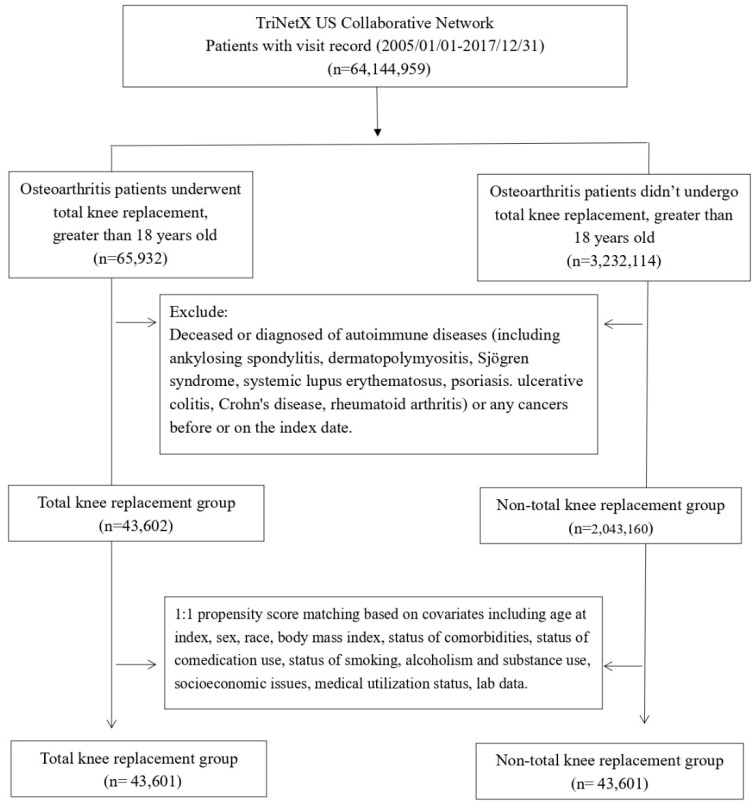
Complications of total knee arthroplasty (TKA) had been widely discussed. However, whether TKA influence risk of rheumatoid arthritis (RA) in osteoarthritis patients remained uncertain. We intend to evaluate the risk of RA in osteoarthritis patients underwent TKA. In this retrospective cohort study, data was retrieved from the US collaborative networks in TriNetX research network. Within the study period between 2005 and 2017, osteoarthritis patients underwent TKA were enrolled as case cohort whereas osteoarthritis patients never underwent TKA were enrolled as control cohort. Covariates were matched via propensity score matching. Risk of RA in TKA patients were valuated under various follow-up time and sensitivity models. Under 1-year, 3-year and 5-year of follow-up, TKA patients were associated with significantly elevated risk of RA, especially under 1-year follow-up (HR=1.74; 95% CI, 1.39-2.18). Subgroup analysis demonstrated a significant increase in the risk of RA following TKA in the female subgroup (HR=1.42; 95% CI, 1.24-1.63), the subgroup aged 18-64 years (HR=1.48; 95% CI, 1.11-1.97), and the subgroup aged greater than 65 years old (HR=1.38; 95% CI, 1.21-1.58) based on 5-year follow-up. Clinicians should be concerned about uncharted association between TKA and RA reported our current study. Additional prospective studies and in-depth mechanistic inquiries were warranted to determine the causation.
全膝关节置换术(TKA)的并发症已被广泛讨论。然而,TKA 是否会增加骨关节炎患者发生类风湿关节炎(RA)的风险仍不确定。我们旨在评估 TKA 对骨关节炎患者发生 RA 的风险。
在这项回顾性队列研究中,数据来自美国 TriNetX 研究网络的合作网络。在 2005 年至 2017 年的研究期间,接受 TKA 的骨关节炎患者被纳入病例队列,而从未接受 TKA 的骨关节炎患者被纳入对照组。通过倾向评分匹配对协变量进行匹配。在各种随访时间和敏感性模型下评估 TKA 患者发生 RA 的风险。
在 1 年、3 年和 5 年的随访中,TKA 患者发生 RA 的风险显著升高,尤其是在 1 年的随访中(HR=1.74;95%CI,1.39-2.18)。亚组分析表明,女性亚组(HR=1.42;95%CI,1.24-1.63)、18-64 岁亚组(HR=1.48;95%CI,1.11-1.97)和大于 65 岁亚组(HR=1.38;95%CI,1.21-1.58)在 5 年的随访中接受 TKA 后,RA 的风险显著增加。
根据我们目前的研究结果,临床医生应该关注 TKA 和 RA 之间未被发现的关联。需要进行额外的前瞻性研究和深入的机制研究,以确定病因。