Institute of Inflammation and Ageing, University of Birmingham, Birmingham B15 2WB, UK.
Royal Orthopaedic Hospital, Bristol Road, Birmingham B31 2AP, UK.
Cell Rep Med. 2024 May 21;5(5):101574. doi: 10.1016/j.xcrm.2024.101574.
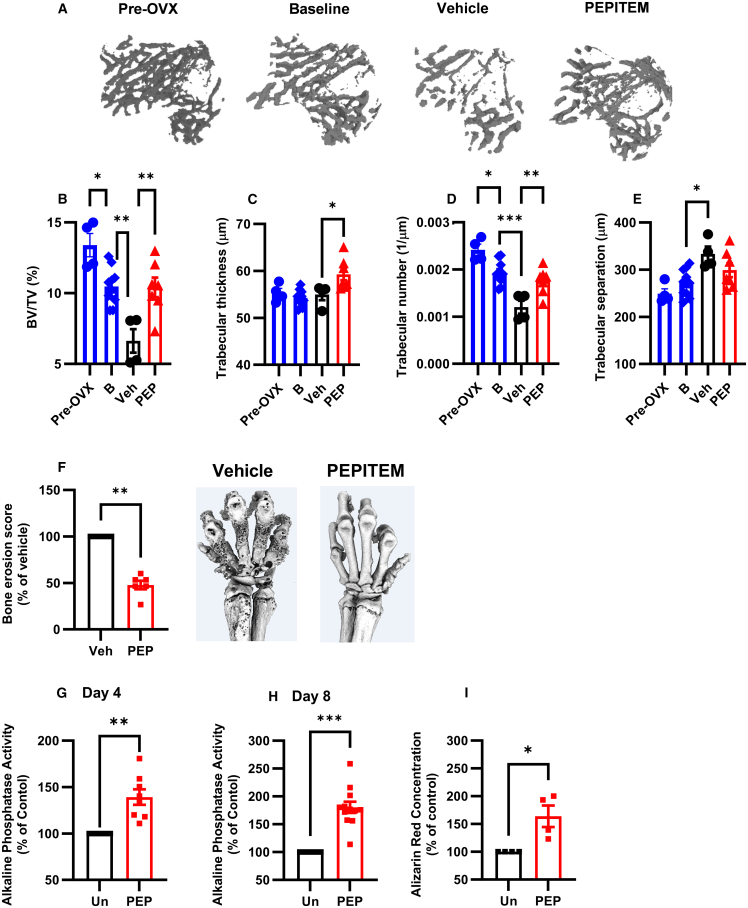
The existing suite of therapies for bone diseases largely act to prevent further bone loss but fail to stimulate healthy bone formation and repair. We describe an endogenous osteopeptide (PEPITEM) with anabolic osteogenic activity, regulating bone remodeling in health and disease. PEPITEM acts directly on osteoblasts through NCAM-1 signaling to promote their maturation and formation of new bone, leading to enhanced trabecular bone growth and strength. Simultaneously, PEPITEM stimulates an inhibitory paracrine loop: promoting osteoblast release of the decoy receptor osteoprotegerin, which sequesters RANKL, thereby limiting osteoclast activity and bone resorption. In disease models, PEPITEM therapy halts osteoporosis-induced bone loss and arthritis-induced bone damage in mice and stimulates new bone formation in osteoblasts derived from patient samples. Thus, PEPITEM offers an alternative therapeutic option in the management of diseases with excessive bone loss, promoting an endogenous anabolic pathway to induce bone remodeling and redress the imbalance in bone turnover.
现有的骨疾病治疗方法主要用于防止进一步的骨质流失,但不能刺激健康的骨形成和修复。我们描述了一种内源性的骨肽(PEPITEM),它具有合成代谢成骨活性,调节健康和疾病中的骨重塑。PEPITEM 通过 NCAM-1 信号直接作用于成骨细胞,促进其成熟和新骨形成,从而增强小梁骨生长和强度。同时,PEPITEM 刺激抑制旁分泌环:促进成骨细胞释放诱饵受体骨保护素,从而隔离 RANKL,从而限制破骨细胞的活性和骨吸收。在疾病模型中,PEPITEM 治疗可阻止骨质疏松症引起的小鼠骨丢失和关节炎引起的骨损伤,并刺激源自患者样本的成骨细胞中的新骨形成。因此,PEPITEM 为治疗过度骨质流失的疾病提供了一种替代治疗选择,促进了内源性合成代谢途径,诱导骨重塑,并纠正骨转换的不平衡。