Pediatric Gastroenterology Institute, "Dana-Dwek" Children's Hospital, Tel Aviv Sourasky Medical Center and the Faculty of Medicine, Tel Aviv University, 6 Weizmann Street, 6423906, Tel Aviv, Israel.
Department of Clinical Science and Education and Department of Gastroenterology, Sachs Children and Youth Hospital, Karolinska Institute, Stockholm, Sweden.
Paediatr Drugs. 2024 Sep;26(5):609-617. doi: 10.1007/s40272-024-00631-z. Epub 2024 May 23.
Current data on ustekinumab therapy in children with ulcerative colitis (UC) or unclassified inflammatory bowel disease (IBDU) are limited. We aimed to evaluate the effectiveness and safety of ustekinumab in pediatric UC and IBDU.
This multicenter retrospective study included 16 centers affiliated with the IBD Interest and Porto groups of ESPGHAN. Children with UC or IBDU treated with ustekinumab were enrolled. Demographic, clinical, laboratory, endoscopic, and imaging data as well as adverse events were recorded. Analyses were all based on the intention-to-treat principle.
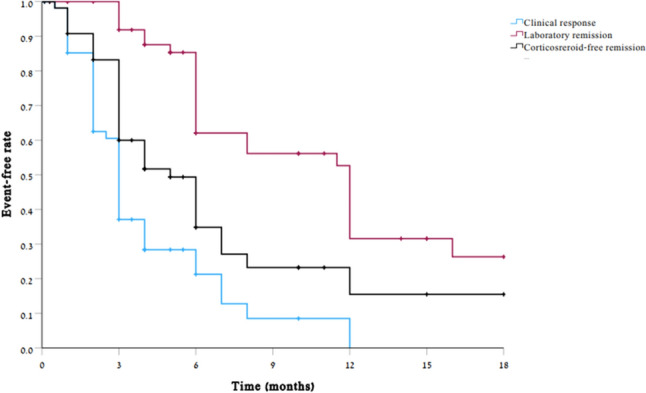
Fifty-eight children (39 UC and 19 IBDU, median age 14.5 [IQR 11.5-16.5] years) were included. All had failed biologic therapies, and 38 (66%) had failed two or more biologics. Corticosteroid-free clinical remission (CFR) was observed in 27 (47%), 33 (57%), and 37 (64%) children at 16, 26, and 52 weeks, respectively. Normalization of C-reactive protein and calprotectin < 150 μg/g were achieved in 60% and 52%, respectively, by 52 weeks. Endoscopic and radiologic remissions were reached in 8% and 23%, respectively. The main predictors of CFR were diagnosis of UC compared with IBDU (hazard ratio [HR] 2.2, 95% CI 1.03-4.85; p = 0.041) and no prior vedolizumab therapy (HR 2.1, 95% CI 1.11-4.27; p = 0.023). Ustekinumab serum levels were not associated with disease activity. Adverse events were recorded in six (10%) children, leading to discontinuation of the drug in three.
Based on these findings, ustekinumab appears as an effective therapy for pediatric refractory UC and IBDU. The potential efficacy should be weighed against the risks of serious adverse events.
目前关于乌司奴单抗治疗溃疡性结肠炎(UC)或未分类炎症性肠病(IBDU)患儿的数据有限。我们旨在评估乌司奴单抗在儿科 UC 和 IBDU 中的疗效和安全性。
这是一项多中心回顾性研究,纳入了 ESPGHAN 的 IBD 兴趣组和波尔图组的 16 个中心。招募了接受乌司奴单抗治疗的 UC 或 IBDU 患儿。记录了人口统计学、临床、实验室、内镜和影像学数据以及不良事件。所有分析均基于意向治疗原则。
共纳入 58 名患儿(39 例 UC 和 19 例 IBDU,中位年龄 14.5 [IQR 11.5-16.5] 岁)。所有患儿均曾接受过生物制剂治疗失败,其中 38 例(66%)曾接受过两种或以上生物制剂治疗失败。16 周、26 周和 52 周时,分别有 27(47%)、33(57%)和 37(64%)例患儿达到无皮质类固醇的临床缓解(CFR)。52 周时,分别有 60%和 52%的患儿 C 反应蛋白和钙卫蛋白恢复正常(<150μg/g)。内镜和影像学缓解率分别为 8%和 23%。CFR 的主要预测因素为 UC 诊断(与 IBDU 相比,危险比 [HR] 2.2,95%CI 1.03-4.85;p=0.041)和无既往维得利珠单抗治疗(HR 2.1,95%CI 1.11-4.27;p=0.023)。乌司奴单抗血清水平与疾病活动度无关。有 6 名(10%)患儿出现不良事件,其中 3 名患儿因药物不良反应而停止治疗。
根据这些发现,乌司奴单抗似乎是治疗儿科难治性 UC 和 IBDU 的有效药物。在权衡潜在疗效时,应考虑严重不良事件的风险。