Mu Xin, Lei Ru, Yan Shuqing, Deng Zixin, Liu Ran, Liu Tiangang
Key Laboratory of Combinatorial Biosynthesis and Drug Discovery, Ministry of Education and School of Pharmaceutical Sciences, Wuhan University, Wuhan, 430072, Hubei Province, China.
State Key Laboratory of Microbial Metabolism, Joint International Research Laboratory of Metabolic and Developmental Sciences, School of Life Sciences and Biotechnology, Shanghai Jiao Tong University, Shanghai, 200030, China.
Synth Syst Biotechnol. 2024 May 10;9(4):609-617. doi: 10.1016/j.synbio.2024.05.001. eCollection 2024 Dec.
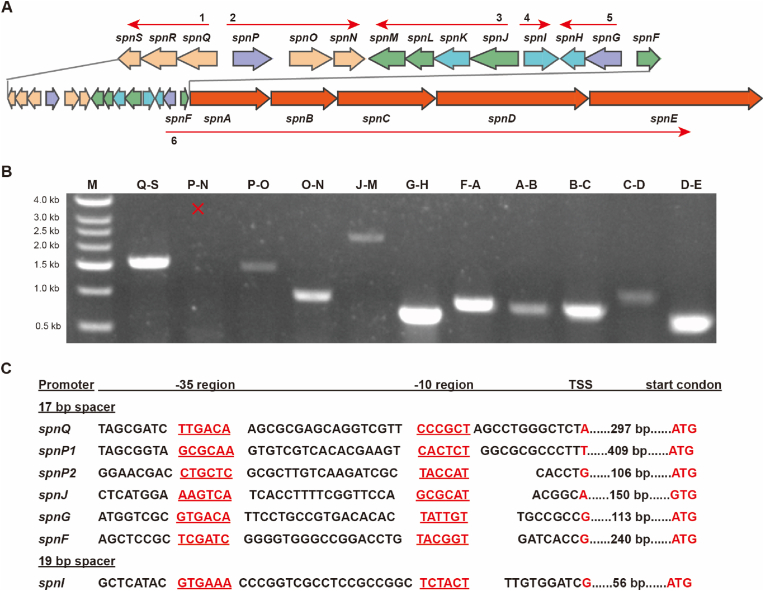
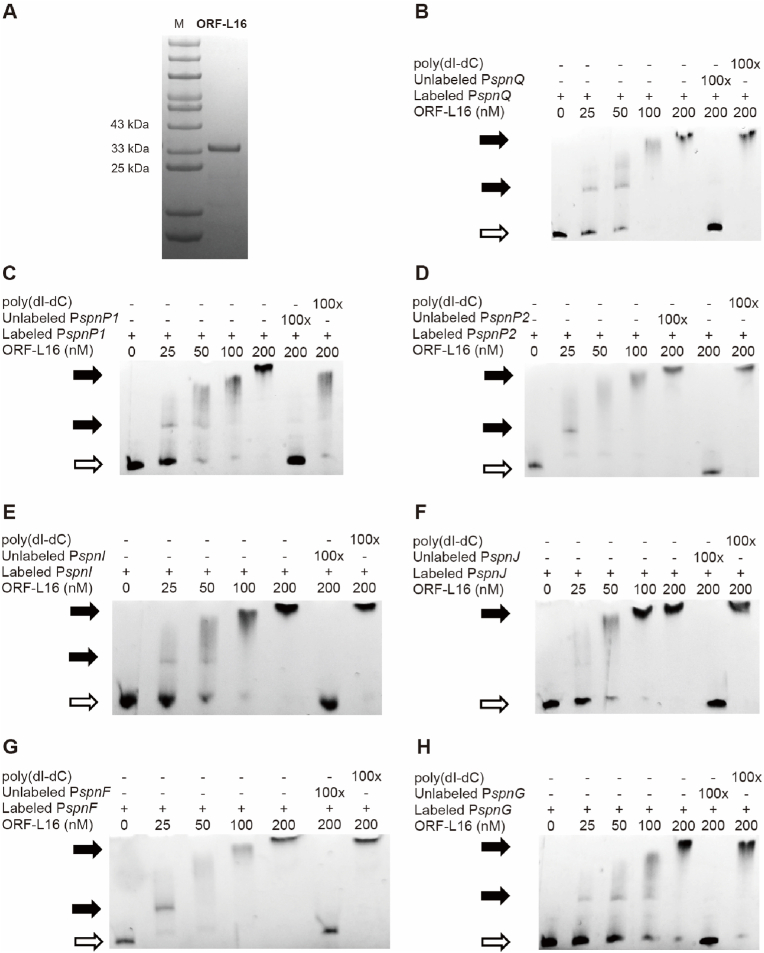
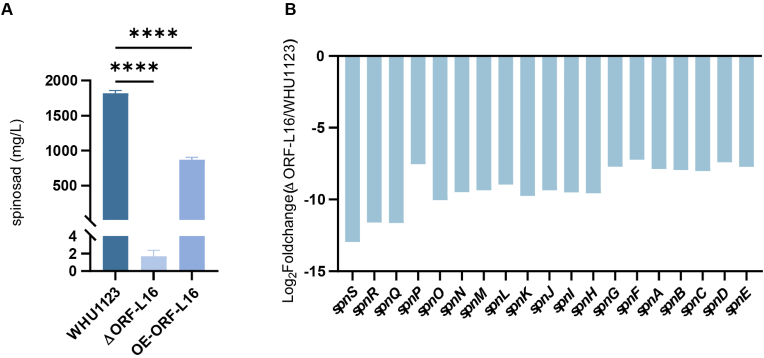
Spinosad, a potent broad-spectrum bioinsecticide produced by , has significant market potential. Despite its effectiveness, the regulatory mechanisms of spinosad biosynthesis remain unclear. Our investigation identified the crucial role of the LysR family transcriptional regulator ORF-L16, located upstream of spinosad biosynthetic genes, in spinosad biosynthesis. Through reverse transcription PCR (RT-PCR) and 5'-rapid amplification of cDNA ends (5'-Race), we unveiled that the spinosad biosynthetic gene cluster (BGC) contains six transcription units and seven promoters. Electrophoretic mobility shift assays (EMSAs) demonstrated that ORF-L16 bound to seven promoters within the spinosad BGC, indicating its involvement in regulating spinosad biosynthesis. Notably, deletion of led to a drastic reduction in spinosad production from 1818.73 mg/L to 1.69 mg/L, accompanied by decreased transcription levels of spinosad biosynthetic genes, confirming its positive regulatory function. Additionally, isothermal titration calorimetry (ITC) and EMSA confirmed that spinosyn A, the main product of the spinosad BGC, served as an effector of ORF-L16. Specifically, it decreased the binding affinity between ORF-L16 and spinosad BGC promoters, thus exerting negative feedback regulation on spinosad biosynthesis. This research enhances our comprehension of spinosad biosynthesis regulation and lays the groundwork for future investigations on transcriptional regulators in .
多杀菌素是由[具体产生菌]产生的一种高效广谱生物杀虫剂,具有巨大的市场潜力。尽管其效果显著,但多杀菌素生物合成的调控机制仍不清楚。我们的研究确定了位于多杀菌素生物合成基因上游的LysR家族转录调节因子ORF-L16在多杀菌素生物合成中的关键作用。通过逆转录PCR(RT-PCR)和5'-cDNA末端快速扩增(5'-Race),我们发现多杀菌素生物合成基因簇(BGC)包含六个转录单元和七个启动子。电泳迁移率变动分析(EMSA)表明,ORF-L16与多杀菌素BGC内的七个启动子结合,表明其参与调控多杀菌素的生物合成。值得注意的是,[具体缺失部分]的缺失导致多杀菌素产量从1818.73mg/L急剧降至1.69mg/L,同时多杀菌素生物合成基因的转录水平降低,证实了其正调控功能。此外,等温滴定量热法(ITC)和EMSA证实,多杀菌素BGC的主要产物多杀菌素A作为ORF-L16的效应物。具体而言,它降低了ORF-L16与多杀菌素BGC启动子之间的结合亲和力,从而对多杀菌素生物合成施加负反馈调节。这项研究增强了我们对多杀菌素生物合成调控的理解,并为未来对[具体研究对象]中转录调节因子的研究奠定了基础。