
铜聚合物纳米反应器融入铜代谢以促进慢性糖尿病伤口愈合。
Cupric-polymeric nanoreactors integrate into copper metabolism to promote chronic diabetic wounds healing.
作者信息
Tang Qi, Tan Yinqiu, Leng Shaolong, Liu Qi, Zhu Linyu, Wang Cuifeng
机构信息
School of Pharmaceutical Sciences, Sun Yat-sen University, Guangzhou 510006, China.
Department of Neurosurgery, Union Hospital, Tongji Medical College, Huazhong University of Science and Technology, 1277 Jiefang Avenue, Wuhan 430022, China.
出版信息
Mater Today Bio. 2024 May 11;26:101087. doi: 10.1016/j.mtbio.2024.101087. eCollection 2024 Jun.
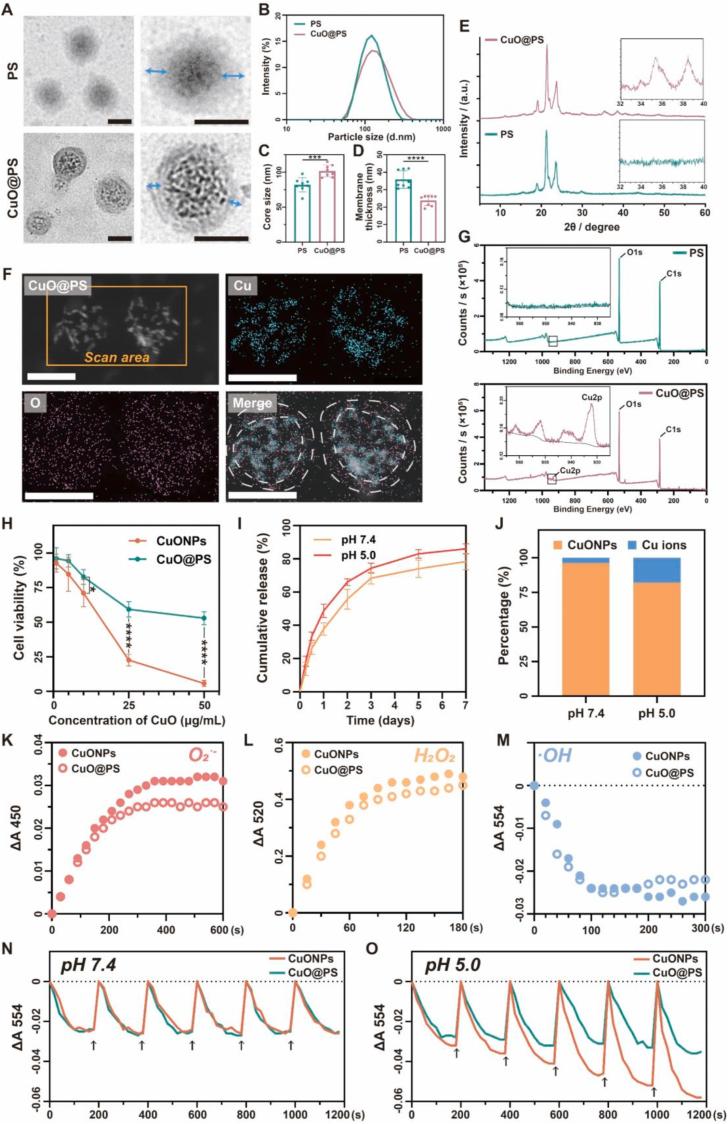
Given multifunction of copper (Cu) contributing to all stages of the physiology of wound healing, Cu-based compounds have great therapeutic potentials to accelerate the wound healing, but they must be limited to a very low concentration range to avoid detrimental accumulation. Additionally, the cellular mechanism of Cu-based compounds participating the healing process remains elusive. In this study, copper oxide nanoparticles (CuONPs) were synthesized to mimic the multiple natural enzymes and trapped into PEG--PCL polymersomes (PS) to construct cupric-polymeric nanoreactors (CuO@PS) via a direct hydration method, thus allowing to compartmentalize Cu-based catalytic reactions in an isolated space to improve the efficiency, selectivity, recyclability as well as biocompatibility. While nanoreactors trafficked to lysosomes following endocytosis, the released Cu-based compounds in lysosomal lumen drove a cytosolic Cu influx to mobilize Cu metabolism mostly via Atox1-ATP7a/b-Lox axis, thereby activating the phosphorylation of mitogen-activated protein kinase 1 and 2 (MEK1/2) to initiate downstream signaling events associated with cell proliferation, migration and angiogenesis. Moreover, to facilitate to lay on wounds, cupric-polymeric nanoreactors were finely dispersed into a thermosensitive Pluronic F127 hydrogel to form a composite hydrogel sheet that promoted the healing of chronic wounds in diabetic rat models. Hence, cupric-polymeric nanoreactors represented an attractive translational strategy to harness cellular Cu metabolism for chronic wounds healing.
鉴于铜(Cu)在伤口愈合生理的各个阶段都具有多种功能,铜基化合物在加速伤口愈合方面具有巨大的治疗潜力,但必须将其限制在非常低的浓度范围内,以避免有害积累。此外,铜基化合物参与愈合过程的细胞机制仍不清楚。在本研究中,合成了氧化铜纳米颗粒(CuONPs)以模拟多种天然酶,并通过直接水合法将其捕获到聚乙二醇-聚己内酯聚合物囊泡(PS)中,构建铜基聚合物纳米反应器(CuO@PS),从而能够在隔离空间中分隔基于铜的催化反应,以提高效率、选择性、可回收性以及生物相容性。当纳米反应器通过内吞作用转运到溶酶体时,溶酶体腔内释放的铜基化合物促使胞质铜流入,主要通过Atox1-ATP7a/b-Lox轴调动铜代谢,从而激活丝裂原活化蛋白激酶1和2(MEK1/2)的磷酸化,启动与细胞增殖、迁移和血管生成相关的下游信号事件。此外,为便于敷于伤口上,将铜基聚合物纳米反应器精细分散到热敏性泊洛沙姆F127水凝胶中,形成复合水凝胶片,促进糖尿病大鼠模型中慢性伤口的愈合。因此,铜基聚合物纳米反应器代表了一种利用细胞铜代谢促进慢性伤口愈合的有吸引力的转化策略。




 Zotero 插件