
肌腱与沟的比例是否与肱二头肌长头肌腱疾病风险升高相关?——一种用于肱二头肌长头肌腱病靶向诊断的术前磁共振成像分析新方法。
Is the Tendon-to-Groove Ratio Associated with Elevated Risk for LHB Tendon Disorders?-A New Approach of Preoperative MR-Graphic Analysis for Targeted Diagnosis of Tendinopathy of the Long Head of Biceps.
作者信息
Gerhardinger Kristina, Klute Lisa, Pfeifer Christian, Straub Josina, Hechinger Laura, Riedl Moritz, Alt Volker, Kerschbaum Maximilian, Henssler Leopold
机构信息
Department of Trauma Surgery, Orthopaedics and Sports Medicine, Hospital Barmherzige Brueder, 93049 Regensburg, Germany.
Department of Trauma Surgery, University Hospital Regensburg, 93053 Regensburg, Germany.
出版信息
J Clin Med. 2024 May 13;13(10):2860. doi: 10.3390/jcm13102860.
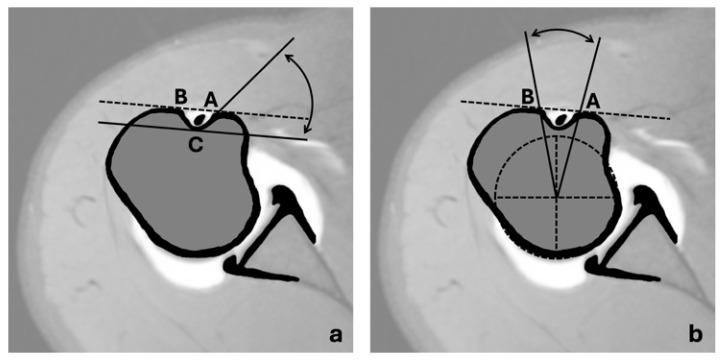
: Pathologies of the long head of the biceps (LHB) tendon are a common cause of anterior shoulder pain. While the influence of the anatomical morphology of the intertubercular groove (ITG) on the development of LHB tendon instability has been investigated with ambiguous results, the relationship of the LHB to ITG anatomy has not yet been considered in this context. The objective of this study was to reliably extract the tendon-to-groove ratio from MRI scans of symptomatic patients and examine its potential influence on the occurrence of certain causes for LHB-associated symptoms. : In this retrospective study, preoperative MRI scans of 35 patients (mean age of 46 ± 14 years) presenting with anterior shoulder pain and clinical indications of LHB tendinopathy were analyzed in transversal planes. Long and short diameters of the LHB tendon and ITG were measured, cross-sectional areas of the LHB tendon and ITG were calculated from these measurements, and the ratio of cross-sectional areas (LHB/ITG) was introduced. All measurements were repeated independently by three investigators and inter-rater reliability was assessed using intraclass correlation coefficient (ICC). Thereafter, tendon-to-groove ratios were compared in patients with and without intraoperative signs of LHB tendon instability. : All patients exhibited intraoperative signs of LHB tendinitis, with additional findings including pulley lesions and SLAP lesions. Analysis revealed variations in the dimensions of the LHB tendon and ITG cross sections, with the tendon-to-groove ratio decreasing from 37% at the pulley to 31% at the deepest point of the sulcus. Very good inter-rater reliability was observed for all measurements. The tendon-to-groove ratio did not significantly differ ( > 0.05) in patients with or without pulley lesions or SLAP lesions. : Our study introduced the novel parameter of the tendon-to-groove ratio of cross-sectional areas as a reproducible parameter for the description of local anatomy in the field of targeted diagnosis of LHB tendon disorders. While our findings do not yet support the predictive value of the tendon-to-groove ratio, they underscore the importance of further research with larger cohorts and control groups to validate these observations.
肱二头肌长头(LHB)肌腱病变是肩部前方疼痛的常见原因。虽然已对结节间沟(ITG)的解剖形态对LHB肌腱不稳定发展的影响进行了研究,但结果并不明确,且尚未在此背景下考虑LHB与ITG解剖结构的关系。本研究的目的是从有症状患者的MRI扫描中可靠地提取肌腱与沟的比例,并检查其对LHB相关症状某些病因发生的潜在影响。:在这项回顾性研究中,对35例(平均年龄46±14岁)出现肩部前方疼痛且有LHB肌腱病临床指征的患者的术前MRI扫描进行横断面分析。测量LHB肌腱和ITG的长径和短径,根据这些测量值计算LHB肌腱和ITG的横截面积,并引入横截面积之比(LHB/ITG)。所有测量均由三名研究人员独立重复进行,并使用组内相关系数(ICC)评估评分者间的可靠性。此后,比较有和没有LHB肌腱不稳定术中体征的患者的肌腱与沟的比例。:所有患者均表现出LHB肌腱炎的术中体征,其他发现包括滑车损伤和SLAP损伤。分析显示LHB肌腱和ITG横截面积的尺寸存在差异,肌腱与沟的比例从滑车处的37%降至沟最深点处的31%。所有测量均观察到非常好的评分者间可靠性。有或没有滑车损伤或SLAP损伤的患者的肌腱与沟的比例没有显著差异(>0.05)。:我们的研究引入了横截面积肌腱与沟比例这一新参数,作为LHB肌腱疾病靶向诊断领域描述局部解剖结构的可重复参数。虽然我们的研究结果尚不支持肌腱与沟比例的预测价值,但它们强调了通过更大样本队列和对照组进行进一步研究以验证这些观察结果的重要性。


 Zotero 插件