Biomedical Engineering Graduate Program, Schulich School of Engineering, University of Calgary, Calgary, AB T2N 1N4, Canada.
Human Performance Laboratory, Faculty of Kinesiology, University of Calgary, Calgary, AB T2N 1N4, Canada.
Sensors (Basel). 2024 May 10;24(10):3019. doi: 10.3390/s24103019.
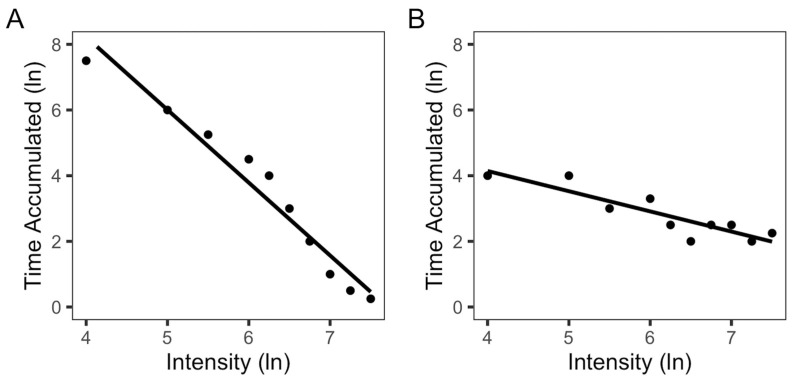
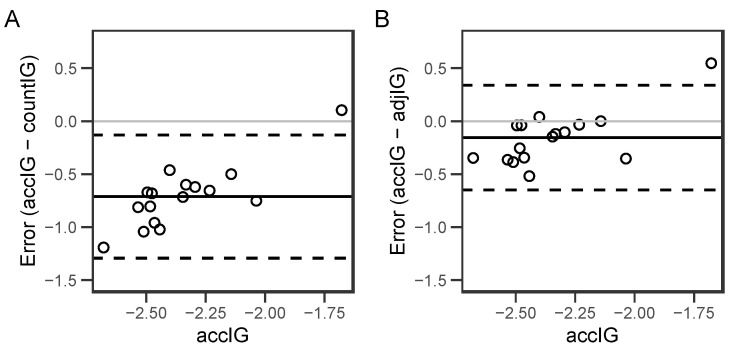
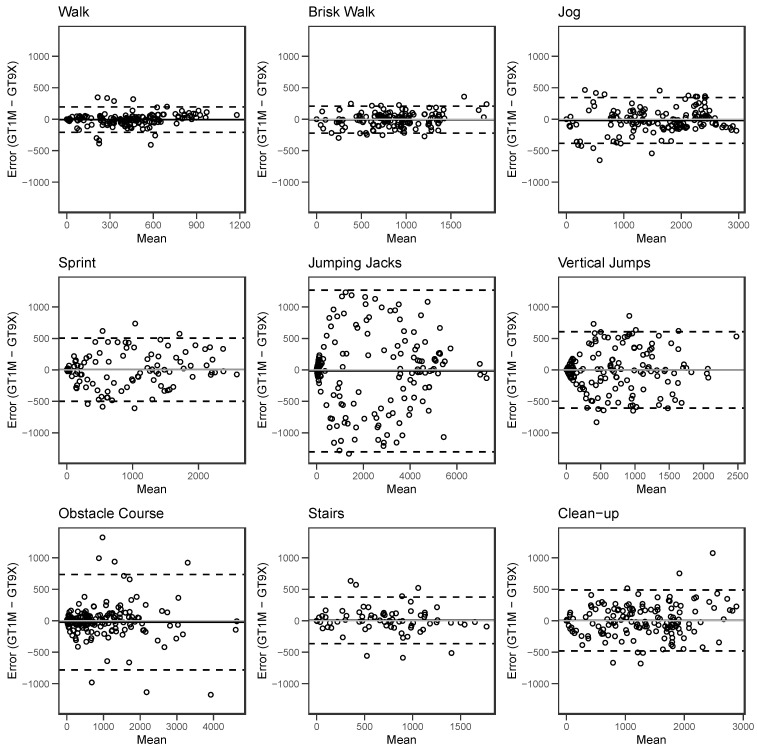
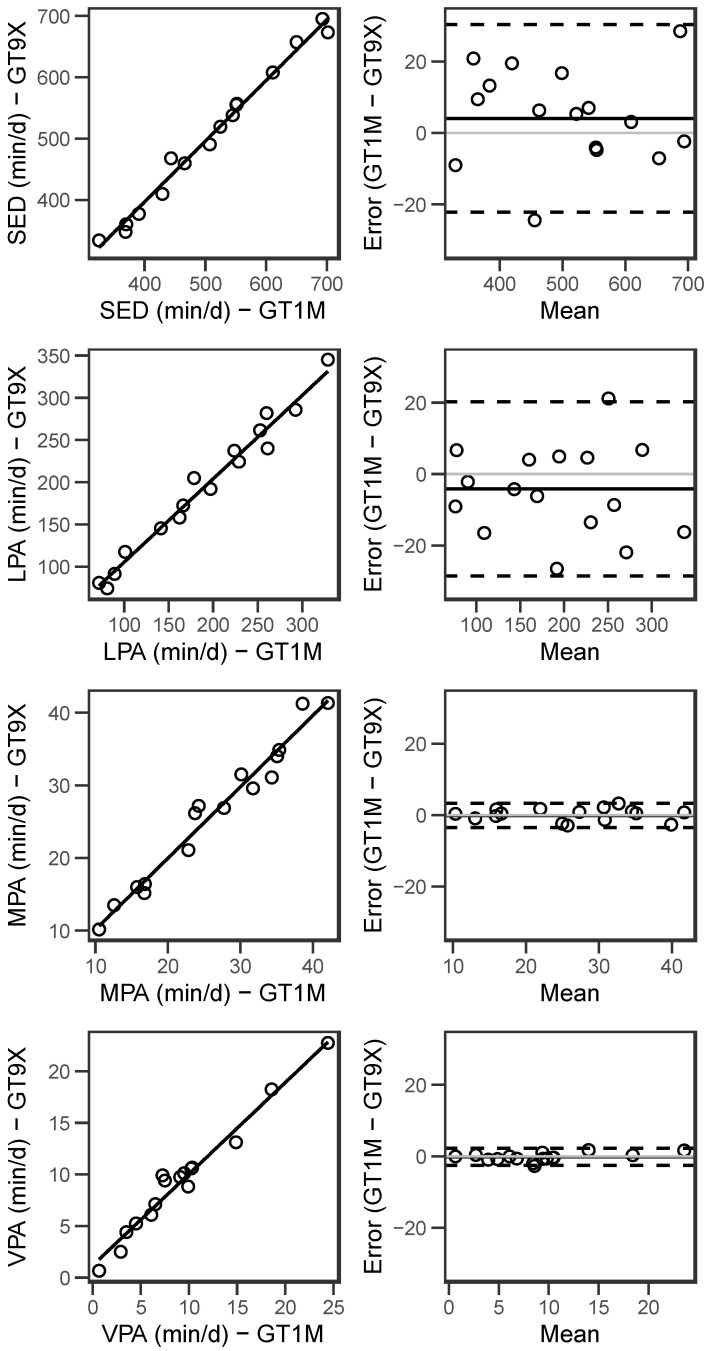
The intensity gradient is a new cutpoint-free metric that was developed to quantify physical activity (PA) measured using accelerometers. This metric was developed for use with the ENMO (Euclidean norm minus one) metric, derived from raw acceleration data, and has not been validated for use with count-based accelerometer data. In this study, we determined whether the intensity gradient could be reproduced using count-based accelerometer data. Twenty participants (aged 7-22 years) wore a GT1M, an ActiGraph (count-based), and a GT9X, ActiGraph (raw accelerations) accelerometer during both in-lab and at-home protocols. We found strong agreement between GT1M and GT9X counts during the combined in-lab activities (mean bias = 2 counts) and between minutes per day with different intensities of activity (e.g., sedentary, light, moderate, and vigorous) classified using cutpoints (mean bias < 5 min/d at all intensities). We generated bin sizes that could be used to generate IGs from the count data (mean bias = -0.15; 95% LOA [-0.65, 0.34]) compared with the original IG. Therefore, the intensity gradient could be used to analyze count data. The count-based intensity gradient metric will be valuable for re-analyzing historical datasets collected using older accelerometer models, such as the GT1M.
强度梯度是一种新的无切点度量标准,用于量化使用加速度计测量的身体活动 (PA)。该度量标准是为使用源自原始加速度数据的 ENMO(欧几里得范数减一)度量标准而开发的,尚未经过验证可用于基于计数的加速度计数据。在这项研究中,我们确定了强度梯度是否可以使用基于计数的加速度计数据重现。二十名参与者(年龄 7-22 岁)在实验室和家庭协议期间佩戴了 GT1M、ActiGraph(基于计数)和 GT9X、ActiGraph(原始加速度)加速度计。我们发现 GT1M 和 GT9X 计数在联合实验室活动中具有很强的一致性(平均偏差= 2 计数),并且使用切点分类的不同活动强度(例如久坐、轻度、中度和剧烈)的分钟数之间具有很强的一致性(在所有强度下平均偏差<5 分钟/天)。与原始 IG 相比,我们生成了可用于从计数数据生成 IG 的箱大小(平均偏差= -0.15;95%LOA[-0.65,0.34])。因此,可以使用基于计数的强度梯度度量标准来分析计数数据。基于计数的强度梯度度量标准将有助于重新分析使用较旧的加速度计模型(如 GT1M)收集的历史数据集。