Faust Lena, Caceres-Cardenas Guillermo, Martinez Leonardo, Huddart Sophie, Vidal Julia Rios, Corilloclla-Torres Ronald, Ayllon Mayra Cordova, Benedetti Andrea, Pai Madhukar, Ugarte-Gil César
Department of Epidemiology, Biostatistics and Occupational Health, McGill University, Montréal, Canada.
McGill International TB Centre, McGill University, Montréal, Canada.
Lancet Reg Health Am. 2024 Mar 27;33:100723. doi: 10.1016/j.lana.2024.100723. eCollection 2024 May.
The COVID-19 pandemic has significantly disrupted tuberculosis (TB) programs, making it urgent to focus TB elimination efforts on key populations. People experiencing incarceration are at high risk for TB, however, how COVID-19-related disruptions have impacted incarcerated populations with TB is unknown.
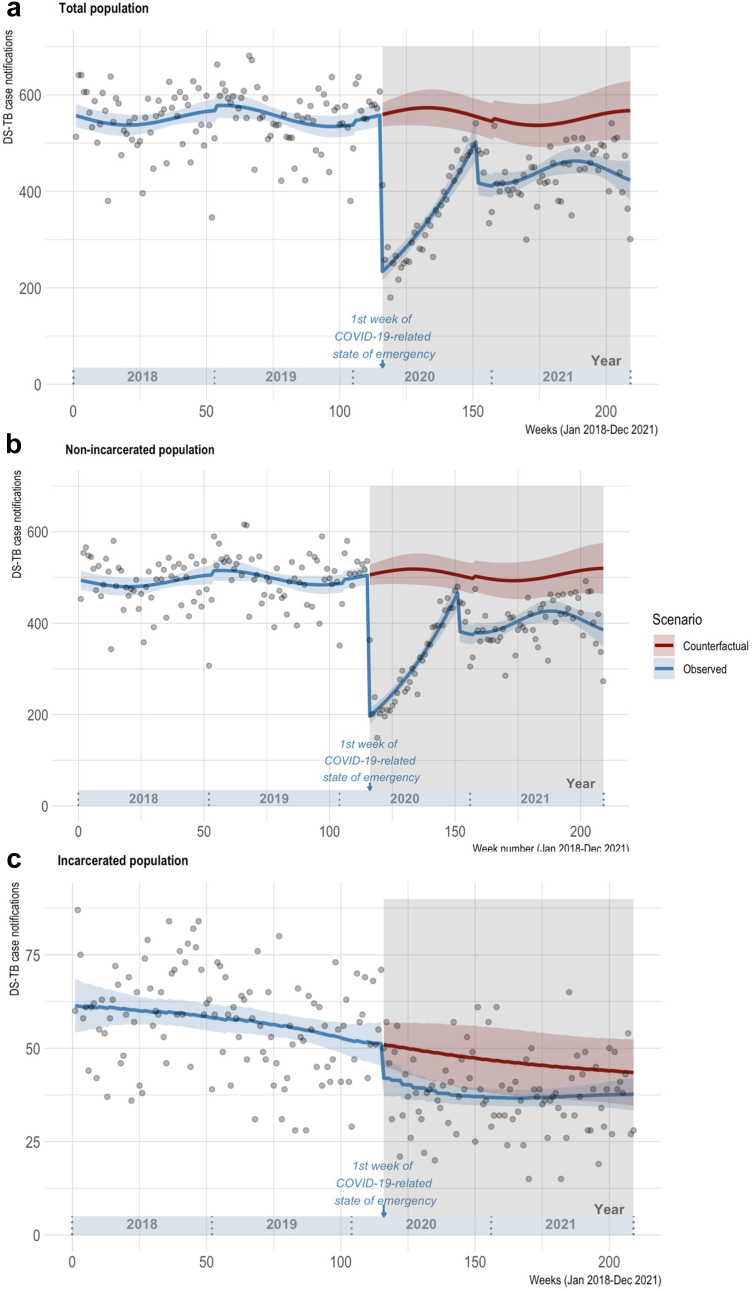
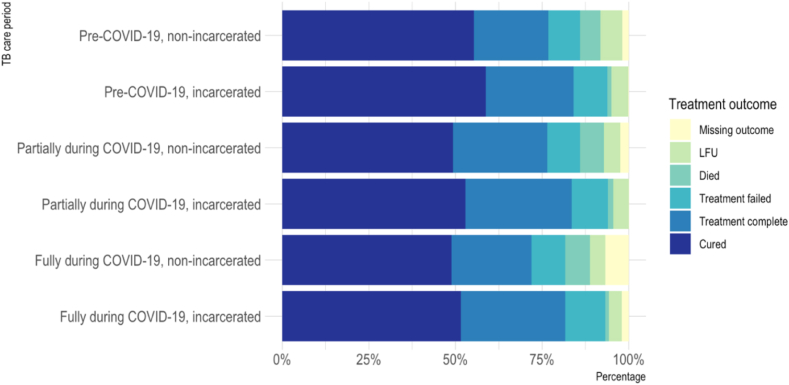
Using Peruvian National TB Program data from Jan 2018 to Dec 2021, an interrupted time series of drug-susceptible (DS) TB case notifications pre- and during COVID-19 was conducted (cut-off date: COVID-19 emergency declaration in Peru, 16 March 2020). The effect of TB care occurring pre-vs. during COVID-19 on TB treatment success in the incarcerated and non-incarcerated populations was explored using logistic regression.
DS-TB cases notified in prisons from Jan 2018 to Dec 2021 (n = 10,134) represented 10% of all cases notified in the country (n = 101,507). In the first week of COVID-19, DS-TB case notifications dropped by 61.2% (95% CI: 59.9-62.7%) in the non-incarcerated population and 17.7% (95% CI: 17.5-17.9%) among the incarcerated population. TB treatment success was significantly lower in people receiving TB care entirely during the COVID-19 pandemic vs. before COVID-19 in the non-incarcerated population (OR: 0.81, 95% CI: 0.78-0.85), but not statistically significantly lower in the incarcerated population (OR: 0.88, 95% CI: 0.76-1.01). Incarceration status was not found to modify the effect of COVID-19 period on TB treatment outcomes (OR: 1.07, 95% CI: 0.92-1.25), although treatment success was higher in the incarcerated population (OR [incarcerated vs. not incarcerated, pre-COVID]: 1.52, 95% CI: 1.39-1.67).
Both incarcerated and non-incarcerated populations experienced a large drop in DS-TB case notifications (although higher in the non-incarcerated population). Lower TB treatment success among those receiving care during COVID-19 indicates significant TB service disruptions in the overall population. The finding that incarceration at time of diagnosis was associated with treatment success is plausible in Peru given increased screening and stricter treatment monitoring in prisons.
Canadian Institutes of Health Research (Funding Reference Number: 179418) .
新冠疫情严重扰乱了结核病防治项目,因此迫切需要将结核病消除工作重点放在关键人群上。受监禁人群感染结核病的风险很高,然而,与新冠疫情相关的干扰对患有结核病的受监禁人群产生了何种影响尚不清楚。
利用秘鲁国家结核病防治项目2018年1月至2021年12月的数据,对新冠疫情之前和期间药物敏感型结核病病例通报进行了中断时间序列分析(截止日期:秘鲁2020年3月16日宣布新冠疫情紧急状态)。使用逻辑回归分析探讨了在新冠疫情之前与期间接受结核病治疗对受监禁人群和非受监禁人群结核病治疗成功率的影响。
2018年1月至2021年12月监狱通报的药物敏感型结核病病例(n = 10134)占该国通报的所有病例(n = 101507)的10%。在新冠疫情的第一周,非受监禁人群的药物敏感型结核病病例通报下降了61.2%(95%置信区间:59.9 - 62.7%),受监禁人群下降了17.7%(95%置信区间:17.5 - 17.9%)。在新冠疫情期间完全接受结核病治疗的人群中,结核病治疗成功率显著低于新冠疫情之前非受监禁人群(比值比:0.81,95%置信区间:0.78 - 0.85),但受监禁人群中差异无统计学意义(比值比:0.88,95%置信区间:0.76 - 1.01)。未发现监禁状态会改变新冠疫情期间对结核病治疗结果的影响(比值比:1.07,95%置信区间:0.92 - 1.25),尽管受监禁人群的治疗成功率更高(比值比[新冠疫情之前受监禁与未受监禁相比]:1.52,95%置信区间:1.39 - 1.67)。
受监禁人群和非受监禁人群的药物敏感型结核病病例通报均大幅下降(尽管非受监禁人群下降幅度更大)。在新冠疫情期间接受治疗的人群中较低的结核病治疗成功率表明总体人群中结核病服务受到严重干扰。鉴于监狱筛查增加和治疗监测更严格,在秘鲁诊断时处于监禁状态与治疗成功相关这一发现是合理的。
加拿大卫生研究院(资助编号:179418) 。