Fan Bingyuan, Wang Qian, Wang Shan, Gao Yahui, Liang Yan, Pan Jinru, Fu Xinrui, Li Li, Meng Wei
Key Laboratory of Biomedical Functional Materials, School of Sciences, China Pharmaceutical University, Nanjing 211198, China.
Nanpi No. 1 Middle School, Cangzhou 061599, China.
Int J Anal Chem. 2024 May 21;2024:8368987. doi: 10.1155/2024/8368987. eCollection 2024.
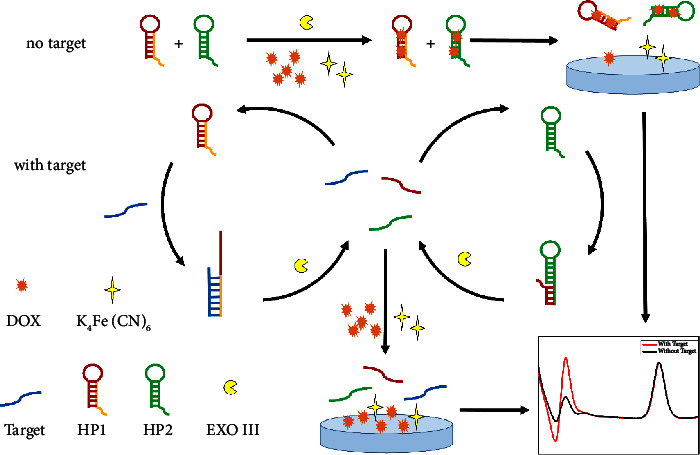
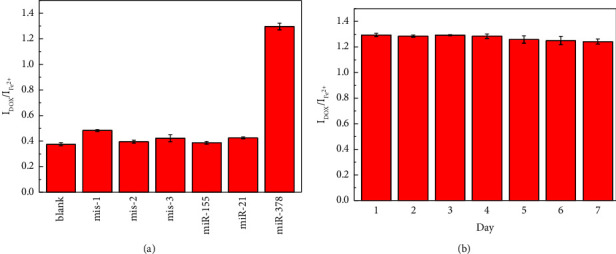
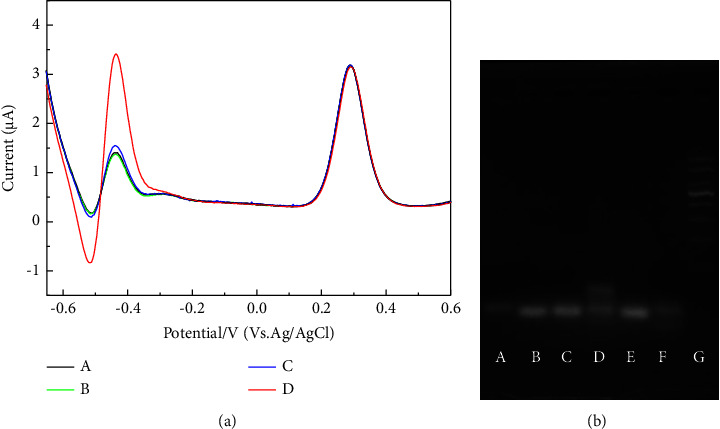
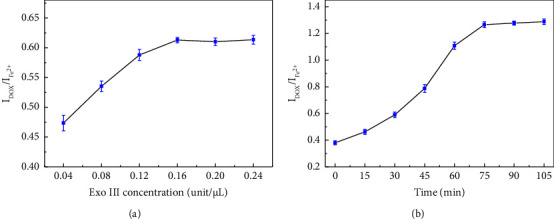
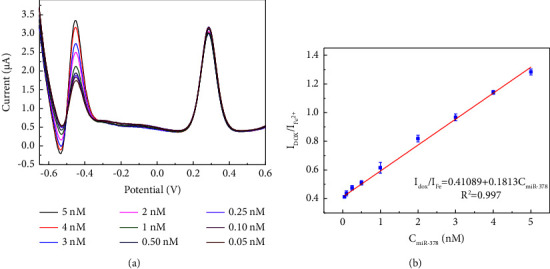
MiR-378 is abnormally expressed in various cancers, such as hepatocellular carcinoma, renal cell carcinoma, and nonsmall cell lung cancer. Here, we developed a label- and immobilization-free ratiometric homogeneous electrochemical strategy based on exonuclease III (Exo III) for the facile and rapid determination of miR-378. Two 3'-protruding hairpin DNA probes (HPs) are designed in this strategy. Doxorubicin (DOX) and potassium ferrocyanide (Fe) were used as label-free probes to produce a response signal (I) and a reference signal (I) in the solution phase. When no target was present in the solution, the HP was stable, most of the DOX was intercalated in the stem of the HP, and the diffusion rate of DOX was significantly reduced, resulting in reduced electrochemical signal response. When miR-378 was present, double-cycle signal amplification triggered by Exo III cleavage was initiated, ultimately disrupting the hairpin structures of HP1 and HP2 and releasing a large amount of DOX into the solution, yielding a stronger electrochemical signal, which was low to 50 pM. This detection possesses excellent selectivity, demonstrating high application potential in biological systems, and offers simple and low-cost electrochemical detection for miR-378.
miR-378在多种癌症中异常表达,如肝细胞癌、肾细胞癌和非小细胞肺癌。在此,我们基于核酸外切酶III(Exo III)开发了一种无标记、免固定的比率型均相电化学策略,用于简便快速地测定miR-378。该策略设计了两种3'端突出的发夹DNA探针(HPs)。阿霉素(DOX)和亚铁氰化钾(Fe)用作无标记探针,在溶液相中产生响应信号(I)和参比信号(I)。当溶液中不存在靶标时,HP稳定,大部分DOX插入HP的茎部,DOX的扩散速率显著降低,导致电化学信号响应降低。当存在miR-378时,由Exo III切割引发双循环信号放大,最终破坏HP1和HP2的发夹结构,将大量DOX释放到溶液中,产生更强的电化学信号,检测下限低至50 pM。该检测具有优异的选择性,在生物系统中显示出高应用潜力,并为miR-378提供了简单且低成本的电化学检测方法。