Centre for Academic Mental Health, Population Health Sciences, Bristol Medical School, University of Bristol, Bristol, UK.
Medical Research Centre (MRC) Integrative Epidemiology Unit (IEU), University of Bristol, Bristol, UK.
Transl Psychiatry. 2024 May 29;14(1):222. doi: 10.1038/s41398-024-02932-w.
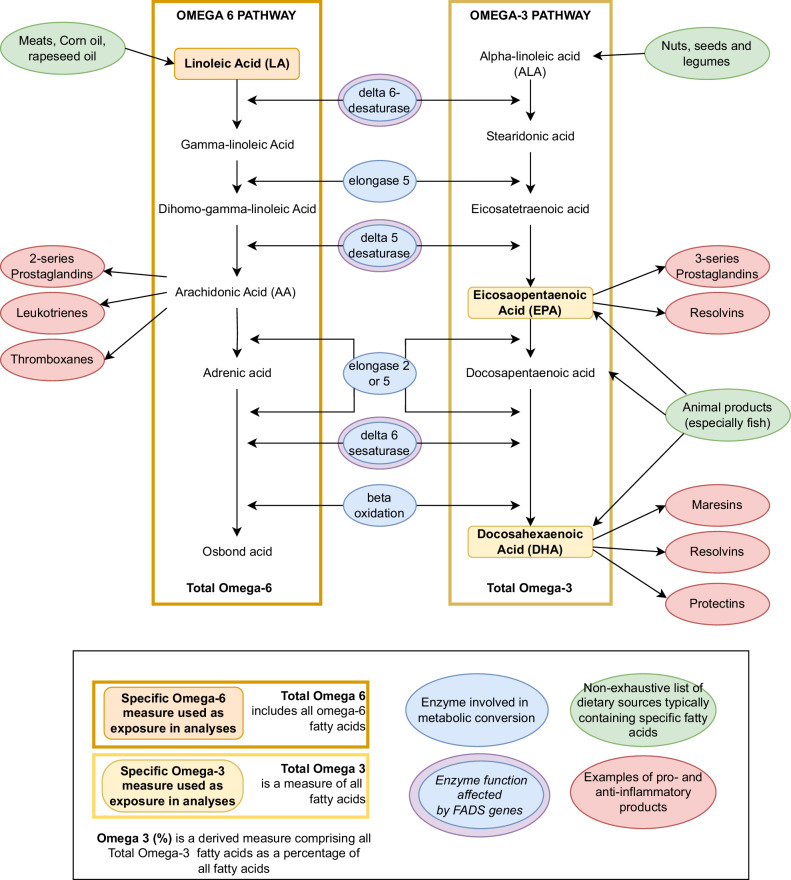
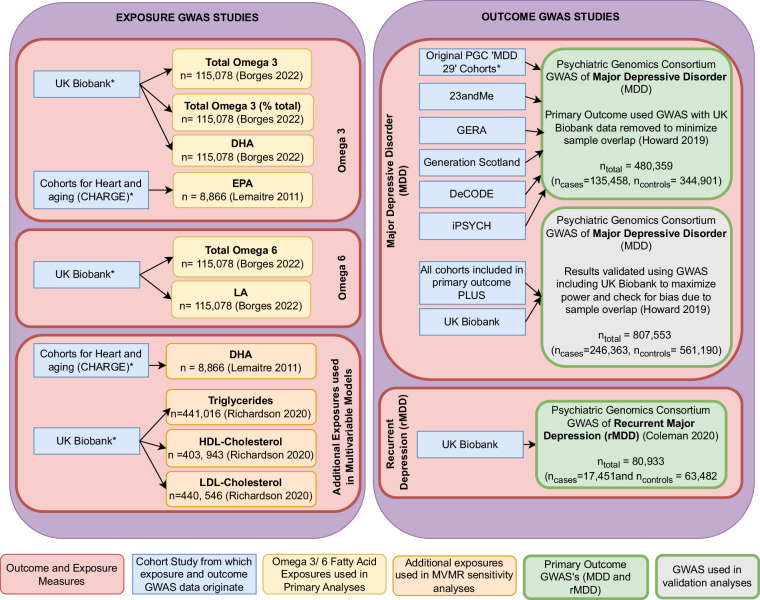
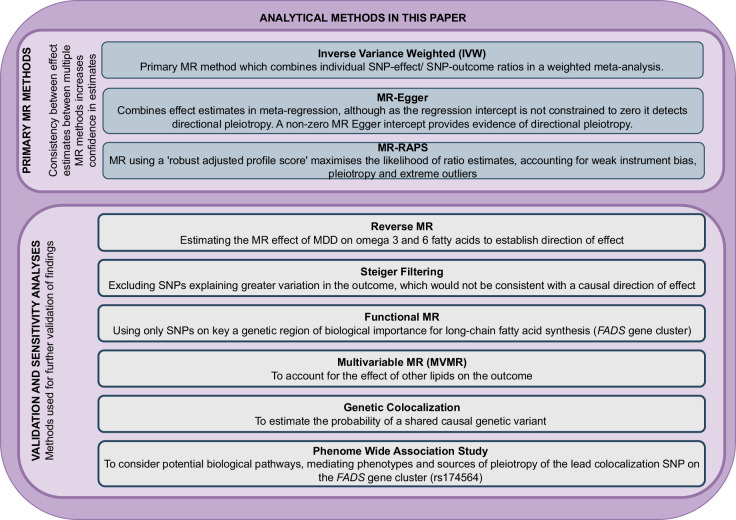
Omega-3 fatty acids have been implicated in the aetiology of depressive disorders, though trials supplementing omega-3 to prevent major depressive disorder (MDD) have so far been unsuccessful. Whether this association is causal remains unclear. We used two sample Mendelian randomization (MR) to investigate causality. Genetic variants associated with circulating omega-3 and omega-6 fatty acids in UK Biobank (UKBB, n = 115,078) were selected as exposures. The Psychiatric Genomics Consortium (PGC) genome-wide association studies (GWAS) of MDD (n = 430,775; cases = 116,209; controls = 314,566) and recurrent depression (rMDD, n = 80,933; cases = 17,451; controls = 62,482), were used as outcomes. Multivariable MR (MVMR) models were used to account for biologically correlated lipids, such as high- and low-density cholesterol and triglycerides, and to explore the relative importance of longer-chain omega-3 fatty acids eicosapentaenoic acid (EPA) and docosahexaenoic acid (DHA) using data from the Cohorts for Heart and Aging Research in Genomic Epidemiology (CHARGE, n = 8866). Genetic colocalization analyses were used to explore the presence of a shared underlying causal variant between traits. Genetically predicted total omega-3 fatty acids reduced the odds of MDD (OR 0.96 per standard deviation (SD, i.e. 0.22 mmol/l) (95% CIs 0.93-0.98, p = 0.003)). The largest point estimates were observed for eicosapentaenoic acid (EPA), a long-chain omega-3 fatty acid (OR 0.92; 95% CI 0.88-0.96; p = 0.0002). The effect of omega-3 fatty acids was robust to MVMR models accounting for biologically correlated lipids. 'Leave-one-out' analyses highlighted the FADS gene cluster as a key driver of the effect. Colocalization analyses suggested a shared causal variant using the primary outcome sample, but genomic confounding could not be fully excluded. This study supports a role for omega-3 fatty acids, particularly EPA, in the aetiology of depression, although pleiotropic mechanisms cannot be ruled out. The findings support guidelines highlighting the importance of EPA dose and ratio for MDD and question whether targeted interventions may be superior to universal prevention trials, as modest effect sizes will limit statistical power.
ω-3 脂肪酸与抑郁障碍的病因学有关,但迄今为止,补充 ω-3 以预防重度抑郁症(MDD)的试验均未成功。这种关联是否具有因果关系尚不清楚。我们使用两种样本 Mendelian 随机化(MR)来探究因果关系。选择与英国生物库(UKBB,n=115078)中循环 ω-3 和 ω-6 脂肪酸相关的遗传变异作为暴露因素。使用精神疾病基因组联盟(PGC)的 MDD(n=430775;病例=116209;对照=314566)和复发性抑郁(rMDD,n=80933;病例=17451;对照=62482)全基因组关联研究(GWAS)作为结局。使用多变量 MR(MVMR)模型来解释具有生物相关性的脂质,如高密度和低密度胆固醇以及甘油三酯,并使用来自基因组流行病学中心和衰老研究的队列(CHARGE,n=8866)的数据来探索长链 ω-3 脂肪酸二十碳五烯酸(EPA)和二十二碳六烯酸(DHA)的相对重要性。遗传共定位分析用于探讨特征之间是否存在共享的潜在因果变异。遗传预测的总 ω-3 脂肪酸降低了 MDD 的患病风险(OR 0.96/标准差(SD,即 0.22mmol/L)(95%CI 0.93-0.98,p=0.003))。观察到的最大点估计值是针对二十碳五烯酸(EPA),一种长链 ω-3 脂肪酸(OR 0.92;95%CI 0.88-0.96;p=0.0002)。ω-3 脂肪酸的作用在 MVMR 模型中是稳健的,该模型考虑了具有生物相关性的脂质。“逐一排除”分析突出了 FADS 基因簇作为效应的关键驱动因素。共定位分析表明,使用主要结局样本存在共享的因果变异,但不能完全排除基因组混杂。这项研究支持 ω-3 脂肪酸,特别是 EPA,在抑郁症发病机制中的作用,尽管不能排除多效性机制。研究结果支持强调 EPA 剂量和比例对 MDD 重要性的指南,并质疑是否靶向干预可能优于普遍预防试验,因为较小的效应大小将限制统计能力。