Department of General Practice and Health Services Research, University Hospital Heidelberg, Heidelberg, Germany.
Department of Nursing Science, Institute of Health Sciences, University Hospital Tuebingen, Tuebingen, Germany.
Integr Cancer Ther. 2024 Jan-Dec;23:15347354241252195. doi: 10.1177/15347354241252195.
Many patients diagnosed with cancer use complementary and integrative healthcare (CIH) approaches to manage their cancer- and treatment-related symptoms and improve their well-being. Evidence suggests that counseling on CIH can improve health outcomes and decrease healthcare costs by increasing patient activation. This qualitative study explores the experiences of cancer patients who underwent interprofessional counseling on CIH to gain insights into how these patients were able to integrate recommended CIH measures into their daily lives while undergoing conventional cancer treatment.
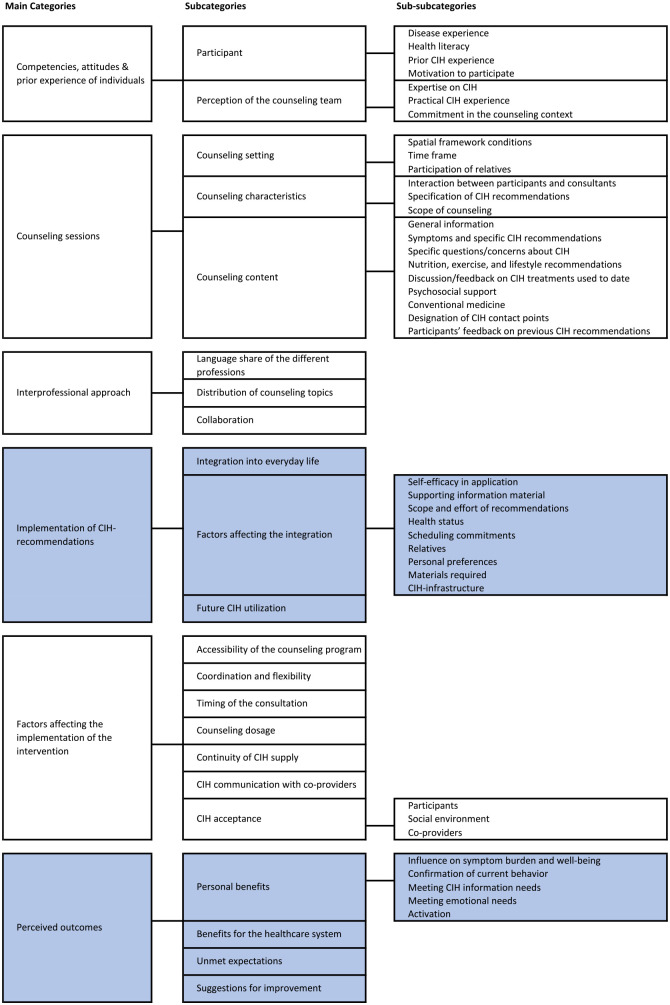
Forty semi-structured interviews were conducted with cancer patients participating in the CCC-Integrativ study and its process evaluation. The interviews were audio-recorded, transcribed verbatim, and analyzed using content analysis following Kuckartz and Rädiker. A purposeful sampling strategy was used to achieve a balanced sample regarding gender, age, cancer diagnosis, and treatment approach.
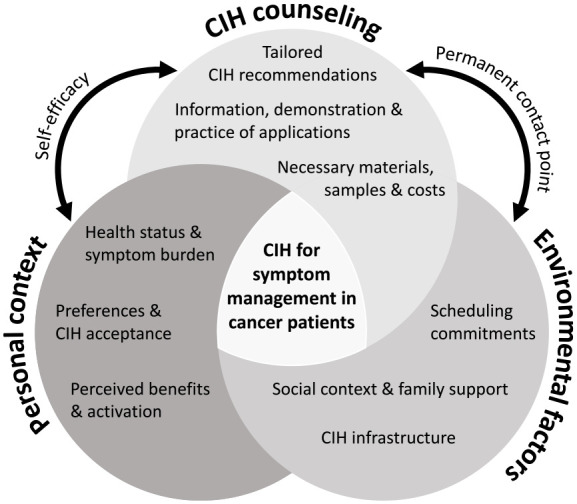
Most patients with cancer reported largely implementing the CIH recommendations. Participants acknowledged the efficacy of CIH recommendations in managing their symptoms. They felt strengthened and empowered to actively take part in their healthcare decisions. However, the patients encountered obstacles in incorporating the recommended CIH applications into their daily routines. These challenges encompassed the effort required for treatment application (e.g., baths, compresses), limitations imposed by the cancer disease (e.g., fatigue, pain), difficulties acquiring necessary materials, associated costs, and lack of infrastructure for CIH. Facilitators of CIH implementation included the availability of easily manageable CIH measures (e.g., herbal teas), informative materials on their application, distribution of samples, family support, and a high level of self-efficacy. The patient-centered approach and strong patient-provider partnership within the counseling context were perceived as empowering. Participants expressed a desire for a consistent point of contact to address their CIH concerns.
The findings underscore the benefits of CIH counseling for cancer patients' symptom management and overall well-being. Healthcare professionals providing CIH counseling to patients with cancer may recognize the barriers identified to better support their patients in the regular use of CIH.
许多被诊断患有癌症的患者使用补充和整合医疗保健(CIH)方法来管理他们的癌症和治疗相关症状,并提高他们的幸福感。有证据表明,对 CIH 的咨询可以通过提高患者的积极性来改善健康结果并降低医疗保健成本。这项定性研究探讨了接受 CIH 跨专业咨询的癌症患者的经验,以深入了解这些患者如何在接受常规癌症治疗的同时将推荐的 CIH 措施融入日常生活。
对参与 CCC-Integrativ 研究及其过程评估的癌症患者进行了 40 次半结构化访谈。采访进行了录音,并逐字转录,然后使用 Kuckartz 和 Rädiker 的内容分析法进行分析。采用目的性抽样策略,在性别、年龄、癌症诊断和治疗方法方面实现了平衡的样本。
大多数癌症患者报告说他们主要实施了 CIH 建议。参与者承认 CIH 建议在管理他们的症状方面的有效性。他们感到更有力量和能力积极参与他们的医疗保健决策。然而,患者在将推荐的 CIH 应用程序纳入他们的日常生活中遇到了障碍。这些挑战包括治疗应用程序所需的努力(例如,沐浴,压缩)、癌症疾病施加的限制(例如,疲劳,疼痛)、获取必要材料的困难、相关费用以及 CIH 的基础设施缺乏。CIH 实施的促进因素包括易于管理的 CIH 措施(例如,草药茶)的可用性、关于其应用的信息材料、样品的分发、家庭支持和高水平的自我效能。咨询背景下以患者为中心的方法和强大的医患伙伴关系被认为是赋权的。参与者表示希望有一个一致的联系点来解决他们的 CIH 问题。
研究结果强调了 CIH 咨询对癌症患者症状管理和整体幸福感的益处。为癌症患者提供 CIH 咨询的医疗保健专业人员可能会认识到已确定的障碍,以更好地支持他们的患者定期使用 CIH。