Watanabe Satoru, Stazic Damir, Georg Jens, Ohtake Shota, Sakamaki Yutaka, Numakura Megumi, Asayama Munehiko, Chibazakura Taku, Wilde Annegret, Steglich Claudia, Hess Wolfgang R
Faculty of Biology, Genetics and Experimental Bioinformatics University of Freiburg Freiburg Germany.
Department of Bioscience Tokyo University of Agriculture Setagaya-ku Tokyo Japan.
mLife. 2023 Feb 15;2(1):43-57. doi: 10.1002/mlf2.12056. eCollection 2023 Mar.
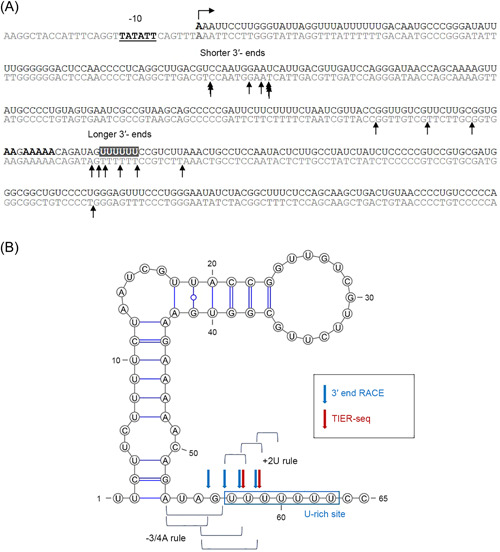
Endoribonucleases govern the maturation and degradation of RNA and are indispensable in the posttranscriptional regulation of gene expression. A key endoribonuclease in Gram-negative bacteria is RNase E. To ensure an appropriate supply of RNase E, some bacteria, such as , feedback-regulate RNase E expression via the 5'-untranslated region (5' UTR) in . However, the mechanisms involved in the control of RNase E in other bacteria largely remain unknown. Cyanobacteria rely on solar light as an energy source for photosynthesis, despite the inherent ultraviolet (UV) irradiation. In this study, we first investigated globally the changes in gene expression in the cyanobacterium sp. PCC 6803 after a brief exposure to UV. Among the 407 responding genes 2 h after UV exposure was a prominent upregulation of mRNA level. Moreover, the enzymatic activity of RNase E rapidly increased as well, although the protein stability decreased. This unique response was underpinned by the increased accumulation of full-length mRNA caused by the stabilization of its 5' UTR and suppression of premature transcriptional termination, but not by an increased transcription rate. Mapping of RNA 3' ends and in vitro cleavage assays revealed that RNase E cleaves within a stretch of six consecutive uridine residues within the 5' UTR, indicating autoregulation. These observations suggest that RNase E in cyanobacteria contributes to reshaping the transcriptome during the UV stress response and that its required activity level is secured at the RNA level despite the enhanced turnover of the protein.
核糖核酸内切酶控制着RNA的成熟和降解,在基因表达的转录后调控中不可或缺。革兰氏阴性菌中的一种关键核糖核酸内切酶是核糖核酸酶E。为确保核糖核酸酶E的适当供应,一些细菌,如[具体细菌名称未给出],通过[具体基因名称未给出]中的5'-非翻译区(5'UTR)对核糖核酸酶E的表达进行反馈调节。然而,其他细菌中控制核糖核酸酶E的机制在很大程度上仍不清楚。尽管存在固有紫外线(UV)辐射,蓝细菌依靠太阳光作为光合作用的能源。在本研究中,我们首先全面研究了蓝细菌[具体蓝细菌名称未给出] sp. PCC 6803在短暂暴露于紫外线后的基因表达变化。紫外线暴露2小时后,在407个响应基因中,[具体基因名称未给出] mRNA水平显著上调。此外,核糖核酸酶E的酶活性也迅速增加,尽管蛋白质稳定性下降。这种独特的反应是由全长[具体基因名称未给出] mRNA积累增加所支撑,这是由于其5'UTR的稳定和过早转录终止的抑制,而不是转录速率的增加。RNA 3'末端图谱分析和体外切割试验表明,核糖核酸酶E在[具体基因名称未给出] 5'UTR内一段连续六个尿苷残基处切割,表明存在自我调节。这些观察结果表明,蓝细菌中的核糖核酸酶E有助于在紫外线应激反应期间重塑转录组,并且尽管蛋白质周转加快,但其所需的活性水平在RNA水平上得以确保。