Essop Fahmida, Dillon Bronwyn, Mhlongo Felicity, Bhengu Louisa, Naicker Thirona, Lambie Lindsay, Smit Liani, Fieggen Karen, Lochan Anneline, Dawson Jessica, Mpangase Phelelani, Hauptfleisch Marc, Scher Gail, Tabane Odirile, Immelman Marelize, Urban Michael, Krause Amanda
Division of Human Genetics, National Health Laboratory Service and School of Pathology, The University of the Witwatersrand, Johannesburg, South Africa.
Genetics, Department of Paediatrics, Inkosi Albert Luthuli Central Hospital and University of KwaZulu-Natal, Durban, South Africa.
Eur J Hum Genet. 2025 Jan;33(1):14-23. doi: 10.1038/s41431-024-01644-5. Epub 2024 Jun 1.
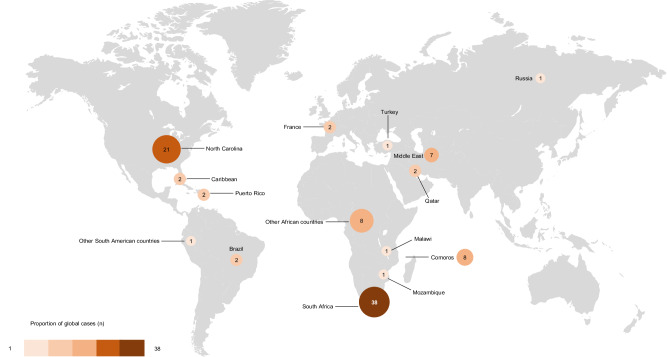
STAC3 disorder, or Native American myopathy, is characterised by congenital myopathy, hypotonia, musculoskeletal and palatal anomalies, and susceptibility to malignant hyperthermia. A STAC3 c.851 G > C (p.Trp284Ser) pathogenic variant, common in the Lumbee Native American tribe, has been identified in other populations worldwide, including patients of African ancestry. We report on the frequency of STAC3 c.851 G > C in a cohort of 127 patients presenting with congenital hypotonia that tested negative for spinal muscular atrophy and/or Prader-Willi syndrome. We present a clinical retrospective, descriptive review on 31 Southern African patients homozygous for STAC3 c.851 G > C. The frequencies of various phenotypic characteristics were calculated. In total, 25/127 (20%) laboratory-based samples were homozygous for STAC3 c.851 G > C. A carrier rate of 1/56 and a predicted birth rate of 1/12 500 was estimated from a healthy cohort. A common haplotype spanning STAC3 was identified in four patients. Of the clinical group, 93% had a palatal abnormality, 52% a spinal anomaly, 59% had talipes equinovarus deformity/deformities, 38% had arthrogryposis multiplex congenita, and 22% had a history suggestive of malignant hyperthermia. The novel finding that STAC3 disorder is a common African myopathy has important clinical implications for the diagnosis, treatment and genetic counselling of individuals, with neonatal and/or childhood hypotonia with or without arthrogryposis multiplex congenita, and their families. The spread of this variant worldwide and the allele frequency higher in the African/African-American ancestry than the Admixed Americans, strongly indicates that the STAC3 c.851 G > C variant has an African origin which may be due to an ancient mutation with migration and population bottlenecks.
STAC3疾病,即美洲原住民肌病,其特征为先天性肌病、肌张力减退、肌肉骨骼和腭部异常,以及对恶性高热敏感。一种STAC3基因c.851 G > C(p.Trp284Ser)致病变异,在伦贝美洲原住民部落中常见,已在全球其他人群中被发现,包括非洲裔患者。我们报告了127例先天性肌张力减退患者队列中STAC3 c.851 G > C的频率,这些患者脊髓性肌萎缩症和/或普拉德 - 威利综合征检测均为阴性。我们对31例STAC3 c.851 G > C纯合的南非患者进行了临床回顾性描述性分析。计算了各种表型特征的频率。总共,127份基于实验室检测的样本中有25份(20%)为STAC3 c.851 G > C纯合子。从一个健康队列估计出的携带率为1/56,预测出生率为1/12500。在4例患者中鉴定出一个跨越STAC3的常见单倍型。在临床组中,93%有腭部异常,52%有脊柱异常,59%有马蹄内翻足畸形,38%有多发性先天性关节挛缩,22%有提示恶性高热的病史。STAC3疾病是一种常见的非洲肌病这一新发现,对于有或无先天性多发性关节挛缩的新生儿和/或儿童期肌张力减退患者及其家庭的诊断、治疗和遗传咨询具有重要临床意义。这种变异在全球的传播以及在非洲/非裔美国人血统中比混血美国人中更高的等位基因频率,强烈表明STAC3 c.851 G > C变异起源于非洲,这可能是由于古代突变以及迁移和种群瓶颈所致。