Department of Biology, University of San Diego, 5998 Alcalá Park, San Diego, CA, 92111, USA.
Department of Biology, York University, 4700 Keele St, Toronto, ON, M3J 1P3, Canada.
Sci Rep. 2024 Jun 3;14(1):12738. doi: 10.1038/s41598-024-62974-4.
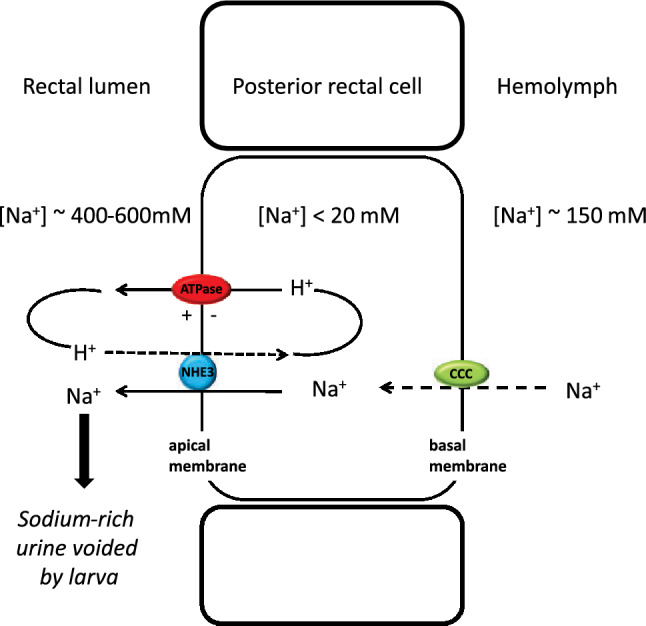
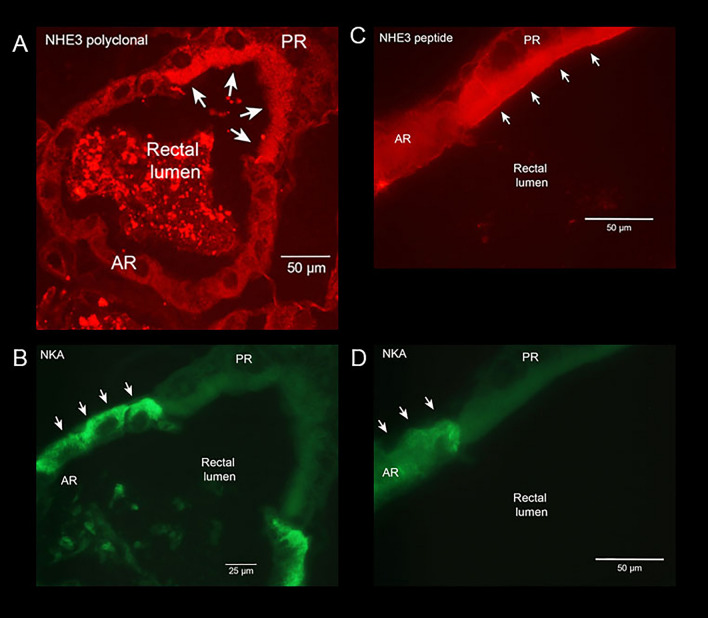
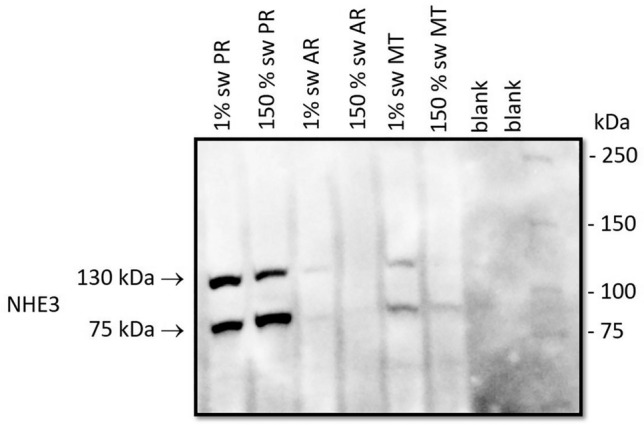
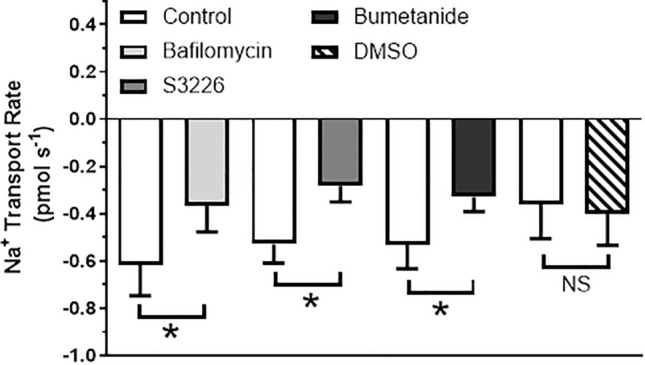
Aquatic animals residing in saline habitats either allow extracellular sodium concentration to conform to environmental values or regulate sodium to lower levels. The latter strategy requires an energy-driven process to move sodium against a large concentration gradient to eliminate excess sodium that diffuses into the animal. Previous studies of invertebrate and vertebrate species indicate a sodium pump, Na/K ATPase, powers sodium secretion. We provide the first functional evidence of a saline-water animal, Aedes taeniorhynchus mosquito larva, utilizing a proton pump to power this process. Vacuolar-type H ATPase (VHA) protein is highly expressed on the apical membrane of the posterior rectal cells, and in situ sodium flux across this epithelium increases significantly in larvae held in higher salinity and is sensitive to Bafilomycin A, an inhibitor of VHA. We also report the first evidence of splice variants of the sodium/proton exchanger, NHE3, with both high and low molecular weight variants highly expressed on the apical membrane of the posterior rectal cells. Evidence of NHE3 function was indicated with in situ sodium transport significantly inhibited by a NHE3 antagonist, S3226. We propose that the outward proton pumping by VHA establishes a favourable electromotive gradient to drive sodium secretion via NHE3 thus producing a hyperosmotic, sodium-rich urine. This H- driven Na secretion process is the primary mechanism of ion regulation in salt-tolerant culicine mosquito species and was first investigated over 80 years ago.
生活在咸水环境中的水生动物要么允许细胞外钠离子浓度与环境值一致,要么将钠离子浓度调节至较低水平。后一种策略需要一个能量驱动的过程,将钠离子逆着大的浓度梯度移动,以消除扩散到动物体内的多余钠离子。先前对无脊椎动物和脊椎动物物种的研究表明,钠泵(Na/K ATPase)为钠离子分泌提供动力。我们提供了第一个功能证据,证明盐水动物——埃及伊蚊幼虫利用质子泵来驱动这个过程。液泡型 H ATPase(VHA)蛋白在直肠后细胞的顶膜上高度表达,并且在高盐环境中,幼虫的上皮细胞中钠离子通量明显增加,并且对 VHA 的抑制剂巴弗洛霉素 A 敏感。我们还首次报道了钠/质子交换器 NHE3 的剪接变体的证据,高和低分子量变体都在上皮细胞的顶膜上高度表达。NHE3 功能的证据表明,NHE3 拮抗剂 S3226 显著抑制了原位钠离子转运。我们提出,VHA 的外向质子泵通过 NHE3 建立有利的电动梯度,从而驱动钠离子分泌,从而产生高渗、富含钠离子的尿液。这种 H+驱动的 Na+分泌过程是耐盐库蚊物种离子调节的主要机制,早在 80 多年前就进行了首次研究。