Department of Health Sciences, University of Florence, Via di San Salvi 12, Pad. 26, Firenze, 50135, Italy.
Integrated Psychodynamic Psychotherapy Institute (IPPI), Via Ricasoli 32, Florence, 50122, Italy.
J Gambl Stud. 2024 Dec;40(4):2077-2091. doi: 10.1007/s10899-024-10322-6. Epub 2024 Jun 4.
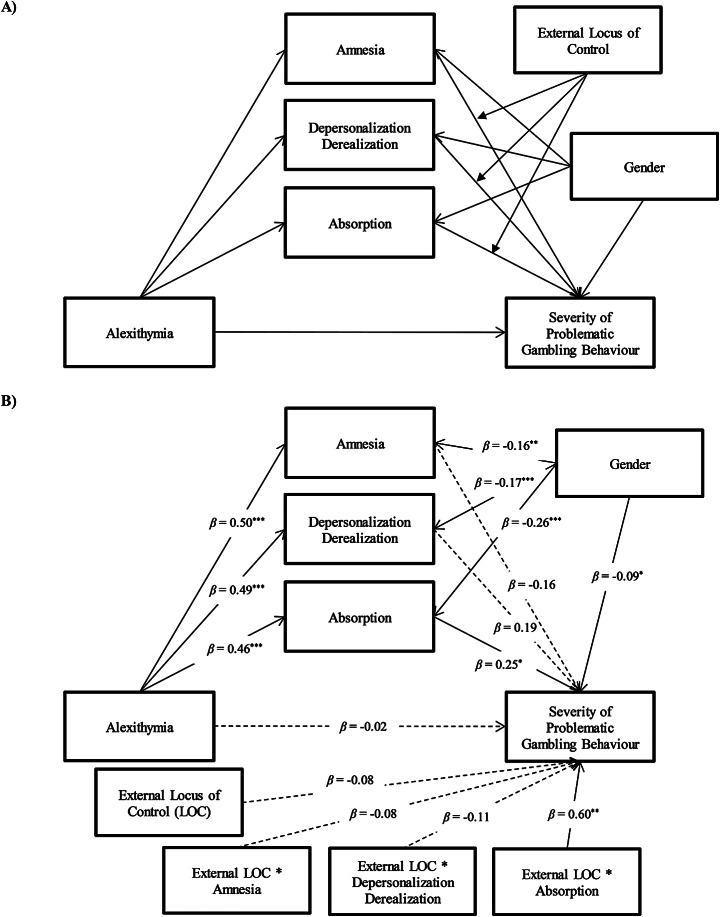
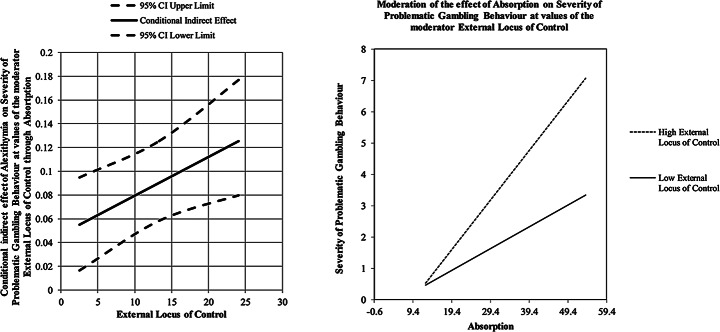
Gambling disorder is a severe condition that significantly compromises the lives of those affected. In light of this clinical relevance, the literature on the antecedents of this form of addiction is constant and continually evolving. Consistently with this framework, the present research aimed at investigating the role of some risk factors in gambling disorder, with a specific focus on alexithymia, dissociation, and locus of control. The research involved a sample of 290 participants (183 males and 107 females; Mage = 34.43, SD = 14.65) who practice gambling at least occasionally. They completed an online survey including the South Oaks Gambling Screen, Twenty-Items Toronto Alexithymia Scale, Dissociative Experience Scale-II, and Locus of Control of Behavior. ANOVA and a moderated-mediation model were implemented to analyse the collected data. Results showed that 19.0% of the participants were At Risk and Problem Gamblers, while 27.6% fell into the category of Problematic Gamblers. Problematic Gamblers showed significantly higher levels of alexithymia, dissociation, and external locus of control. Moreover, a significant association between alexithymia and the severity of problematic gambling behaviour was found and was significantly mediated by absorption (a dissociation feature). Furthermore, the external locus of control significantly moderated this indirect effect. The role of gender as a covariate was also investigated. Such findings may offer further insights into the field of clinical research on gambling disorder and may provide useful information for effective clinical practice.
赌博障碍是一种严重的疾病,会严重影响患者的生活。鉴于这种临床相关性,关于这种成瘾形式的前驱因素的文献是持续不断且不断发展的。基于这一框架,本研究旨在调查一些风险因素在赌博障碍中的作用,特别关注述情障碍、分离和控制源。研究涉及 290 名参与者(183 名男性和 107 名女性;Mage=34.43,SD=14.65),他们至少偶尔进行赌博。他们完成了一项在线调查,包括南奥克斯赌博筛查、多伦多 20 项述情障碍量表、分离体验量表-II 和行为控制源。实施了方差分析和调节中介模型来分析收集的数据。结果表明,19.0%的参与者处于风险和问题赌博者类别,而 27.6%的参与者属于问题赌博者类别。问题赌博者表现出明显更高的述情障碍、分离和外部控制源水平。此外,还发现述情障碍与问题性赌博行为的严重程度之间存在显著关联,且这种关联被吸收(一种分离特征)显著中介。此外,外部控制源显著调节了这种间接效应。还研究了性别作为协变量的作用。这些发现可能为赌博障碍的临床研究领域提供进一步的见解,并为有效的临床实践提供有用的信息。