Shibeshi Ketema Ayele, Lemu Yohannes Kebede, Gebretsadik Lakew Abebe, Gebretsadik Abebe Mamo, Morankar Sudhakar
Department of Health, Behavior and Society, Jimma University, Jimma, Ethiopia.
Department of Public Health, Dire Dawa University, Dire Dawa, Ethiopia.
Int J Womens Health. 2024 May 30;16:987-1007. doi: 10.2147/IJWH.S457357. eCollection 2024.
This study aimed to compare knowledge and attitudes towards obstetric danger signs and care between females receiving maternal care and their male partners.
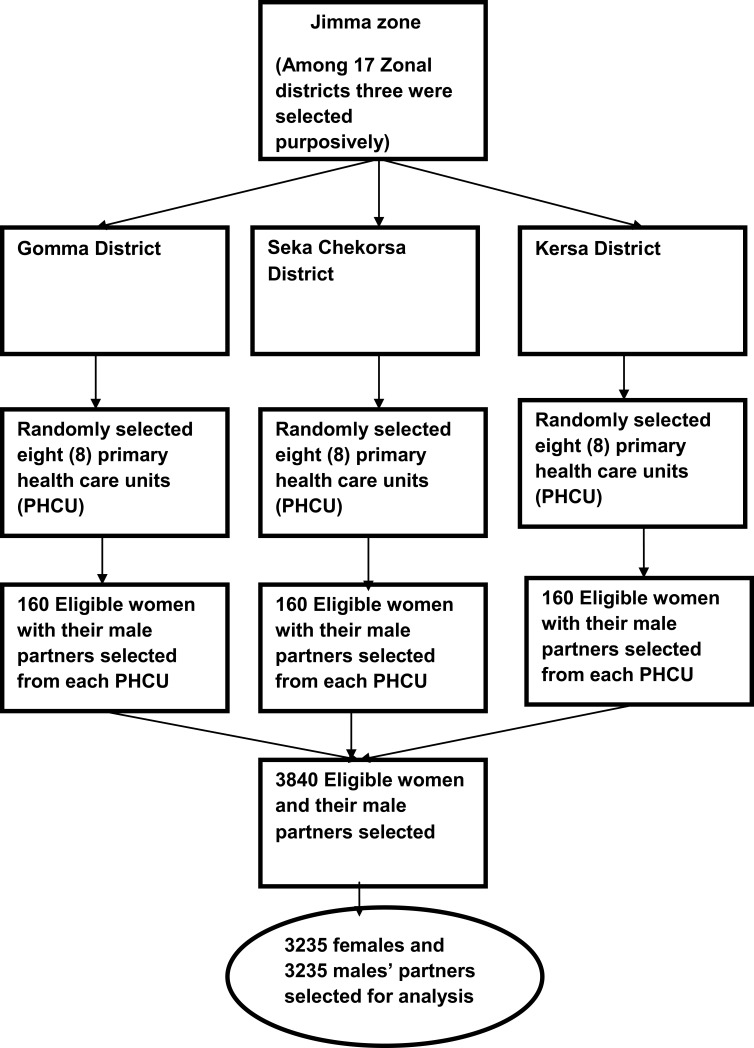
A community-based comparative cross-sectional study was conducted in the rural setting of Jimma, Ethiopia. Female and their male partners were selected randomly. The number of participants included from each sex was 3235 totaling 6470. Face-to-face data collection was employed using open data kit (ODK) software. A pre-test was performed before the data collection. Descriptive and analytical statistical analysis was used to compare knowledge and attitudes regarding obstetric danger signs and care. Predictor variables were declared considering a 95% confidence interval, adjusted odds ratio (AOR) and P-value less than 0.05.
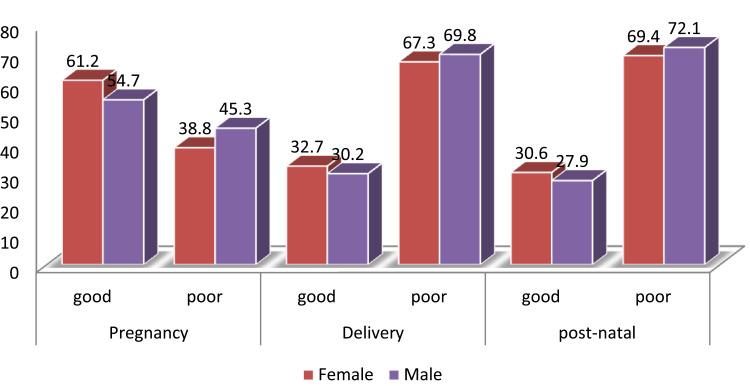
On average, male and female participants identified at least two obstetric danger signs. More females could mention more antenatal, childbirth, and postnatal danger signs than their male partners. Both females and their male partners who listened to the radio at least once per week had a statistically significant positive attitude towards obstetric care. Nonetheless, both had an almost similar magnitude of attitude towards obstetric care irrespective of belonging to different occupational, educational, and other social strata. Males' knowledge of danger signs during pregnancy (95% CI = (1.07-1.62), AOR = 1.32, P < 0.008) and postnatal care (95% CI = (1.16-1.89), AOR = 1.48, P < 0.002) had a statistically significant association with the females utilization antenatal care (ANC) service, though not delivery care (DC) or postnatal (PNC).
There were inequalities in obstetric danger signs knowledge between females and their male partners. Male partners' knowledge of obstetric danger signs is not only significant during pregnancy and delivery but also has a lasting impact on post-natal service utilization, which underscores the importance of their involvement in maternal healthcare.
本研究旨在比较接受孕产妇护理的女性及其男性伴侣对产科危险信号和护理的知识与态度。
在埃塞俄比亚吉马的农村地区开展了一项基于社区的比较横断面研究。女性及其男性伴侣被随机选取。每个性别的参与者人数均为3235人,总计6470人。使用开放数据工具包(ODK)软件进行面对面数据收集。在数据收集之前进行了预测试。采用描述性和分析性统计分析来比较关于产科危险信号和护理的知识与态度。考虑到95%置信区间、调整后的优势比(AOR)和P值小于0.05来确定预测变量。
平均而言,男性和女性参与者至少识别出两种产科危险信号。与男性伴侣相比,更多女性能够提及更多产前、分娩和产后危险信号。每周至少收听一次广播的女性及其男性伴侣对产科护理的态度在统计学上具有显著的积极意义。尽管如此,无论属于不同的职业、教育和其他社会阶层,两者对产科护理的态度几乎相似。男性对孕期危险信号(95%置信区间=(1.07 - 1.62),AOR = 1.32,P < 0.008)和产后护理(95%置信区间=(1.16 - 1.89),AOR = 1.48,P < 0.002)的了解与女性使用产前护理(ANC)服务在统计学上具有显著关联,不过与分娩护理(DC)或产后护理(PNC)无关。
女性及其男性伴侣在产科危险信号知识方面存在不平等。男性伴侣对产科危险信号的了解不仅在孕期和分娩期间具有重要意义,而且对产后服务利用有持久影响,这凸显了他们参与孕产妇保健的重要性。