
下颌后静脉与面神经颞外段的关系:一项对24侧半面进行的前瞻性尸体研究。
The Relationship Between the Retromandibular Vein and the Extratemporal Segment of the Facial Nerve: A Prospective Cadaveric Study of 24 Hemifaces.
作者信息
Poutoglidis Alexandros, Triaridis Stefanos, Paraskevas George K, Karamitsou Paraskevi, Mykoniatis Ioannis, Langas Georgios, Tsiakaras Stavros, Galanis Nektarios, Lazaridis Nikolaos
机构信息
Department of Anatomy and Surgical Anatomy, School of Medicine, Aristotle University of Thessaloniki, Thessaloniki, GRC.
First Department of Otorhinolaryngology-Head and Neck Surgery, School of Medicine, Aristotle University of Thessaloniki, AHEPA University Hospital, Thessaloniki, GRC.
出版信息
Cureus. 2024 May 4;16(5):e59637. doi: 10.7759/cureus.59637. eCollection 2024 May.
INTRODUCTION
Anatomical preservation and functional integrity of the facial nerve (FN) are the main concerns of parotid surgery. Even though a variety of anatomical landmarks have been proposed and widely utilized, temporal or permanent postoperative FN palsy is still a significant comorbidity of parotid surgery. Therefore, the literature must fully elucidate the consistency of the anatomical relationship between the FN and the retromandibular vein (RMV).
METHODS
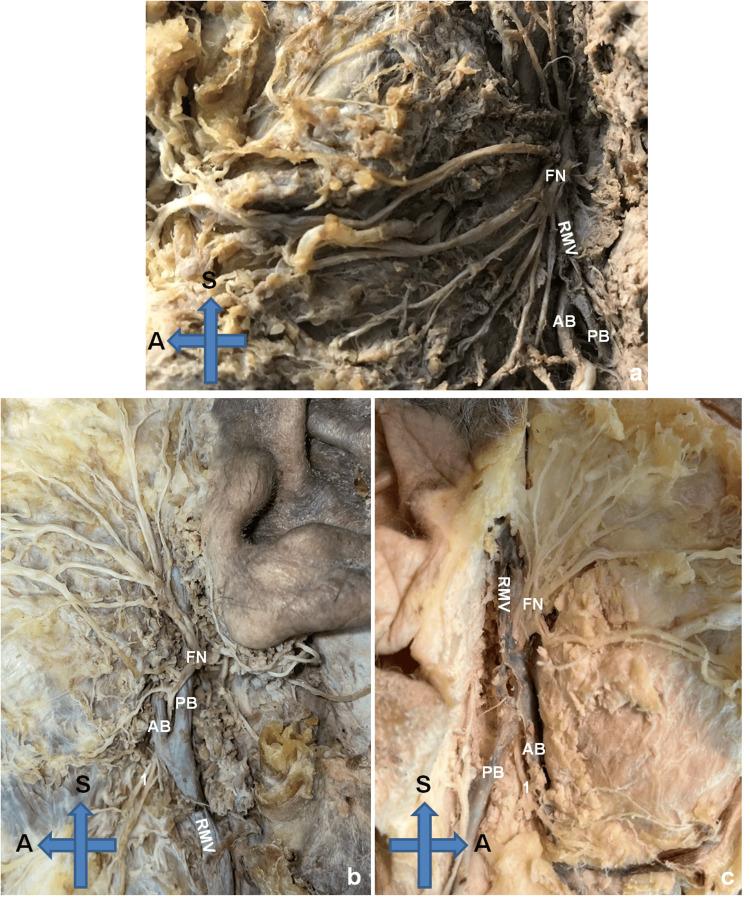
We conducted a cadaveric study of 24 hemifaces to map the relationship between the FN and the RMV. Three distinct patterns were identified. Fourteen of the hemifaces were males, and 10 were females. Thirteen cadaveric dissections were performed on the right side and 11 on the left side.
RESULTS
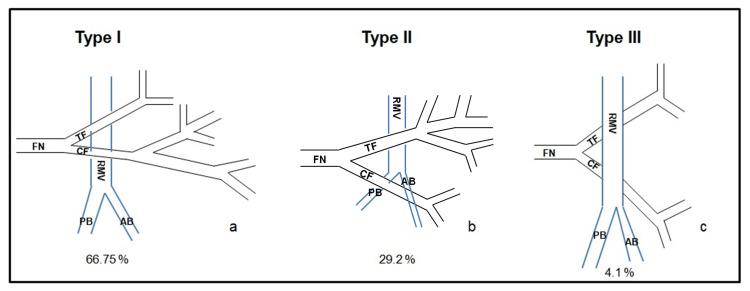
Our study found three distinct patterns and proposed a classification system. Type I (66.7%) is when the nerve lies exclusively lateral to the RMV. Type II (29.2%) is when the FN lies superficial to the RMV, but its mandibular branch lies deep to the anterior branch of the RMV, and type III (4.1%) is when the FN lies exclusively medial to the RMV.
CONCLUSION
The FN and RMV relationship is not constant, and surgeons should be aware of every anatomical variation. Especially in cases where the FN is estimated to lie more in-depth to the level of the RMV, a retrograde approach may be required to avoid a FN injury.
引言
面神经(FN)的解剖结构保存和功能完整性是腮腺手术的主要关注点。尽管已经提出并广泛应用了多种解剖标志,但术后暂时性或永久性面神经麻痹仍是腮腺手术的一种重要合并症。因此,文献必须充分阐明面神经与下颌后静脉(RMV)之间解剖关系的一致性。
方法
我们对24个半侧面部进行了尸体研究,以描绘面神经与下颌后静脉之间的关系。识别出三种不同模式。其中14个半侧面部为男性,10个为女性。在右侧进行了13次尸体解剖,在左侧进行了11次。
结果
我们的研究发现了三种不同模式,并提出了一种分类系统。I型(66.7%)是指神经完全位于下颌后静脉外侧。II型(29.2%)是指面神经位于下颌后静脉浅面,但其下颌支位于下颌后静脉前支深面,III型(4.1%)是指面神经完全位于下颌后静脉内侧。
结论
面神经与下颌后静脉的关系并不恒定,外科医生应了解每一种解剖变异。特别是在估计面神经位于下颌后静脉水平更深位置的情况下,可能需要采用逆行入路以避免面神经损伤。
 Zotero 插件