National Cancer Center Hospital East, Kashiwa, Japan.
Department of Medical Oncology, State Key Laboratory of Oncology in South China, Sun Yat-Sen University Cancer Center, Guangdong, China.
J Clin Oncol. 2024 Aug 20;42(24):2918-2927. doi: 10.1200/JCO.23.02736. Epub 2024 Jun 4.
Treatment options are limited for patients with previously treated metastatic colorectal cancer (mCRC). In the LEAP-017 study, we evaluate whether lenvatinib in combination with pembrolizumab improves outcomes compared with standard of care (SOC) in previously treated mismatch repair proficient or not microsatellite instability high (pMMR or not MSI-H) mCRC.
In this international, multicenter, randomized, controlled, open-label, phase III study, eligible patients age 18 years and older with unresectable, pMMR or not MSI-H mCRC, that had progressed on or after, or could not tolerate, standard treatment, were randomly assigned 1:1 to lenvatinib 20 mg orally once daily plus pembrolizumab 400 mg intravenously once every 6 weeks or investigator's choice of regorafenib or trifluridine/tipiracil (SOC). Randomization was stratified by presence or absence of liver metastases. The primary end point was overall survival (OS). LEAP-017 is registered at ClinicalTrials.gov (NCT04776148), and has completed recruitment.
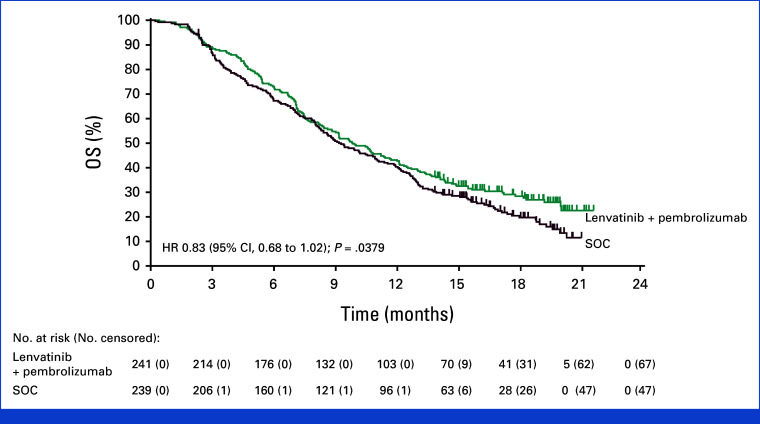
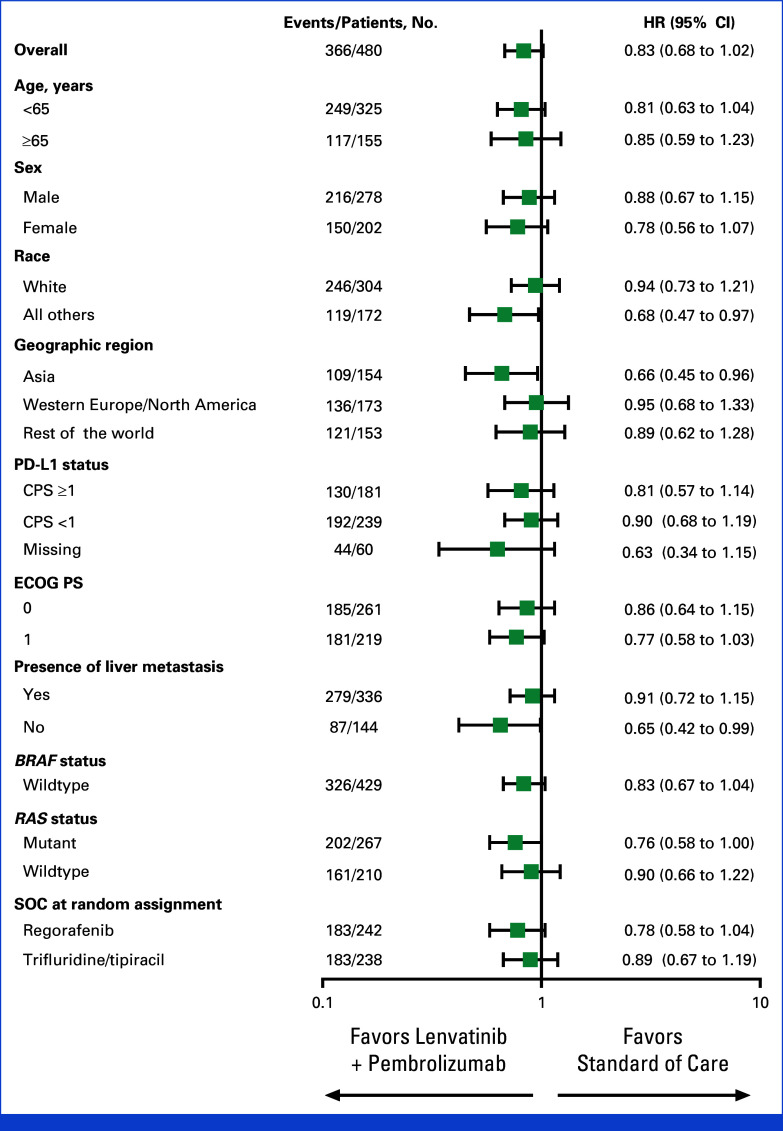
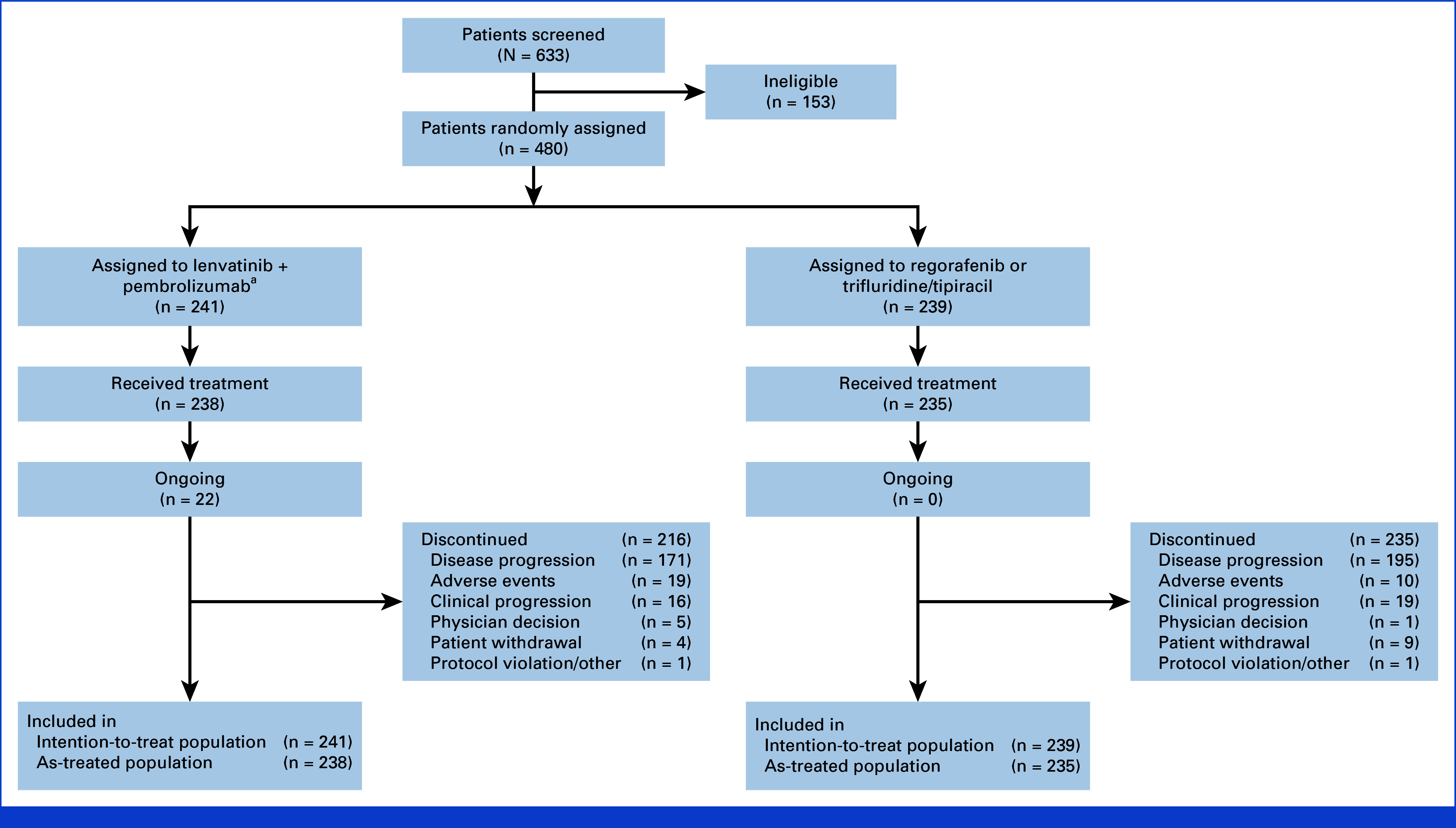
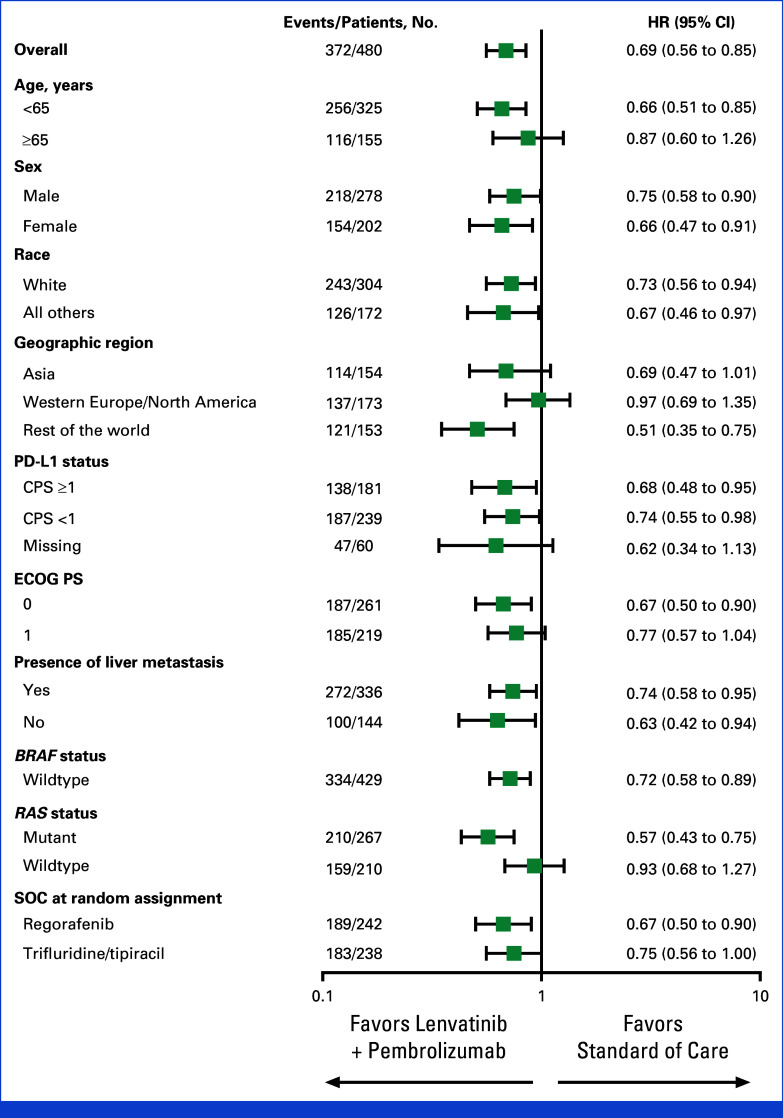
Between April 8, 2021, and December 21, 2021, 480 patients were randomly assigned to lenvatinib plus pembrolizumab (n = 241) or SOC (n = 239). At final analysis (median follow-up of 18.6 months [IQR, 3.9]), median OS with lenvatinib plus pembrolizumab versus SOC was 9.8 versus 9.3 months (hazard ratio [HR], 0.83 [95% CI, 0.68 to 1.02]; = .0379; prespecified threshold = .0214). Grade ≥3 treatment-related adverse events occurred in 58.4% (lenvatinib plus pembrolizumab) versus 42.1% (SOC) of patients. Two participants died due to treatment-related adverse events, both in the lenvatinib plus pembrolizumab arm.
In patients with pMMR or not MSI-H mCRC that had progressed on previous therapy, there was no statistically significant improvement in OS after lenvatinib plus pembrolizumab treatment versus SOC. No new safety signals were observed.
对于既往治疗的转移性结直肠癌(mCRC)患者,治疗选择有限。在 LEAP-017 研究中,我们评估了仑伐替尼联合帕博利珠单抗与标准治疗(SOC)相比,在既往治疗的错配修复功能完整或不微卫星不稳定高(pMMR 或 not MSI-H)mCRC 患者中的疗效。
这是一项国际性、多中心、随机、对照、开放标签、III 期研究,纳入年龄 18 岁及以上、不可切除、pMMR 或 not MSI-H mCRC、既往治疗后进展或不耐受标准治疗的患者,按 1:1 比例随机分组,接受仑伐替尼 20mg 口服每日一次联合帕博利珠单抗 400mg 静脉注射每 6 周一次或研究者选择的瑞戈非尼或替匹嘧啶(SOC)。随机分组按是否存在肝转移分层。主要终点为总生存期(OS)。LEAP-017 在 ClinicalTrials.gov(NCT04776148)注册,现已完成招募。
2021 年 4 月 8 日至 2021 年 12 月 21 日,480 例患者随机分配至仑伐替尼联合帕博利珠单抗(n=241)或 SOC(n=239)组。在最终分析(中位随访 18.6 个月[IQR,3.9]),仑伐替尼联合帕博利珠单抗与 SOC 相比,中位 OS 分别为 9.8 个月和 9.3 个月(风险比[HR],0.83[95%CI,0.68 至 1.02];=0.0379;预设阈值=0.0214)。仑伐替尼联合帕博利珠单抗组和 SOC 组分别有 58.4%(241 例)和 42.1%(239 例)的患者发生≥3 级治疗相关不良事件。有 2 例患者因治疗相关不良事件死亡,均发生在仑伐替尼联合帕博利珠单抗组。
在既往治疗后进展的 pMMR 或 not MSI-H mCRC 患者中,仑伐替尼联合帕博利珠单抗治疗与 SOC 相比,OS 无统计学显著改善。未观察到新的安全性信号。