Yang Shenmiao, Wei Rong, Shi Hongxia, Wang Yazhe, Lai Yueyun, Zhao Xiaosu, Lu Jin, Schmitz Norbert
Peking University Institute of Hematology, Peking University Peoples' Hospital, Beijing, China.
Department of Medicine A, University Hospital Muenster, Muenster, Germany.
Front Oncol. 2024 May 21;14:1396913. doi: 10.3389/fonc.2024.1396913. eCollection 2024.
Impact of B-cell depletion following treatment with Bruton tyrosine kinase-inhibitors (BTKi) on the outcome of SARS-CoV-2 infection in chronic lymphocytic leukemia (CLL) patients remain controversial. We investigated the impact of BTKi on susceptibility and the severity of COVID-19 in Chinese patients with CLL during the first wave of COVID-19 (Omicron variant).
CLL patients (n=171) visiting the Institute of Hematology, Peoples' Hospital, China (November 15, 2022- January 20, 2023) were included in the study. Seventeen patients receiving BTKi and venetoclax with or without obinutuzumab were excluded. Data from 117 patients receiving treatment with BTKi were collected using a standardized questionnaire through telephone interviews. Thirty-four patients without CLL-specific treatment served as controls. The data was analysed using IBM SPSS Software version 21 and a P value of <0.05 was considered statistically significant.
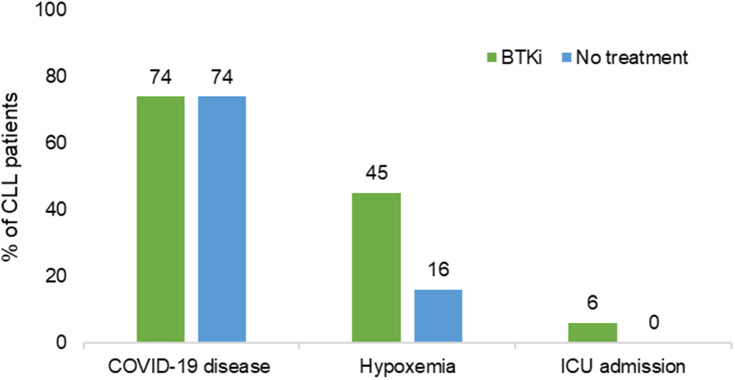
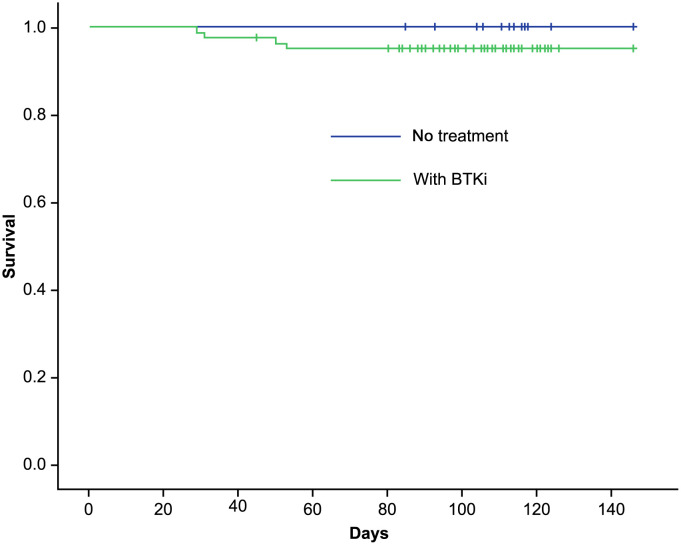
The median age of patients was 67 years and majority were males (n=100). Treatment with BTKi was not associated with higher incidence of COVID-19 (74% [95% Confidence Interval (CI) 60%, 92%]) versus 74% (CI 48%, 100%) without any treatment (=0.92). Hypoxemia was reported by 45% (32%, 61%) and 16% (4%, 41%) (=0.01). BTKi was the only independent risk factor of hypoxemia (Hazard Ratio [HR], 4.22 [1.32, 13.50]; = 0.02). Five (5.7%) patients with COVID-19 under BTKi required ICU admission; 4 of them died. No ICU admissions/deaths were observed in the control group.
In Chinese patients with CLL and treated with BTKi experienced more severe lung disease and ICU admissions due to COVID-19 than patients without CLL therapy. Frequency of infections with SARS-CoV-2, however, was not different in patients with or without BTKi treatment.
布鲁顿酪氨酸激酶抑制剂(BTKi)治疗后B细胞耗竭对慢性淋巴细胞白血病(CLL)患者感染严重急性呼吸综合征冠状病毒2(SARS-CoV-2)的结果的影响仍存在争议。我们调查了在新冠疫情第一波(奥密克戎变异株)期间,BTKi对中国CLL患者感染新冠病毒的易感性和严重程度的影响。
纳入在中国人民医院血液病研究所就诊的CLL患者(n = 171例)(2022年11月15日至2023年1月20日)。排除17例接受BTKi联合维奈克拉治疗(无论是否联合奥妥珠单抗)的患者。通过电话访谈,使用标准化问卷收集117例接受BTKi治疗患者的数据。34例未接受CLL特异性治疗的患者作为对照。使用IBM SPSS软件21版对数据进行分析,P值<0.05被认为具有统计学意义。
患者的中位年龄为67岁,大多数为男性(n = 100例)。接受BTKi治疗与新冠病毒感染的较高发生率无关(74% [95%置信区间(CI)60%,92%]),未接受任何治疗的患者发生率为74%(CI 48%,100%)(P = 0.92)。报告有低氧血症的患者分别为45%(32%,61%)和16%(4%,41%)(P = 0.01)。BTKi是低氧血症的唯一独立危险因素(风险比[HR],4.22 [1.32,13.50];P = 0.02)。接受BTKi治疗的5例(5.7%)新冠病毒感染患者需要入住重症监护病房(ICU);其中4例死亡。对照组未观察到ICU入住/死亡情况。
在中国CLL患者中,接受BTKi治疗的患者因新冠病毒感染导致的肺部疾病比未接受CLL治疗的患者更严重,且入住ICU的比例更高。然而,接受或未接受BTKi治疗的患者感染SARS-CoV-2的频率没有差异。